
 by
by Global Energy Cloud Platform Market to Expand at 19.5% CAGR; North America Leads, Asia Pacific Set for Fastest Growth.
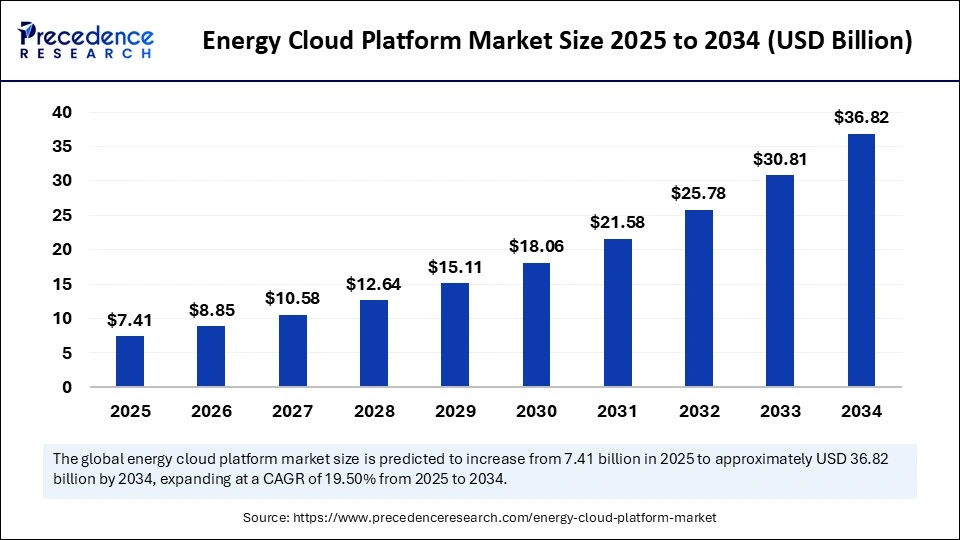
The global energy cloud platform market, valued at $7.41 billion in 2025, is soaring with a forecasted 19.5% CAGR through 2034, projected to reach a robust $36.82 billion by 2034. This dynamic expansion is propelled by the rapid integration of digital technologies, especially cloud computing, IoT, and Artificial Intelligence, fueling smarter energy management and the seamless adoption of renewable sources across grid networks.
Get this report to explore global market size, share, CAGR, and trends, featuring detailed segmental analysis and an insightful competitive landscape overview @ https://www.precedenceresearch.com/sample/7017
Energy Cloud Platform Market Key Insights
-
The market size stands at $7.41 billion for 2025 and is set to jump to $36.82 billion by 2034.
-
The U.S. market alone will scale from $2.14 billion in 2025 to $10.84 billion by 2034, maintaining a robust 19.7% CAGR.
-
North America dominates with nearly 38% market share due to leading digital infrastructure and early smart grid adoption.
-
Asia Pacific is poised for the fastest growth, led by massive investments in smart cities and renewables.
-
The Software-as-a-Service (SaaS) segment leads at 54% share in 2024, thanks to flexible, scalable deployment.
-
Utilities are the largest end-users, holding a 45% share due to demand for advanced grid optimization and energy trading solutions.
-
Energy trading and optimization applications command a 35% market share, driven by real-time management and price forecasting innovations.
What’s the Market Worth?
| Year | Global Market Value | U.S. Market Value |
|---|---|---|
| 2025 | $7.41 Billion | $2.14 Billion |
| 2026 | $8.85 Billion | $2.56 Billion |
| 2034 | $36.82 Billion | $10.84 Billion |
AI is at the heart of the energy cloud revolution, unlocking predictive analytics, grid automation, and asset optimization. Energy companies are tapping into machine learning for anomaly detection, demand forecasting, and operational efficiency. With real-time data streams from IoT devices and cloud-based platforms, AI automates responses, reduces costs, and improves grid resilience. Notably, utilities leverage AI-powered insights to balance loads, forecast renewable output, and drive sustainable practices across distributed energy networks.
AI’s role extends beyond grid management—energy cloud platforms powered by advanced analytics enable smart trading and optimization, empowering stakeholders to analyze market dynamics and maximize revenues. Stakeholders can rapidly synthesize large datasets and make data-driven decisions in an increasingly decentralized, renewables-focused industry.
What Are the Growth Factors Driving This Surge?
-
Widespread adoption of digital technologies, with cloud and IoT solutions connecting distributed energy assets.
-
Robust government incentives fueling clean energy transitions and sustainability projects worldwide.
-
Demand for scalable, subscription-based solutions steers utilities and developers to SaaS and PaaS platforms.
-
Strong momentum toward integrating renewable resources and achieving net-zero emissions targets.
-
Investment surge in data centers, grid modernization, and AI-driven cloud infrastructure.
Where Do New Opportunities and Trends Lie in the Market?
Can Blockchain Transform Decentralized Energy Trading?
Blockchain enables safe, transparent peer-to-peer trading, drastically reducing reliance on intermediaries and enhancing traceability for carbon credits. As sustainability goals intensify, decentralized trading models and secure data exchanges are gaining traction.
Will SaaS and PaaS Models Revolutionize Utility Cloud Adoption?
SaaS delivers scalable applications for grid optimization and analytics, lowering deployment barriers for utilities and energy firms. PaaS platforms spur rapid development of customized energy applications, driving interoperability and seamless integration across the sector.
How Will Asia Pacific Outpace Other Regions?
Asia Pacific’s explosive growth is attributed to smart city initiatives, rapid industrialization, and aggressive renewables development. Governments are proactively encouraging digital transformation in utilities to boost efficiency and sustainability.
Regional Analysis: Which Region Leads and Why?
North America leads the global market with a 38% share, driven by advanced infrastructure, early adoption of smart grid technologies, and well-funded government programs. The region’s utilities and cloud providers are front-runners in integrating IoT and AI solutions for grid management.
Asia Pacific is set for the fastest climb, benefiting from large-scale infrastructure investment and bold regulatory reforms. Digital transformation pushes for sustainability, and the market is propelled by high FDI, urbanization, and strategic cloud partnerships.
Energy Cloud Platform Market Segmentation Analysis
Which Applications Capture the Most Investment?
-
Energy Trading and Optimization: Holds a 35% market share thanks to real-time grid optimization and pricing tools.
-
Renewable Integration: Fastest-growing segment, driven by net-zero ambitions and advanced forecasting capabilities for wind and solar farms.
What Service Models Are Dominating?
-
SaaS: Most popular, with 54% share due to ease of deployment, scalable infrastructure, and cost efficiency.
-
PaaS: Fastest-growing, enabling developers to innovate specialized tools for energy monitoring and trading.
Who’s Using These Platforms?
-
Utilities: Main users (45% share), seeking grid, trading, and optimization solutions for robust data-driven operations.
-
Renewable Developers: Fast-growing, relying on predictive analytics and asset optimization for high-performance wind and solar franchises.
Energy Cloud Platform Market Companies
- Microsoft Azure: Provides Azure Energy Data Services, offering scalable cloud and AI solutions for grid optimization, renewable integration, and real-time energy analytics.
- Amazon Web Services (AWS): Delivers AWS Energy Competency solutions that enable IoT-driven energy monitoring, predictive maintenance, and decarbonization insights for utilities and oil & gas.
- Google Cloud Platform (GCP): Offers AI-powered data analytics and sustainability platforms for optimizing energy efficiency, carbon tracking, and renewable asset management.
- IBM Cloud: Integrates AI, IoT, and hybrid cloud technologies via IBM Maximo and Watson AI to drive predictive maintenance and energy infrastructure digitization.
- Oracle Cloud: Provides Oracle Utilities Cloud for advanced energy management, smart metering, and customer experience solutions within the energy transition ecosystem.
- Siemens MindSphere: A leading industrial IoT platform enabling energy asset monitoring, grid management, and predictive maintenance through real-time operational data analytics.
- GE Vernova (Predix): Offers Predix Platform, combining digital twins and AI analytics to enhance power plant performance, grid reliability, and emission reduction.
- Schneider Electric: Provides EcoStruxure™, a cloud-based platform integrating IoT, analytics, and AI for energy automation, smart grids, and sustainable power management.
- Siemens Energy: Delivers digital energy solutions leveraging cloud data analytics for asset optimization, renewable integration, and energy transition management.
- Honeywell Forge: A connected platform providing AI-enabled industrial energy management, focusing on efficiency, carbon reduction, and asset health optimization.
- SAP Leonardo: Integrates IoT, machine learning, and blockchain into energy management systems for real-time visibility, billing, and sustainability analytics.
- Accenture: Provides end-to-end digital energy transformation services, leveraging partnerships with major cloud providers to enable smart grid and ESG data integration.
- Country: Delivers cloud-based energy data and AI solutions for utilities and renewables, helping clients accelerate smart grid digitization and energy efficiency programs.
- Country: Focuses on AI-driven energy cloud platforms that support smart metering, asset optimization, and renewable forecasting for global energy providers.
- Tata Consultancy Services (TCS): Offers TCS Clever Energy™, a sustainability platform for energy performance optimization, carbon tracking, and predictive insights.
- Country: Provides cloud-based digital twin and IoT analytics solutions to support predictive energy management and decarbonization initiatives across enterprises.
- Wipro: Delivers AI, IoT, and blockchain-powered cloud platforms for smart grids, distributed energy resources, and energy efficiency management.
- Tech Mahindra: Focuses on smart energy and IoT cloud systems, offering predictive grid analytics, asset tracking, and renewable integration solutions.
- Country: Provides Energy Cloud and IoT consulting services, helping utilities implement data-driven optimization and sustainability reporting platforms.
- HCL Technologies: Offers cloud-hosted energy management solutions leveraging AI and data analytics to optimize asset performance and energy distribution.
What Are the Biggest Challenges and Cost Pressures?
Interoperability remains a pivotal hurdle, with legacy systems posing integration issues and slowing cloud adoption. Cost pressures arise from expensive customizations to harmonize outdated infrastructure with cutting-edge cloud platforms. The sector also faces compliance costs for evolving data privacy and digital sovereignty regulations.
Case Study: U.S. Utility Deploys AI-Driven SaaS to Optimize Grid Performance
A leading U.S. utility utilized SaaS-based energy cloud solutions combined with AI analytics to streamline peak-demand management and real-time trading. This resulted in 27% operational cost reduction and a measurable increase in grid reliability, paving the way for broader renewables integration.
Segments Covered in the Report
By Application
- Energy Trading and Optimization
- Grid Management
- Renewable Energy Integration
- Demand Response and Load Balancing
- Energy Storage Management
- Asset Management
- Workforce Management
By Service Model
- Software-as-a-Service (SaaS)
- Platform-as-a-Service (PaaS)
- Infrastructure-as-a-Service (IaaS)
By Deployment Model
- Public Cloud
- Private Cloud
- Hybrid Cloud
By End-User Industry
- Utilities
- Renewable Energy Developers
- Energy Retailers
- Industrial and Commercial Energy Consumers
By Connectivity Technology
- Internet of Things (IoT)
- Smart Meters
- Distributed Energy Resources (DERs)
- Blockchain
By Organization Size
- Large Enterprises
- Small and Medium Enterprises (SMEs)
By Region
- North America
- Europe
- Asia-Pacific
- Latin America
- Middle East & Africa
Read Also: High-Bandwidth Memory Market
You can place an order or ask any questions. Please feel free to contact us at sales@precedenceresearch.com |+1 804 441 9344

- Managed DNS Services Market Size to Hit USD 2,288.60 Million by 2035 - March 5, 2026
- Power EPC Market Size to Hit USD 1,376.29 Billion by 2035 - March 5, 2026
- Ursolic Acid Market Size to Hit USD 68.77 Billion by 2035 - March 5, 2026
