
 by
by The global rodenticides market is projected to reach $9.82 billion by 2034, expanding at a CAGR of 5.78% as smart pest management and sustainable solutions reshape industry growth.
The global rodenticides market, estimated at $5.92 billion in 2025, is projected to climb to $9.82 billion by 2034, registering a CAGR of 5.78%.
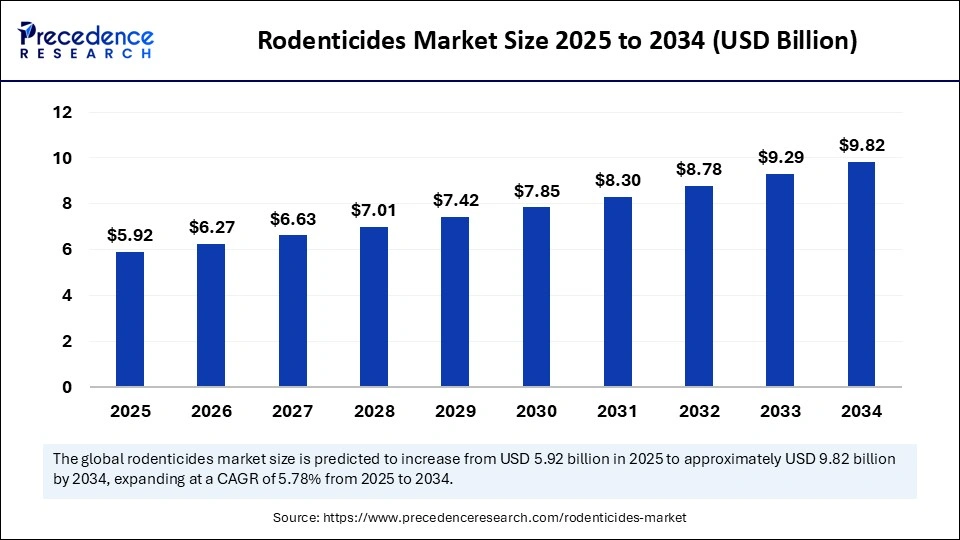
This accelerating growth reflects surging urbanization, increased crop production, the spread of food storage facilities, and the rise of integrated pest management. As governments and industries reinforce hygiene standards and food security, demand for advanced rodent control escalates worldwide. The evolution from traditional toxic chemicals to safety-focused bio-based and AI-driven rodenticides is driving the market’s long-term prospects.
Rodenticides Market Key Insights
-
The global rodenticides market is valued at $5.92 billion in 2025 and forecasted to reach $9.82 billion by 2034.
-
North America leads the market, thanks to advanced infrastructure and strict hygiene mandates.
-
Asia Pacific is the fastest-growing region, propelled by modernization and expanding urban footprints.
-
Anticoagulants remain the dominant rodenticide type, prized for prolonged effectiveness and regulatory acceptance.
-
Pellets are the most widely used form, offering durability and precision in dosing.
-
Agricultural fields account for the largest share of application and end-user market, followed by commercial warehouses and pest control industry.
-
The U.S. rodenticides market alone will reach $2.89 billion by 2034, growing at a CAGR of 5.96%.
Rodenticides Market Revenue Table
| Year | Global Market Size (USD Billion) | U.S. Market Size (USD Billion) |
|---|---|---|
| 2025 | 5.92 | 1.71 |
| 2026 | 6.27 | 1.81 |
| 2034 | 9.82 | 2.89 |
| CAGR (2025-2034) | 5.78% | 5.96% |
Artificial intelligence is rapidly transforming rodent management systems from labor-intensive interventions to high-tech, data-powered solutions. The use of smart dispensers connected to IoT sensors enables real-time tracking and remote monitoring of bait stations. Data analytics toolkits support accurate infestation mapping and targeted deployments, reducing chemical usage and human oversight. Today, AI-driven pest surveillance programs are helping cities and farms achieve surgical pest control while ensuring compliance with evolving safety and ecological mandates.
Biologically inspired bait systems are also being paired with digital monitoring, enabling automated supply refills and dose adjustments based on rodent behavior analytics. This synergy of digital and biological innovation is helping operators reduce environmental impact, minimize secondary wildlife poisoning, and deliver results with unparalleled precision in agriculture, warehouses, and urban environments.
What Is Driving Market Growth?
-
Rising Urbanization: Higher population densities bring increased rodent activity, heightening the need for smart pest control in cities and food storage facilities.
-
Surge in Agricultural Production: Grain losses and root damage from rodents necessitate the integration of rodenticides into crop protection regimes.
-
Post-Pandemic Hygiene Awareness: The focus on disease prevention, safe environments, and regulatory compliance has rejuvenated interest in proactive rodent management.
-
Technological Advancements: Automation, IoT-enabled bait systems, and advanced formulation technologies support safer and more effective rodent management.
Are There Emerging Opportunities and Trends?
Will Bio-Based and AI-Assisted Rodenticides Become Mainstream?
Demand for non-toxic, eco-friendly rodenticides is opening new growth avenues. Manufacturers are investing in plant-based toxins, microbial repellents, and algorithm-driven rodent tracking platforms. Government support for sustainable practices and smart infrastructure is enabling wider deployment of these intelligent solutions. The convergence of biotech and AI is set to define the next wave of market expansion, especially as farmers and urban planners demand more precise and eco-conscious interventions.
Can Non-Anticoagulant Solutions Rival the Dominance of Anticoagulants?
While anticoagulants remain market leaders, non-anticoagulant rodenticides including hypercalcemia and neurotoxicity-inducing compounds are gaining traction due to ecological concerns and rodent resistance. These alternatives offer faster action, lower persistence in the environment, and reduced risk of secondary wildlife poisoning—key for food processing, organic farming, and high-traffic urban areas.
Are Pellets Still the Gold Standard?
Pellets remain the preferred form thanks to their weather resistance, controlled dosage, and compatibility with automated dispensers. However, advancements in biodegradable binders and flavor additives are making pellets more environmentally sustainable and effective for large-scale agricultural and industrial application. Meanwhile, the popularity of powder forms is rising in indoor environments and targeted burrow treatments, with innovation focusing on dust-free, micro-encapsulated powders for worker safety and swift action.
Rodenticides Market Segmentation and Regional Insights
Type Insights
Anticoagulants: The Market Dominator
Anticoagulants continue to dominate the rodenticides market for their prolonged efficacy and precision in rodent control. These compounds disrupt blood clotting, leading to gradual elimination and reducing bait aversion. Their use in large-scale agricultural and urban programs highlights their reliability and safety, as the delayed action minimizes risks to non-target species.
Regulatory approval of second-generation anticoagulants reinforces their dominance, while ongoing R&D focuses on eco-friendly formulations such as biodegradable and microencapsulated variants. These advancements enhance weather resistance, stability, and field performance. Integration with smart bait stations and IoT systems further strengthens their efficiency in modern pest management.
Non-Anticoagulants: Fastest-Growing Segment
Non-anticoagulant rodenticides are emerging rapidly, driven by the need to combat resistance and promote environmental safety. Their mechanisms—ranging from neurotoxicity to hypercalcemia induction—offer quick action and reduced secondary toxicity. These compounds are increasingly preferred for farmlands and storage facilities due to their low residue and minimal ecological impact.
Innovations like plant-based alkaloids and RNA interference (RNAi) are reshaping the market, offering species-specific control. Supportive government initiatives and consumer demand for chemical-free pest management are propelling this segment’s growth. As sustainability gains traction, non-anticoagulants symbolize the next generation of responsible rodent control.
Form Insights
Pellets: The Leading Form
Pellets dominate the market owing to their durability, consistent dosing, and versatility. Their uniform structure ensures precise distribution across agricultural and industrial areas, while compression improves palatability and weather resistance. Pellets can integrate flavor enhancers, tracking agents, and smart sensor compatibility, making them ideal for large-scale and automated applications.
Manufacturers are focusing on biodegradable binders and UV-stable coatings to reduce environmental impact. Their controlled-release properties enhance efficiency and reduce waste, making pellets a cornerstone of long-term pest control strategies.
Powders: Rapidly Growing Form
Powdered rodenticides are gaining traction for their adaptability and precision, especially in indoor and confined environments. Their fine dispersion allows effective reach into burrows and crevices. Enhanced dust-free and microencapsulated formulations ensure safe handling and extended shelf life.
The adoption of electrostatic application systems has further improved adhesion and coverage. Preferred in warehouses, farms, and food facilities, powders combine eco-sensitivity, affordability, and targeted lethality, defining the future of smart rodent management.
Application Insights
Agriculture: Core Application Area
Agricultural fields account for the largest share of rodenticides usage. Rodents threaten crop yields, grain storage, and root systems, making chemical control integral to farming operations. The use of anticoagulant baits alongside crop protection ensures continuous safeguarding against infestations.
Governments worldwide promote integrated pest management (IPM), blending technology and eco-conscious strategies. The rise of IoT-based monitoring systems and biodegradable baits reinforces agriculture’s dominance. Collaborative efforts between agrotech firms and pesticide manufacturers are yielding region-specific solutions for sustainable rodent control.
Warehouses: Fastest-Growing Application
Warehouses are the fastest-expanding segment, driven by e-commerce and global logistics growth. The need to protect food, textiles, and packaging has accelerated the adoption of smart monitoring systems integrated with fast-acting, low-residue rodenticides.
Urban warehouses demand odor-neutral, dust-free formulations, and AI-driven analytics to track infestations in real time. Regulatory emphasis on hygiene and sustainability is reshaping warehouse pest control into a technology-driven ecosystem for biosecurity.
End-Use Insights
Agriculture: The Backbone of Demand
The agriculture sector remains the largest end user of rodenticides, ensuring crop and storage protection against recurring infestations. Anticoagulant pellets continue to be widely used due to their reliability and ease of deployment. Climate-induced rodent proliferation has made continuous intervention essential for yield preservation.
Policies promoting IPM frameworks, coupled with the rise of bio-rodenticides and solar-powered repellents, reflect the sector’s shift toward sustainable pest control. Collaboration with research bodies enables predictive rodent management, strengthening agriculture’s foundational role.
Pest Control Industry: Fastest-Growing End Use
The pest control industry is witnessing rapid growth fueled by urbanization and hygiene compliance. Professional services now employ AI, pheromone tracking, and automated baiting systems for precision management. Non-anticoagulant and bio-based products dominate urban settings due to their low toxicity and odor neutrality.
Public-private partnerships and citywide rodent mapping projects highlight the integration of technology and sustainability. With growing consumer demand for eco-labeled services, pest control firms are emerging as key players in modern urban biosecurity.
Rodenticides Market Regional Insights
North America: Market Leader
North America leads the global rodenticides market, supported by advanced infrastructure, stringent sanitation laws, and mature agriculture. Increasing rodent-borne diseases and grain storage capacity have heightened demand for smart pest management systems.
In the U.S., the market was valued at USD 1.71 billion in 2025 and is projected to reach USD 2.89 billion by 2034 at a CAGR of 5.96%. Strong EPA compliance, innovation in eco-safe formulations, and public-private pest surveillance initiatives drive steady growth.
Asia Pacific: Fastest-Growing Region
Asia Pacific is the fastest-growing region, driven by agricultural modernization, rapid urbanization, and increasing hygiene awareness. Expanding food processing and hospitality industries are major growth catalysts.
In China, advancements in biotechnological pest control and digital monitoring lead innovation, while India’s government programs support large-scale agricultural rodent control. The region’s blend of traditional methods and modern science is shaping a globally competitive and sustainable pest management ecosystem.
What Are the Major Challenges and Cost Pressures?
Environmental regulation, secondary wildlife poisoning, and compliance costs are squeezing traditional chemical-based rodenticides. Companies must invest in reformulation, eco-certification, and smart technological integrations to navigate these constraints. The shift to green chemistry and digital systems, while increasing upfront costs, provides long-term value through improved safety and lower operational risk.
Case Study: Smart Warehousing and AI-Driven Rodent Control
Modern warehouses are transitioning from passive storage to active biosecure nodes. One example is the deployment of automated storage and pest control solutions that use AI-driven bait analytics and real-time infestation mapping. This approach not only improves sanitation but also enables swift intervention, reduced residue, and sustainable operations—representing the future of logistics-driven pest management.
Read Also: Induced Pluripotent Stem Cell (iPSC) Therapy Market
You can place an order or ask any questions. Please feel free to contact us at sales@precedenceresearch.com |+1 804 441 9344

- Managed DNS Services Market Size to Hit USD 2,288.60 Million by 2035 - March 5, 2026
- Power EPC Market Size to Hit USD 1,376.29 Billion by 2035 - March 5, 2026
- Ursolic Acid Market Size to Hit USD 68.77 Billion by 2035 - March 5, 2026
