
 by
by What is the Privacy Preserving AI Market Size in 2026?
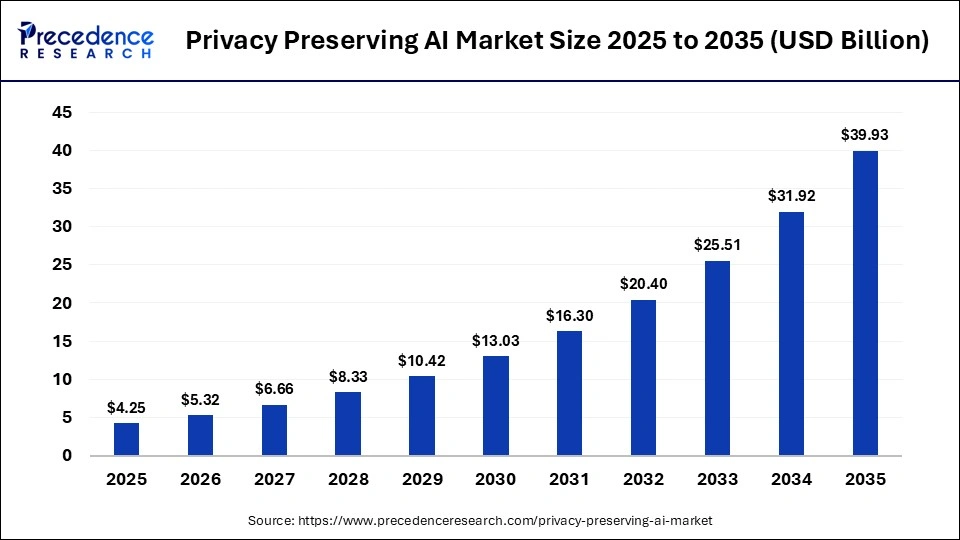
The global Privacy Preserving AI market size was valued at USD 4.25 billion in 2025 and is expected to grow from USD 5.32 billion in 2026 to approximately USD 39.93 billion by 2035, expanding at a CAGR of 25.10% from 2026 to 2035.
The market is witnessing substantial growth due to increasing data privacy regulations, the growing need for secure AI-driven analytics, and rising concerns about data misuse. Privacy preserving AI technologies allow organizations to train artificial intelligence models without exposing sensitive data, enabling secure and trustworthy AI adoption across multiple industries.
Read Also: Gas Leak Detectors Market
Privacy Preserving AI Market Overview
Privacy preserving AI refers to advanced technologies and frameworks that enable artificial intelligence systems to analyze and process sensitive data while maintaining strict privacy protections. These solutions are designed to ensure that data remains confidential during AI training and analysis.
Organizations are increasingly adopting privacy preserving AI to comply with strict global data protection regulations and ethical AI practices. Techniques such as federated learning, homomorphic encryption, differential privacy, and secure multi-party computation allow companies to extract insights from data without directly sharing raw information.
These technologies are widely used in industries that deal with highly sensitive information, including:
-
Healthcare
-
Banking and financial services
-
Telecommunications
-
Government agencies
-
Retail and e-commerce
The rapid expansion of AI-driven analytics and machine learning applications is further accelerating the adoption of privacy-preserving technologies.
Key Technological Shifts in the Privacy Preserving AI Market
The privacy preserving AI market is undergoing a major transformation as organizations move from traditional perimeter-based security models to decentralized and privacy-enhancing computation systems.
One of the most significant shifts is the concept of bringing AI models to the data instead of moving data to centralized systems. This allows organizations to collaborate on AI model training without transferring sensitive information.
Another important development is the growing use of synthetic data generation. Instead of using real personal data, companies create artificial datasets that maintain the statistical patterns of original data while eliminating privacy risks.
Additionally, zero-knowledge proofs and confidential computing environments are being integrated into AI workflows to ensure that data remains protected even during processing.
These innovations are helping organizations unlock the value of data while maintaining strict compliance with privacy regulations.
Major Trends Driving the Privacy Preserving AI Market
Rising Adoption of Federated Learning
Federated learning has emerged as one of the most promising privacy-preserving technologies. It allows AI models to learn from decentralized datasets located on different devices or servers without accessing raw data directly.
This approach is widely used in mobile devices, healthcare systems, and IoT environments, where data privacy is critical.
Increasing Demand for Synthetic Data
Organizations are increasingly using synthetic datasets generated through generative AI models. These datasets replicate real-world patterns without containing personally identifiable information (PII), enabling safe AI model training.
Synthetic data is particularly useful in industries such as finance, healthcare, and autonomous vehicle development.
Growth of Confidential Computing
Confidential computing is gaining popularity as it protects data during processing within hardware-based secure environments known as Trusted Execution Environments (TEEs).
This technology ensures that even cloud service providers cannot access sensitive information while computations are being performed.
Emergence of Privacy-by-Design AI Frameworks
Businesses are increasingly implementing privacy-by-design principles when developing AI systems. This approach integrates privacy safeguards into the entire AI lifecycle, from data collection to model deployment.
Organizations are also adopting AI governance frameworks and risk management strategies to maintain compliance with global privacy regulations.
Privacy Preserving AI Market Segment Insights
Offering Insights
The software platforms segment dominated the market in 2025, accounting for approximately 48% of the total market share.
These platforms simplify complex cryptographic processes by providing integrated tools such as:
-
Federated learning frameworks
-
Homomorphic encryption libraries
-
Secure model training environments
-
Data governance dashboards
By offering all these features in a single platform, companies can implement privacy-preserving AI without building complex cryptographic infrastructures.
Meanwhile, the infrastructure and security modules segment is expected to grow at the fastest rate during the forecast period. This growth is driven by increasing demand for confidential computing, secure hardware modules, and trusted execution environments.
Technology Insights
The federated learning segment accounted for the largest market share of around 29% in 2025.
Federated learning allows multiple organizations to collaboratively train AI models using decentralized datasets without sharing raw data. This approach is especially valuable in industries with strict data privacy laws.
On the other hand, the homomorphic encryption segment is expected to grow at the fastest CAGR during the forecast period. Homomorphic encryption enables AI systems to perform computations on encrypted data without decrypting it, ensuring maximum data security.
Major technology companies are investing heavily in this field to enable secure AI processing in cloud environments.
Deployment Mode Insights
The cloud-based deployment segment dominated the market in 2025, accounting for about 54% of the total share.
Cloud platforms provide scalable computing infrastructure, advanced encryption tools, and secure AI environments, allowing organizations to implement privacy-preserving technologies without large upfront investments.
However, the hybrid deployment segment is expected to grow at the fastest rate during the forecast period.
Hybrid models allow companies to store sensitive data on-premise while performing complex AI computations in the cloud, ensuring both compliance and scalability.
Application Insights
The data privacy and secure analytics segment held the largest share of around 31% in 2025.
This segment enables organizations to analyze sensitive data, such as:
-
Financial transactions
-
Healthcare records
-
Personal user data
without exposing confidential information.
The healthcare data collaboration segment is expected to witness the fastest growth in the coming years. Hospitals and research institutions are increasingly using privacy-preserving technologies to share insights from patient data without compromising confidentiality.
Industry Vertical Insights
The banking, financial services, and insurance (BFSI) sector dominated the market with around 28% share in 2025.
Financial institutions rely heavily on privacy-preserving AI technologies to perform:
-
Fraud detection
-
Credit risk assessment
-
Anti-money laundering monitoring
while maintaining strict customer data privacy.
Meanwhile, the healthcare and life sciences sector is expected to grow at the fastest pace. Privacy-preserving AI enables healthcare organizations to analyze genomic data, clinical trial information, and patient records while complying with strict medical data protection regulations.
Regional Insights
North America
North America held the largest market share of approximately 38% in 2025. The region benefits from strong technology infrastructure, large AI investments, and strict data protection laws.
Major technology companies are actively developing privacy-enhancing technologies to support secure AI applications across industries.
Asia Pacific
The Asia Pacific region is expected to grow at the fastest CAGR between 2026 and 2035. Rapid digital transformation, expanding AI adoption, and new data protection regulations are driving market growth.
Countries such as India and China are investing heavily in AI technologies while implementing strict data governance policies.
In India, the Digital Personal Data Protection Act (2023) is encouraging companies to adopt privacy-preserving AI technologies to ensure secure data usage.
Competitive Landscape
The privacy preserving AI market is highly competitive, with several global technology companies investing in advanced privacy-enhancing technologies.
Key companies operating in the market include:
-
IBM
-
Microsoft
-
Google
-
Amazon Web Services (AWS)
-
NVIDIA
-
Zama
-
Duality Technologies
-
Intel Corporation
-
Palantir Technologies
-
Apple Inc.
-
Owkin Inc.
-
Meta
-
Cisco Systems Inc.
-
Private AI
-
Enveil
For inquiries regarding discounts, bulk purchases, or customization requests, please contact us at sales@precedenceresearch.com

- Managed DNS Services Market Size to Hit USD 2,288.60 Million by 2035 - March 5, 2026
- Power EPC Market Size to Hit USD 1,376.29 Billion by 2035 - March 5, 2026
- Ursolic Acid Market Size to Hit USD 68.77 Billion by 2035 - March 5, 2026
