
 by
by What is the Chemical Hydrogen Market Size in 2026?
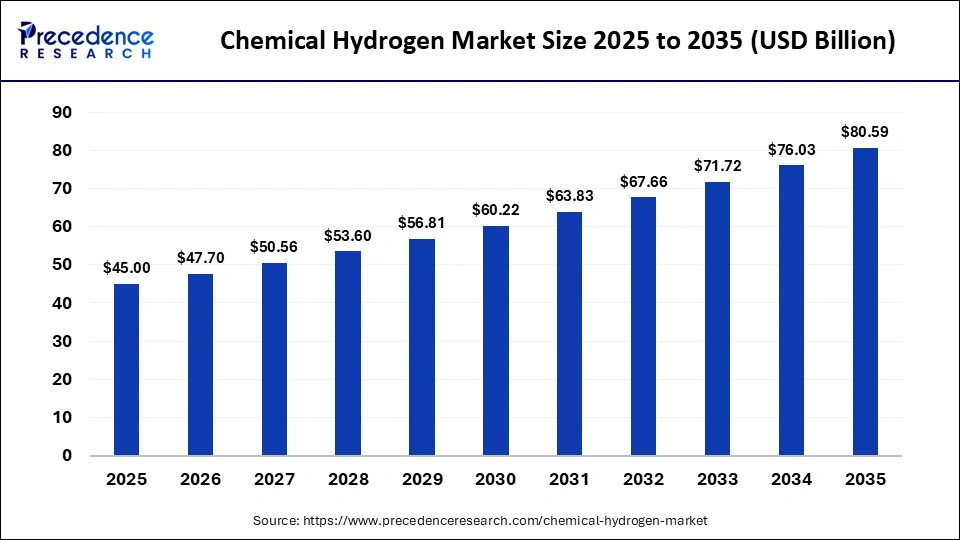
The global chemical hydrogen market size was valued at USD 45.00 billion in 2025 and is projected to grow from USD 47.70 billion in 2026 to approximately USD 80.59 billion by 2035, expanding at a CAGR of 6.00% between 2026 and 2035.
The market is expanding steadily as industries increase the use of hydrogen for clean energy solutions, chemical synthesis, petroleum refining, and decarbonization initiatives. Rising demand from sectors such as fertilizers, petrochemicals, and energy storage is significantly driving market growth worldwide.
Read Also: Privacy Preserving AI Market
Chemical Hydrogen Market Overview
Chemical hydrogen plays a critical role in several industrial processes, particularly in ammonia production, methanol synthesis, and petroleum refining. Hydrogen is widely used as a feedstock in the chemical industry and as a clean energy carrier in emerging energy systems.
Growing global focus on reducing carbon emissions and transitioning to sustainable energy sources has increased the importance of hydrogen technologies. Governments and private companies are investing heavily in green hydrogen and blue hydrogen production technologies to support the global energy transition.
The rising demand for fertilizers, stricter fuel regulations, and the expansion of renewable energy infrastructure are further accelerating the adoption of hydrogen in chemical and energy applications.
Key Factors Driving the Chemical Hydrogen Market
Several factors are contributing to the rapid growth of the chemical hydrogen market:
-
Increasing global demand for fertilizers and ammonia production
-
Growing use of hydrogen in petroleum refining for desulfurization
-
Rising investments in green hydrogen projects
-
Expanding use of hydrogen as an energy storage medium
-
Strong government initiatives promoting clean hydrogen technologies
Hydrogen’s versatility as both a chemical feedstock and an energy carrier makes it a key component of future sustainable energy systems.
How Artificial Intelligence is Transforming the Chemical Hydrogen Market
Artificial intelligence (AI) is playing an increasingly important role in optimizing hydrogen production and distribution.
AI-powered monitoring systems are being used to improve electrolyzer performance, reduce operational costs, and predict equipment failures. These technologies enable real-time monitoring of production facilities, which helps improve operational efficiency and reduce downtime.
Advanced data analytics also allows energy companies to optimize hydrogen production based on renewable energy availability, improving integration with solar and wind power systems.
As digital technologies continue to evolve, AI-driven process optimization will accelerate large-scale hydrogen commercialization and sustainable production methods.
Key Trends in the Chemical Hydrogen Market
Rising Adoption of Green Hydrogen
Growing investments in renewable-powered electrolysis are accelerating the production of green hydrogen. Renewable energy sources such as solar and wind are increasingly being used to produce hydrogen with minimal carbon emissions.
Expansion of Carbon Capture Technologies
Blue hydrogen production is gaining momentum as companies integrate carbon capture and storage (CCS) technologies into conventional hydrogen production processes to reduce greenhouse gas emissions.
Increasing Hydrogen Use in Refineries
Stricter environmental regulations are increasing hydrogen consumption for desulfurization processes in petroleum refining. Hydrogen helps remove sulfur compounds from fuels to meet low-emission fuel standards.
Growth in Fertilizer Production
Rising global food demand is increasing the need for fertilizers, which rely heavily on hydrogen for ammonia production.
Infrastructure Development for Hydrogen Distribution
Governments and energy companies are investing in hydrogen storage, transportation pipelines, and distribution networks to support the growth of hydrogen-based energy systems.
Future Opportunities in the Chemical Hydrogen Market
The market is expected to witness several new opportunities in the coming years:
Large-Scale Green Hydrogen Plants
Expansion of renewable energy projects is creating opportunities for large-scale green hydrogen production facilities.
Hydrogen Export Markets
Countries developing hydrogen hubs may benefit from growing global demand for hydrogen exports.
Renewable Energy Integration
Surplus electricity generated from solar and wind power can be used to produce hydrogen through electrolysis.
Hydrogen for Power Generation
Hydrogen blending in natural gas turbines offers promising opportunities for cleaner power generation.
Transportation Fuel Applications
Hydrogen fuel cell vehicles and heavy transportation sectors are expected to create long-term demand for hydrogen.
Hydrogen Storage Innovations
Advanced storage technologies, including liquid hydrogen and solid hydrogen carriers, are emerging as key solutions for long-term energy storage.
Chemical Hydrogen Market Segment Insights
Production Type Insights
Grey Hydrogen
The grey hydrogen segment dominated the market with a 68% share in 2025.
Grey hydrogen is produced from natural gas through steam methane reforming (SMR), which is currently the most cost-effective method of hydrogen production. Due to its lower production cost and well-established infrastructure, grey hydrogen remains widely used in industries such as:
-
Petroleum refining
-
Ammonia production
-
Chemical manufacturing
Blue Hydrogen
The blue hydrogen segment is expected to grow at the fastest CAGR of 5.2% during the forecast period.
Blue hydrogen combines traditional hydrogen production methods with carbon capture and storage technologies, significantly reducing emissions. As industries aim to lower their carbon footprints, blue hydrogen is emerging as a bridge solution between conventional and fully renewable hydrogen production.
Application Insights
Ammonia Production
The ammonia production segment accounted for the largest market share of 42% in 2025.
Hydrogen is a critical component in ammonia synthesis, which is widely used for producing agricultural fertilizers. Increasing global food demand is driving the need for fertilizers, thereby boosting hydrogen consumption.
Methanol Production
The methanol production segment is expected to grow at a CAGR of 5.4% during the forecast period.
Methanol is widely used in:
-
Chemical manufacturing
-
Fuel additives
-
Plastics production
Hydrogen serves as a key feedstock in methanol synthesis, which is supporting the growth of this segment.
End-Use Insights
Chemical Processing
The chemical processing segment dominated the market with a 78% share in 2025.
Hydrogen is extensively used as a feedstock in petrochemical and chemical manufacturing processes, including ammonia, methanol, and hydrocarbon processing.
Energy Storage
The energy storage segment is expected to grow at the fastest CAGR of 5.6% during the forecast period.
Hydrogen is emerging as an efficient long-term energy storage solution for renewable energy systems. It can store excess electricity generated from renewable sources and convert it back into power when needed.
Regional Insights
Asia Pacific
Asia Pacific dominated the chemical hydrogen market with a 42% market share in 2025.
The region benefits from rapid industrialization, expanding manufacturing sectors, and increasing demand for fertilizers and petrochemicals. Countries such as China, India, and Japan are investing heavily in hydrogen infrastructure and clean energy technologies.
North America
North America is expected to grow at the fastest CAGR of 6.5% between 2026 and 2035.
Strong government support, advanced hydrogen production facilities, and large-scale investments in clean energy projects are driving the market in this region.
The United States remains a major contributor due to its well-developed petrochemical industry and abundant natural gas resources used for hydrogen production.
India
India is emerging as a promising hydrogen market due to strong government initiatives such as the National Hydrogen Mission. Investments in renewable energy and green hydrogen production are expected to significantly boost the country’s hydrogen economy.
Competitive Landscape
The global chemical hydrogen market is highly competitive, with several major industrial gas and energy companies operating worldwide.
Key companies include:
-
Air Liquide
-
Linde plc
-
Air Products and Chemicals, Inc.
-
Technip Energies N.V.
-
Resonac Holdings Corporation
-
Reliance Industries Limited
-
Messer Group GmbH
-
Cummins Inc.
-
Plug Power Inc.
-
INOX Air Products Ltd.
-
Iwatani Corporation
-
Matheson Tri-Gas
-
Hydrogenics / Nel Hydrogen
-
Tokyo Gas Chemicals Co., Ltd.
-
Adani Green Energy

- Managed DNS Services Market Size to Hit USD 2,288.60 Million by 2035 - March 5, 2026
- Power EPC Market Size to Hit USD 1,376.29 Billion by 2035 - March 5, 2026
- Ursolic Acid Market Size to Hit USD 68.77 Billion by 2035 - March 5, 2026
