
 by
by Visible Light Range Scientific Camera Market: Growth, Trends, and Outlook (2026–2035)
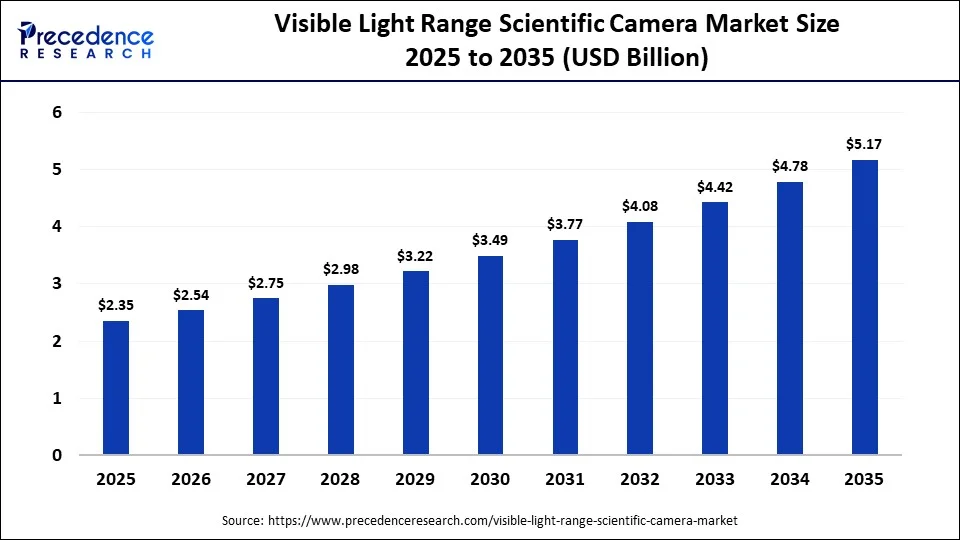
The global visible light range scientific camera market is on a strong upward trajectory, driven by rapid advances in imaging technology and rising demand across life sciences, industry, and research. According to market estimates, the industry was valued at USD 2.35 billion in 2025 and is projected to grow to USD 5.17 billion by 2035, registering a CAGR of 8.21% from 2026 to 2035.
This article unpacks the market size, key segments, regional outlook, and emerging trends shaping the future of visible‑light scientific imaging systems.
Read Also: Aircraft Turbofan Engine Market
What Are Visible Light Range Scientific Cameras?
Visible light range scientific cameras are specialized imaging devices designed to capture high‑resolution pictures within the visible spectrum of light (typically 400–700 nanometers). Unlike conventional DSLR cameras used in consumer photography, these systems prioritize accuracy, sensitivity, low noise, and precise image acquisition for scientific and analytical applications.
These cameras usually employ Charge-Coupled Device (CCD) or Complementary Metal-Oxide Semiconductor (CMOS) sensors—often in scientific‑grade configurations such as sCMOS—to deliver superior quantum efficiency and dynamic range. They are widely used in fields like microscopy, spectroscopy, materials analysis, and industrial inspection, where reproducible and high‑fidelity images are essential.
Market Size and Growth (2025–2035)
The visible light range scientific camera market is expanding steadily, thanks to the growing adoption of advanced imaging platforms in research labs and industrial environments.
Key market metrics include:
-
Market size in 2025: USD 2.35 billion
-
Market size in 2026: USD 2.54 billion (estimated)
-
Market size by 2035: USD 5.17 billion (projected)
-
CAGR from 2026 to 2035: 8.21%
The forecast period (2026–2035) is characterized by rising investments in life sciences, biomedical research, industrial automation, and optical instrumentation, all of which rely heavily on high‑resolution visible‑light imaging.
How AI Is Transforming Scientific Cameras
One of the most significant drivers reshaping the market is artificial intelligence (AI) integration into visible‑light scientific cameras. By coupling cameras with AI‑powered software, researchers can now:
-
Automate image classification, pattern detection, and anomaly identification.
-
Analyze complex datasets from microscopy and life‑science imaging in real time.
-
Improve diagnostic accuracy and experimental throughput in biomedical and industrial workflows.
AI‑enhanced scientific cameras are increasingly used in cell imaging, tissue analysis, and high‑throughput screening, where the ability to distinguish subtle morphological differences is critical.
Key Market Trends
Several structural and technological trends are supporting growth in the visible light range scientific camera market.
1. Advanced CMOS and sCMOS Sensors
Modern scientific cameras are shifting toward enhanced CMOS and sCMOS sensors that offer:
-
Higher frame rates for real‑time imaging.
-
Improved sensitivity and reduced noise.
-
Better suitability for live‑cell imaging, industrial inspection, and time‑lapse microscopy.
sCMOS sensors, in particular, combine high speed, low noise, and wide field‑of‑view imaging, making them attractive for next‑generation research and industrial systems.
2. High‑Speed Visible Light Cameras
Demand for high‑speed visible‑light cameras is rising in fields such as biomedical research, materials science, and fluid dynamics. These systems enable scientists to capture fast biological and chemical processes, improving the precision of experiments and diagnostics.
3. Miniaturization and Portability
Manufacturers are developing compact, lightweight scientific cameras for field‑based research and portable lab setups. These miniaturized designs can be easily integrated into microscopes, handheld devices, and field instruments without compromising sensitivity or image quality.
4. Rising Demand in Life Sciences
Applications in life sciences and biomedical research—including fluorescence microscopy, cell imaging, genomics, and drug discovery—are fueling the adoption of advanced visible‑light scientific cameras.
Market Segments at a Glance
The visible light range scientific camera market is segmented by camera type, sensor technology, application, end user, and region.
Camera Type (Market Share, 2025)
-
CCD scientific cameras dominate due to their high image quality, excellent sensitivity, and low noise performance, making them ideal for microscopy, spectroscopy, and astronomy.
-
CMOS scientific cameras are gaining traction because of lower power consumption, faster frame rates, and cost‑efficiency, especially in high‑throughput research and industrial settings.
Sensor Technology (Market Share, 2025)
-
CCD sensors remain leaders in applications requiring high accuracy and reproducibility, such as microscopy and astronomy.
-
sCMOS sensors are expected to grow the fastest, thanks to their high‑speed, low‑noise, and wide dynamic‑range performance.
Applications (Market Share, 2025)
-
Life sciences & biomedical research is the largest application segment, driven by the need for high‑resolution, low‑noise imaging in cellular biology and drug development.
-
Forensic analysis and industrial inspection are poised for rapid growth, supported by the demand for accurate digital evidence capture and automated defect detection.
End Users (Market Share, 2025)
-
Research institutions and universities account for the largest share, owing to their extensive use of scientific cameras in microscopy, spectroscopy, and materials research.
-
Healthcare and diagnostic laboratories are one of the fastest‑growing segments, fueled by the adoption of digital pathology and high‑resolution imaging in clinical workflows.
Regional Outlook
The market is divided into North America, Europe, Asia‑Pacific, Latin America, and the Middle East & Africa.
North America Leads the Market
-
North America held the largest market share (around 45% in 2025) and is projected to grow from USD 1.06 billion in 2025 to USD 2.35 billion by 2035, at a CAGR of 8.29%.
-
The U.S. alone accounts for roughly USD 793.13 million in 2025, with an expected rise to around USD 1,764.26 billion by 2035, reflecting a strong CAGR of 8.32%.
Key drivers in North America include:
-
Presence of leading research institutions, biotech firms, and pharmaceutical companies.
-
Heavy government funding for scientific research, healthcare innovation, and Industry 4.0 initiatives.
-
Rapid integration of AI, automation, and digital lab platforms in scientific imaging.
Asia‑Pacific: Fastest‑Growing Region
-
The Asia‑Pacific region is expected to record the fastest CAGR (around 8.9%) during the forecast period.
-
Countries such as China, Japan, South Korea, and India are investing heavily in modern laboratories, universities, and technology centers.
Growth in Asia‑Pacific is driven by:
-
Expanding research infrastructure in life sciences, materials science, and environmental monitoring.
-
Government programs promoting scientific innovation, smart manufacturing, and digital healthcare.
Supply Chain and Key Players
The visible light range scientific camera supply chain spans component manufacturing, sensor testing, integration with camera systems, and after‑sales support.
Key Stages in the Supply Chain
-
Component manufacturing: Production of CMOS/CCD sensors, optical lenses, and precision imaging electronics by specialized suppliers.
-
Testing and quality control: Rigorous electrical and stress tests to ensure pixel performance, noise levels, and long‑term reliability.
-
Distribution to OEMs and integrators: Secure logistics with anti‑static packaging and controlled‑temperature delivery.
-
Lifecycle support and recycling: Firmware updates, technical support, and sustainable reuse or recycling of camera components.
Major Companies in the Market
Leading players in the visible light range scientific camera market include:
-
Atik Cameras
-
Diffraction Limited
-
Excelitas PCO GmbH
-
Hamamatsu Photonics
-
Horiba Scientific
-
IDEX Health & Science
-
Meiji Techno
-
Oxford Instruments (Andor Technology)
-
Photonic Science
-
Raptor Photonics
-
Spectral Instruments, Inc.
-
Teledyne Technologies
-
Thorlabs, Inc.
-
XIMEA GmbH
Recent developments include:
-
Teledyne Technologies’ acquisition of TransponderTech (August 2025) to strengthen its imaging and instrumentation portfolio.
-
Hamamatsu Photonics’ launch of the ORCA Halo C17440‑20U sCMOS camera (May 2025), featuring a back‑illuminated sensor with high quantum efficiency (~86%) and low noise.
Conclusion
The visible light range scientific camera market is entering a high‑growth phase, supported by AI‑driven imaging, sCMOS sensors, and expanding research and industrial applications. With North America currently leading the market and Asia‑Pacific emerging as the fastest‑growing region, stakeholders—from manufacturers to research institutions—can expect continued opportunities in high‑resolution visible‑light imaging over the next decade.
Get Sample: https://www.precedenceresearch.com/sample/8268
For inquiries regarding discounts, bulk purchases, or customization requests, please contact us at sales@precedenceresearch.com

