
 by
by The global Emotion AI market is entering an unprecedented growth phase, fueled by rapid advancements in machine learning, deep learning, and human-computer interaction technologies. Valued at USD 9.10 billion in 2025, the market is projected to surge from USD 12.96 billion in 2026 to a staggering USD 311.99 billion by 2035, expanding at an exceptional CAGR of 42.40%.
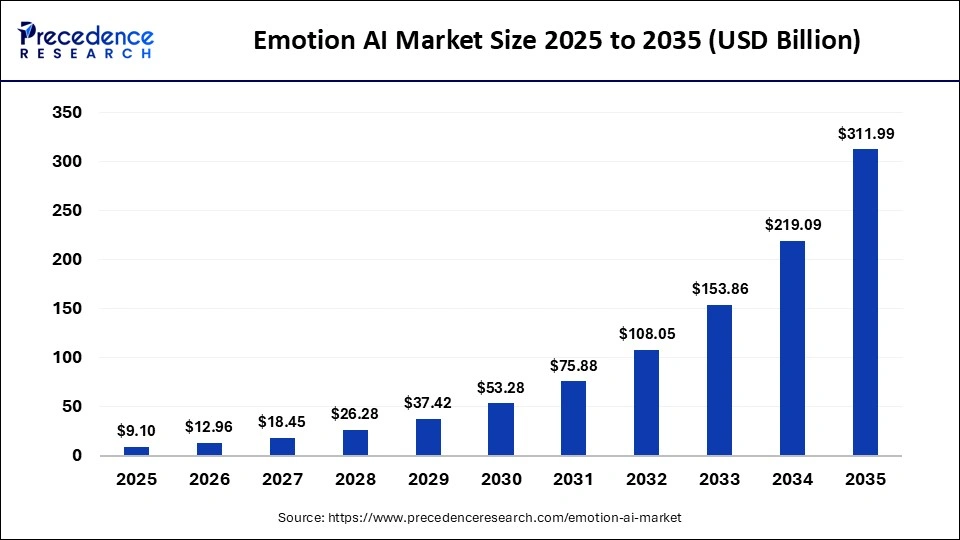
This remarkable growth reflects the rising importance of emotional intelligence in digital systems. From healthcare diagnostics to automotive safety and personalized marketing, Emotion AI—also known as affective AI—is redefining how machines interpret and respond to human emotions. As enterprises increasingly prioritize customer experience, behavioral insights, and real-time engagement, the demand for emotion aware technologies is accelerating globally.
Read Also: Ready to Drink Beverages Market
Quick Insights: What is Powering the Emotion AI Boom?
- The global Emotion AI market is valued at USD 12.96 billion in 2026 and is projected to reach USD 311.99 billion by 2035.
- North America dominated the market in 2025 with a 38.30% share due to strong R&D and enterprise adoption.
- Asia Pacific is expected to witness the fastest growth, driven by government-backed AI initiatives.
- The software segment led the market with a 72% share in 2025, supported by advanced analytics capabilities.
- Machine learning & deep learning technologies accounted for 55% of the market, forming the backbone of emotion recognition systems.
- Healthcare & life sciences emerged as the leading application segment with a 30% share.
- Enterprises & SMEs dominated end-user adoption with nearly 58% share, leveraging emotion AI for customer engagement and analytics.
How is Artificial Intelligence Shaping the Emotion AI Market?
Artificial intelligence is not just powering Emotion AI—it is fundamentally redefining it. Advanced AI models are now capable of analyzing facial expressions, vocal tones, physiological signals, and textual sentiment with unprecedented accuracy. Machine learning algorithms continuously learn from vast datasets, improving emotional detection capabilities and enabling real-time responsiveness across applications.
Moreover, AI-driven predictive analytics is unlocking deeper behavioral insights. Organizations can now anticipate customer emotions, tailor experiences, and optimize decision-making processes. This shift toward predictive emotional intelligence is enabling hyper-personalized engagement strategies, making Emotion AI a critical component of next-generation digital ecosystems.
What Are the Core Growth Drivers Behind Emotion AI Adoption?
The rapid digitization of enterprises across industries is a major driver of the Emotion AI market. Businesses in sectors such as healthcare, automotive, retail, and media are integrating emotion recognition technologies to enhance user experience, improve operational efficiency, and gain competitive advantages.
Another key factor is the growing reliance on natural language processing (NLP) and behavioral analytics. As digital interactions increase, organizations are leveraging Emotion AI to interpret customer sentiment from text, voice, and video data. This capability is particularly valuable in customer service, mental health monitoring, and targeted marketing, where understanding emotional context is crucial.
What Opportunities and Trends Are Reshaping the Market?
How is Emotion AI Enhancing Customer Experience Platforms?
Emotion AI is increasingly integrated into customer experience platforms, enabling businesses to analyze real-time sentiment and deliver personalized interactions. This enhances customer satisfaction and strengthens brand loyalty.
Why is Biometric Integration Becoming Critical?
The incorporation of biometric data such as heart rate, skin conductance, and body temperature is significantly improving the accuracy of emotion detection systems. This multi-modal approach is driving innovation in healthcare and security applications.
Can Emotion AI Improve Automotive Safety?
Yes, automakers are adopting Emotion AI in driver monitoring systems to detect drowsiness, distraction, and stress levels. This is enhancing road safety and supporting the development of autonomous vehicles.
What Role Does Predictive Analytics Play in Emotion AI?
Emotion AI-powered predictive analytics enables businesses to forecast customer behavior and emotional responses. This allows for more effective marketing strategies, product development, and customer engagement initiatives.
Segment Analysis: Where is the Market Expanding?
Why Does the Software Segment Dominate the Market?
The software segment accounted for 72% of the market in 2025, driven by the growing adoption of emotion recognition, facial analysis, and speech processing tools. These solutions provide real-time insights into human behavior, enabling businesses to optimize interactions and outcomes.
Meanwhile, the services segment is expected to grow at the fastest rate, as organizations increasingly rely on consulting, integration, and maintenance services to implement Emotion AI solutions effectively.
Technology Analysis: Why Are Machine Learning & Deep Learning Leading?
Machine learning and deep learning technologies dominated with a 55% share due to their ability to process complex emotional data and improve detection accuracy. These technologies are essential for analyzing facial expressions, speech patterns, and behavioral signals.
Natural language processing (NLP) is emerging as the fastest-growing segment, driven by its ability to analyze textual data from social media, customer feedback, and online platforms.
Application Analysis: Why is Healthcare Leading Adoption?
Healthcare & life sciences held the largest share of 30% in 2025, as Emotion AI enables patient monitoring, mental health assessment, and personalized treatment strategies.
The automotive sector is also witnessing strong growth, leveraging Emotion AI for driver monitoring and safety enhancements. Meanwhile, retail and marketing applications are expanding rapidly, driven by the need for personalized customer experiences.
End User Analysis: Why Do Enterprises Lead?
Enterprises and SMEs dominated with a 58% share, as they increasingly deploy Emotion AI to enhance customer engagement, workforce analytics, and operational efficiency. Cloud-based solutions are further enabling SMEs to adopt these technologies at scale.
Regional Insights: Where is the Growth Concentrated?
Why Does North America Dominate the Market?
North America led the market with a 38.30% share in 2025, supported by strong R&D investments, advanced technological infrastructure, and the presence of key players such as Affectiva, Hume AI, and Cogito Corp.
Why is Asia Pacific the Fastest-Growing Region?
Asia Pacific is emerging as a major growth hub due to strong government support, rapid digitalization, and increasing AI adoption across industries. Countries like China are leading innovation with large-scale AI initiatives.
How is Europe Strengthening Its Position?
Europe holds a significant share, driven by stringent regulations, enterprise adoption, and advancements in customer analytics. Companies such as Smart Eye and Realeyes are contributing to regional growth.
Leading Companies Driving Innovation
Key players shaping the Emotion AI market include:
- Affectiva, Inc.
- IBM Corporation
- Microsoft Corporation
- Google LLC
- NVIDIA Corporation
- Clarifai, Inc.
- Realeyes Ltd.
- Kairos AR, Inc.
- Cogito Corporation
Recent Developments Accelerating Market Growth
- In March 2026, Neurojourney was selected for the 2026 Youth Startup Academy, highlighting innovation in multimodal Emotion AI.
- In November 2025, Jehangir Wellness Centre in Pune integrated AI-driven emotional assessments into preventive healthcare, marking a global milestone in combining emotional and physical health.
What Challenges Are Hindering Market Growth?
Despite its rapid expansion, the Emotion AI market faces significant challenges related to privacy and ethics. Concerns over emotional data tracking, algorithmic bias, and lack of transparency are limiting adoption and raising regulatory scrutiny.
Additionally, the complexity of integrating Emotion AI into existing systems and the high cost of advanced hardware and software solutions pose barriers for smaller organizations.
Case Study: Emotion AI in Healthcare Transformation
A healthcare institution in India successfully implemented Emotion AI to monitor patient emotional well-being alongside physical health metrics. By analyzing facial expressions and speech patterns, clinicians were able to identify early signs of mental distress, leading to improved treatment outcomes and patient satisfaction. This case highlights the transformative potential of Emotion AI in personalized healthcare.
Conclusion: Emotion AI as the Future of Human-Machine Interaction
The Emotion AI market is set to redefine the digital landscape by enabling machines to understand and respond to human emotions. With applications spanning healthcare, automotive, retail, and beyond, the technology is becoming a cornerstone of next-generation AI systems.
As innovation continues and ethical frameworks evolve, Emotion AI is poised to unlock new dimensions of human-centric technology, driving exponential market growth over the next decade.
Get Sample Link: https://www.precedenceresearch.com/sample/8282
For inquiries regarding discounts, bulk purchases, or customization requests, please contact us at sales@precedenceresearch.com

