
 by
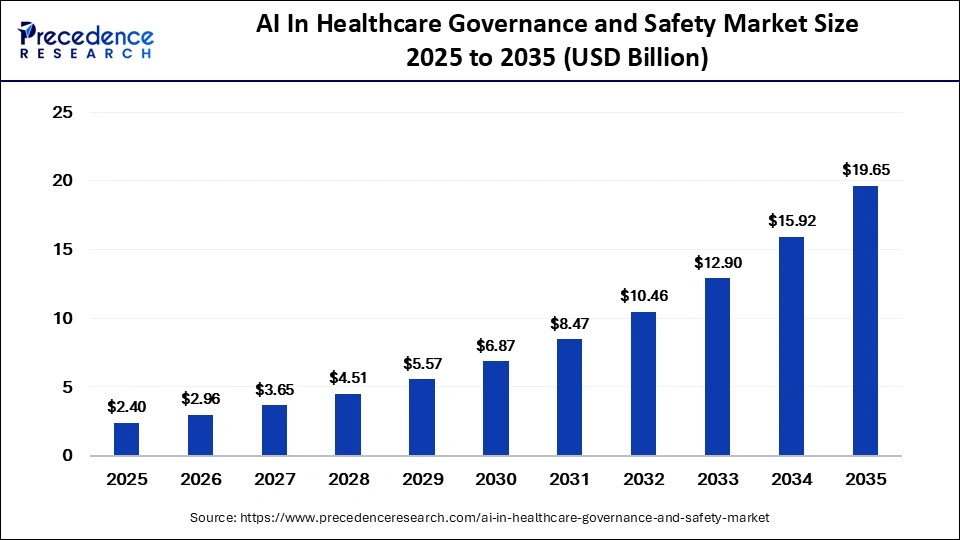
by The global AI in healthcare governance and safety market is projected to grow from USD 2.96 billion in 2026 to USD 19.65 billion by 2035 at a CAGR of 23.40%. Explore market trends, growth drivers, regional insights, key companies, and future opportunities in healthcare AI governance.
Introduction
Artificial intelligence is transforming the healthcare industry by improving diagnostics, operational efficiency, clinical decision-making, and patient outcomes. However, the rapid integration of AI into healthcare systems has also increased the need for strong governance, transparency, compliance, cybersecurity, and patient safety frameworks.
Healthcare organizations worldwide are increasingly adopting AI governance and safety platforms to ensure ethical AI deployment, regulatory compliance, data protection, and risk management across clinical environments. AI governance technologies help hospitals and healthcare providers monitor algorithm performance, reduce bias, secure patient data, and maintain accountability in AI-powered healthcare systems.
According to Precedence Research, the global AI in healthcare governance and safety market size was valued at USD 2.40 billion in 2025 and is expected to increase from USD 2.96 billion in 2026 to approximately USD 19.65 billion by 2035, expanding at a CAGR of 23.40% during the forecast period.
Read Also: Injection Molding Market
AI in Healthcare Governance and Safety Market Overview
AI in healthcare governance and safety refers to technologies, frameworks, and software platforms used to ensure safe, transparent, explainable, and compliant deployment of artificial intelligence across healthcare systems.
Healthcare organizations are increasingly implementing AI governance solutions for clinical risk management, patient safety monitoring, fraud detection, cybersecurity, AI model oversight, and regulatory compliance. These systems help healthcare institutions manage AI accountability while minimizing operational and clinical risks.
The growing use of predictive analytics, AI-assisted diagnostics, telehealth platforms, electronic health records, and connected medical devices is accelerating demand for governance-focused AI infrastructure globally.
Key Market Statistics
Major Market Highlights
- The AI in healthcare governance and safety market is projected to grow at a CAGR of 23.40% from 2026 to 2035.
- North America dominated the market with 43% share in 2025.
- Europe accounted for 29% of market share in 2025 and is expected to grow at a CAGR of 23.5%.
- Software solutions dominated the component segment with 72% share in 2025.
- Cloud-based deployment accounted for 70% of market share in 2025.
- Machine learning technology held 28% market share in 2025.
- Clinical risk management represented 24% of application share in 2025.
- Hospitals contributed 38% of end-use market share in 2025.
- Explainable AI (XAI) is projected to witness the fastest CAGR of 29.5% through 2035.
Key Market Drivers
Rising Need for Responsible and Explainable AI
Healthcare organizations are under increasing pressure to ensure transparency, fairness, and accountability in AI-powered decision-making systems.
AI governance platforms help healthcare providers monitor algorithm behavior, identify bias, validate models, and maintain explainability in clinical workflows. Explainable AI technologies are becoming essential for regulatory compliance and patient trust.
The increasing complexity of AI-driven diagnostics and predictive analytics is further accelerating adoption of governance-focused solutions.
Growing Concerns Regarding Patient Safety
Patient safety remains a top priority across global healthcare systems.
AI governance solutions enable hospitals and healthcare providers to identify clinical risks, monitor treatment recommendations, track anomalies, and reduce adverse events through real-time oversight systems. Clinical risk management accounted for 24% market share in 2025 due to increasing demand for AI-powered patient safety monitoring tools.
Healthcare organizations are increasingly implementing governance frameworks to ensure that AI technologies support safe and reliable patient care delivery.
Increasing Regulatory Compliance Requirements
Governments and regulatory agencies worldwide are introducing stricter rules regarding AI deployment in healthcare.
Regulations such as the EU AI Act, FDA AI guidance frameworks, HIPAA, and healthcare cybersecurity laws are driving demand for governance and compliance platforms. Healthcare providers are increasingly investing in AI compliance monitoring systems to meet regulatory obligations and reduce legal risks.
The growing number of AI-enabled medical devices is also increasing demand for continuous oversight infrastructure.
Expansion of Healthcare Cybersecurity Infrastructure
The rise in cyberattacks targeting hospitals and healthcare systems has increased the need for AI-powered governance and security solutions.
Healthcare organizations are increasingly adopting AI-based threat detection, compliance monitoring, and privacy protection systems to secure patient data and prevent unauthorized access.
The growing digitization of healthcare operations continues to accelerate investments in AI cybersecurity technologies.
Impact of Artificial Intelligence on Healthcare Governance
Artificial intelligence itself is reshaping healthcare governance by enabling automated monitoring, predictive risk analysis, and intelligent compliance management.
AI-powered governance platforms continuously analyze clinical workflows, patient safety indicators, cybersecurity threats, and algorithm performance to identify risks and ensure regulatory adherence. Machine learning models help healthcare organizations detect anomalies, optimize operational oversight, and improve decision-making accuracy.
Hospitals are increasingly integrating AI governance systems into enterprise healthcare infrastructure to improve accountability, transparency, and operational resilience.
Market Trends
Growing Adoption of Explainable AI (XAI)
Explainable AI is emerging as one of the most important trends in healthcare governance.
Healthcare providers increasingly require AI systems that offer transparent reasoning and understandable outputs for physicians, regulators, and patients. The explainable AI segment is projected to grow at the fastest CAGR of 29.5% during the forecast period.
XAI technologies help improve trust in AI-assisted diagnostics and clinical recommendations.
Expansion of AI Governance Frameworks Across Hospitals
Hospitals worldwide are increasingly implementing structured AI governance programs.
According to industry findings, nearly 70% of U.S. health systems implemented AI governance frameworks in 2025, compared to around 40% in 2024.
Healthcare organizations are creating dedicated governance committees, compliance systems, and AI oversight infrastructures to manage enterprise-wide AI deployments.
Rising Demand for Cloud-Based Governance Platforms
Cloud-based deployment continues to dominate the market because of scalability, centralized monitoring, and remote accessibility.
Cloud-native governance platforms allow healthcare organizations to monitor AI systems across distributed clinical environments while improving interoperability and operational flexibility. Cloud-based deployment accounted for 70% market share in 2025.
Integration of Predictive Analytics and AI Monitoring
Predictive analytics technologies are increasingly being integrated into healthcare governance systems.
AI-powered monitoring tools help hospitals identify operational risks, forecast clinical issues, detect cybersecurity threats, and optimize healthcare resource management.
Market Restraints
Data Privacy and Security Challenges
Healthcare organizations manage highly sensitive patient information, making cybersecurity and privacy protection major concerns.
The increasing use of AI systems and cloud-based infrastructure raises the risk of data breaches, ransomware attacks, and unauthorized access. Organizations must invest heavily in encryption, cybersecurity frameworks, and compliance systems to maintain data security.
Lack of Standardized Governance Frameworks
The absence of globally standardized AI governance regulations creates operational complexity for healthcare providers.
Different countries and regulatory bodies continue to develop varying compliance requirements for healthcare AI systems, making cross-border implementation more challenging.
High Implementation and Integration Costs
Deploying AI governance infrastructure often requires substantial investment in software platforms, cybersecurity systems, compliance management, and workforce training.
Small and mid-sized healthcare organizations may face financial and technical barriers during implementation.
Emerging Opportunities
Expansion of Responsible AI Infrastructure
Healthcare organizations are increasingly investing in responsible AI ecosystems to support ethical and compliant AI deployment.
Hospitals are expanding investments in privacy-preserving AI environments, synthetic data platforms, and centralized governance systems to strengthen operational oversight.
This trend is expected to create substantial opportunities for governance technology providers.
Growth in AI-Enabled Medical Devices
The rapid increase in AI-powered medical devices is accelerating demand for continuous governance and monitoring systems.
By the end of 2024, more than 1,000 AI-enabled medical devices had received approval from the U.S. Food and Drug Administration.
This expansion is increasing the need for AI safety monitoring, post-market surveillance, and compliance infrastructure.
Rising Demand for AI Risk Monitoring Systems
Healthcare providers are increasingly adopting real-time AI monitoring systems to improve patient safety and operational resilience.
Emerging governance technologies enable healthcare institutions to continuously validate AI model performance, identify drift, and manage clinical risk more effectively.
Segmental Analysis
By Component
Software Segment Dominance
The software segment dominated the market with 72% share in 2025 because healthcare organizations increasingly adopted governance-focused AI software platforms for transparency, compliance, and operational oversight.
Services Segment Growth
The services segment is expected to grow steadily due to increasing demand for compliance consulting, cybersecurity management, bias auditing, and AI system validation services.
By Deployment Mode
Cloud-Based Deployment Leadership
Cloud-based deployment held 70% market share in 2025 due to increasing adoption of connected healthcare systems and distributed governance infrastructure.
On-Premise Deployment
On-premise solutions remain important for healthcare organizations requiring higher levels of data control and customized governance systems.
By Technology
Machine Learning Leadership
Machine learning accounted for 28% market share in 2025 because of its extensive use in predictive monitoring, anomaly detection, and healthcare decision-making systems.
Explainable AI Expansion
Explainable AI technologies are witnessing the fastest growth because of increasing regulatory pressure for transparency and accountability in healthcare AI applications.
Regional Analysis
North America
North America dominated the AI in healthcare governance and safety market with 43% share in 2025.
The region benefits from advanced healthcare infrastructure, rapid AI adoption, strong cybersecurity investments, and proactive regulatory initiatives.
Major healthcare systems and technology companies in the United States are heavily investing in governance frameworks, explainable AI systems, and compliance monitoring infrastructure.
Europe
Europe accounted for 29% market share in 2025 and is expected to witness significant growth during the forecast period.
The EU AI Act and increasing focus on ethical AI deployment are accelerating demand for governance technologies across healthcare systems.
Countries such as Germany, the United Kingdom, and France are investing heavily in AI compliance and patient safety infrastructure.
Asia-Pacific
Asia-Pacific is emerging as a rapidly growing market due to increasing healthcare digitization, AI adoption, and government investments in healthcare modernization.
China, Japan, India, and South Korea are increasingly implementing AI-powered healthcare infrastructure and governance systems.
Latin America and Middle East & Africa
These regions are gradually adopting AI governance technologies as healthcare digital transformation initiatives continue to expand.
Key Companies in the AI in Healthcare Governance and Safety Market
Major companies operating in the market include:
- Microsoft
- Oracle
- NVIDIA
- IBM
- SAP
- Amazon Web Services
- Mayo Clinic
- Cleveland Clinic
- Stanford Medicine
Get a Sample Copy: https://www.precedenceresearch.com/sample/8411
For inquiries regarding discounts, bulk purchases, or customization requests, please contact us at sales@precedenceresearch.com

- Hexanal Market Size to Reach USD 412.98 Billion by 2035 - June 26, 2026
- Cubeb Oil Market Size to Reach USD 122.93 Billion by 2035 - June 26, 2026
- U.S. Battery Logistics Market Size to Reach USD 11.43 Billion by 2035 - June 25, 2026
