
 by
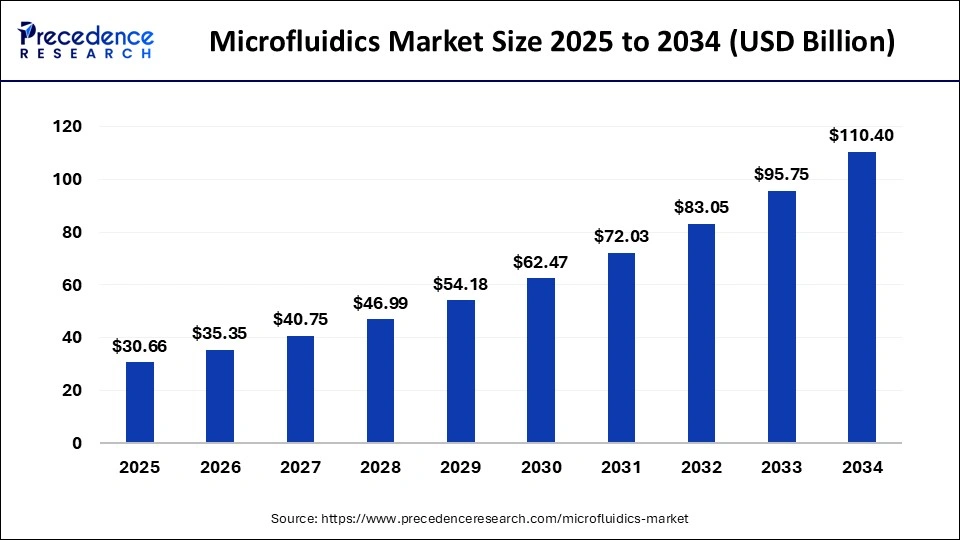
by The global microfluidics market was valued at USD 30.66 billion in 2025 and is projected to grow from USD 35.35 billion in 2026 to approximately USD 123.75 billion by 2035, registering a robust CAGR of 14.97% during the forecast period. Market growth is being driven by the increasing demand for rapid diagnostics, personalized medicine, and cost-effective analytical solutions that deliver highly accurate results using minimal sample volumes. Additionally, the rising adoption of point-of-care testing, continuous advancements in lab-on-a-chip technologies, and expanding applications across healthcare, pharmaceutical, and research sectors are further accelerating the growth of the microfluidics industry worldwide.
Get Sample : https://www.precedenceresearch.com/sample/1116
Market Highlights
- North America led the global market with the highest market share of 43% in 2025.
- By Material, the polydimethylsiloxane (PDMS) segment is estimated to hold the highest market share of 34.5% in 2025.
- By Technology, the medical technology segment has held the biggest revenue share of 83% in 2025.
- By Application, the lab-on-a-chip segment had the largest market share of 38% in 2025.
Market Overview
The microfluidics market comprises technologies and devices that enable the manipulation, processing, and analysis of extremely small fluid volumes within microscale channels. These systems play a vital role in healthcare, life sciences, pharmaceuticals, diagnostics, and industrial testing by delivering precise results while reducing sample and reagent requirements. The increasing demand for rapid diagnostics, enhanced testing accuracy, and cost-effective analytical solutions is driving the widespread adoption of microfluidic technologies across various industries.
One of the primary factors fueling market growth is the expanding use of microfluidic platforms in point-of-care testing, allowing laboratory-grade diagnostic results in portable and decentralized healthcare settings. The growing focus on personalized medicine, genomics, molecular diagnostics, and targeted therapies is further broadening the application scope of these technologies. Their capability to support high-throughput screening and real-time analysis makes them indispensable in modern healthcare and advanced research environments.
In addition to healthcare applications, microfluidics is increasingly being utilized in environmental monitoring, food safety testing, and chemical analysis. Ongoing advancements in device miniaturization, automation, and digital integration are improving performance, efficiency, and ease of use. As industries continue to seek faster, more scalable, and highly efficient testing solutions, microfluidics is expected to remain a cornerstone technology for the next generation of diagnostic and analytical platforms.
How is AI Impacting the Microfluidics Market?
Artificial intelligence is improving microfluidic technologies, leading to greater efficiency in data analysis and more effective device development. Microfluidic systems generate vast quantities of complex biological and chemical information, which AI algorithms can analyze in real time to detect patterns, improve diagnostic accuracy, and facilitate clinical decision-making. Artificial intelligence for microfluidic platforms plays an essential role in drug discovery in that they offer the ability to screen thousands of compounds more effectively, reducing drug discovery processes and lowering the cost of experimental design.
Machine learning and lab-on-a-chip devices are enhancing automation by optimizing fluid handling, sample processing, and assay execution. Because data-driven methodologies increasingly dominate healthcare and biotechnology applications, hybridization of AI and microfluidics leads to smarter analytical platforms that allow rapid, precise, and scalable solutions for diagnostics, personalized medicine applications, and biomedical research endeavors.
Market Report Coverage and Key Metrics
| Report Highlights | Details |
| Market Size in 2025 | USD 30.66 Billion |
| Market Size in 2026 | USD 35.35 Billion |
| Market Size by 2035 | USD 123.75 Billion |
| Growth Rate from 2026 to 2035 | CAGR of 14.97% |
| Largest Market | North America |
| Fastest Growing Market | Asia Pacific |
| Base Year | 2025 |
| Forecast Period | 2026 to 2035 |
Market Regional Analysis: North America, Europe, Asia-Pacific
Why Did North America Dominate the Microfluidics Market?
North America dominated the global microfluidics market in 2025 due to its advanced biotechnology ecosystem, strong healthcare infrastructure, significant R&D investments, and presence of leading pharmaceutical and diagnostic companies. The region has witnessed widespread adoption of point-of-care testing, molecular diagnostics, lab-on-a-chip systems, and organ-on-chip technologies across healthcare and life sciences applications. Strong collaborations between academic institutions, research organizations, and industry players continue to drive innovation and commercialization of advanced microfluidic solutions.
Why is Asia Pacific Experiencing the Fastest Growth in the Microfluidics Market?
Asia Pacific is expected to register the fastest growth during the forecast period due to rapid advancements in biotechnology, increasing healthcare investments, and rising demand for affordable and efficient diagnostic solutions. Government initiatives supporting life sciences research, precision medicine, and medical technology development are encouraging the adoption of microfluidic systems. Growing disease burden, expanding healthcare access, and increasing demand for early diagnosis are further supporting regional market expansion.
How is Europe Growing in the Microfluidics Market?
Europe is expected to grow at a significant rate due to supportive regulatory frameworks, advanced research infrastructure, and increasing focus on personalized medicine. The integration of microfluidics with genomics, proteomics, and molecular diagnostics is enabling more accurate and targeted healthcare solutions. Growing demand for decentralized healthcare, point-of-care diagnostics, and sustainable medical technologies is further supporting regional expansion.
Value Chain Analysis
- Raw Material Sourcing: Raw materials include specialty polymers COC, COP, PMMA, elastomers (PDMS), glass and silicon wafers, adhesives, coatings, and microfabrication chemicals. Suppliers must meet strict purity, biocompatibility, and thermal stability requirements. Polymer sourcing increasingly favors medical-grade, low-leachate materials with traceability. Manufacturers diversify across suppliers to mitigate shortages in specialized plastics.
- Technological Advancements: Key advancements include droplet microfluidics, digital microfluidics, paper-based microdevices, hybrid polymer-glass chips, AI-assisted flow control, and integrated optical/electronic sensing. Emerging trends include lab-on-skin wearables, organ-on-chip platforms mimicking physiological functions, high-density single-cell analysis arrays, and microfluidic bioreactors for cell and gene therapy manufacturing.
Key players: PerkinElmer
Market Competitive Landscape: Leading Companies and Strategies
The microfluidics market is characterized by a competitive and moderately fragmented landscape, with global technology companies, life science firms, and specialized microfluidics developers competing through innovation, strategic collaborations, and application-specific solutions. Leading companies maintain strong positions through advanced R&D capabilities, proprietary technologies, extensive product portfolios, and partnerships with pharmaceutical companies, diagnostic laboratories, and research institutions.
Key market players include Danaher Corporation, Thermo Fisher Scientific, F. Hoffmann-La Roche Ltd., Agilent Technologies, Bio-Rad Laboratories, and PerkinElmer. These companies are focusing on expanding microfluidic platforms for applications such as point-of-care diagnostics, genomics, molecular testing, drug discovery, and organ-on-chip technologies.
Microfluidics Market Companies
- Agilent Technologies, Inc.
- Illumina, Inc.
- Perkinelmer, Inc.
- Life Technologies Corporation
- Danaher
- Bio-Rad Laboratories, Inc.
- Hoffmann-La Roche Ltd
- Abbott Laboratories
- Fluidigm Corporation
- Qiagen N.V.
- Thermo Fischer Scientific
- Biomérieux
- Cellix Ltd.
- Elveflow
- Micronit Micro Technologies B.V.
Recent Developments in the Microfluidics Market (2025–2026)
- In January 2025, Sphere Fluidics Ltd (UK) introduced Cyto-Mine Chroma, a proprietary picodroplet microfluidics platform geared to making optimal use of single cells for single-cell analysis. An inclusive platform that supports applications in antibody discovery, cell line, and cell therapy studies.
(Source: Sphere Fluidics launches Cyto-Mine Chroma and announces Early Access Program – Samedan) - In April 2025, Germany-based Sartorius AG announced the purchase of the US companies MatTek Corporation and Visikol Inc. from BICO Group. This acquisition is a further addition to Sartorius’ range of 3D microtissue models with potential integration into microfluidic systems and organ-on-chip technologies for drug discovery and biomedical research. (Source: Sartorius to acquire microtissue business MatTek from Swedish BICO AB)
- In January 2026, Blacksheep Sciences Limited (UK) and Rapid Fluidics Limited (UK) collaborated in forming a joint strategic partnership to help accelerate the development and release of advanced life science tools with 3D-printed components for microfluidic applications on the go. They are focused on speeding up the workflow from establishing a prototype to mass production. (Source: Blacksheep Sciences and Rapid Fluidics Announce Strategic Collaboration to Advance 3D-Printed Microfluidic Solutions | Bionow)
Segments Covered in the Report
By Material
- Glass
- Silicon
- PDMS
- Polymers
- Others
By Technology
- Non-Medical
- Medical
- Gel Electrophoresis
- PCR & RT-PCR
- ELISA
- Microarrays
- Others
By Application
- Organs-on-chips
- Lab-on-a-chip
- Continuous Flow Microfluidics
- Acoustofluidics and Microfluidics
- Optofluidics and Microfluidics
- Electrophoresis and Microfluidics
By Region
- North America
- Europe
- Asia-Pacific
- Latin America
- Middle East and Africa
Check this Report too: In Vitro Diagnostics Market
Get this report to explore global market size, share, CAGR, and trends, featuring detailed segmental analysis and an insightful competitive landscape overview @ https://www.precedenceresearch.com/sample/1116
You can place an order or ask any questions, please feel free to contact us at sales@precedenceresearch.com |+1 804 441 8440

- Microfluidics Market Set for Robust Growth from USD 35.35 Billion in 2026 to USD 123.75 Billion by 2035 - June 22, 2026
- In Vitro Diagnostics Market: Expanding Clinical Testing Capabilities Amid Rising Global Disease Burden - June 22, 2026
- Construction Equipment Rental Market Size to Reach USD 175.21 Bn by 2035 - June 19, 2026
