
 by
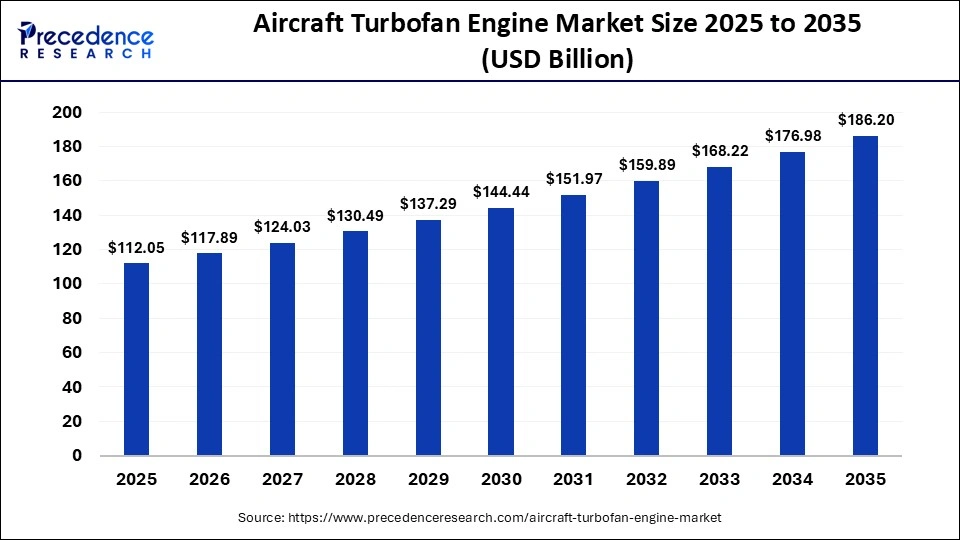
by The global aircraft turbofan engine market is witnessing strong momentum as aviation demand rebounds and technological innovation accelerates. The market size was valued at USD 112.05 billion in 2025 and is projected to grow from USD 117.89 billion in 2026 to approximately USD 186.20 billion by 2035, expanding at a CAGR of 5.21%.
This growth is primarily fueled by increasing global air passenger traffic, rising aircraft production, and significant investments in advanced engine materials and fuel-efficient technologies.
Read Also: Next-Gen Aircraft Propulsion System Market
What is an Aircraft Turbofan Engine?
An aircraft turbofan engine is a highly efficient air-breathing jet engine widely used in modern aviation. It features a large front fan that pushes air around the engine core, generating thrust more efficiently than traditional turbojet engines.
By combining the speed of jet propulsion with the efficiency of propeller systems, turbofan engines deliver:
- Lower fuel consumption
- Reduced noise levels
- Improved environmental performance
Key Market Highlights
- Market Size 2026: USD 117.89 Billion
- Projected Size 2035: USD 186.20 Billion
- CAGR (2026–2035): 5.21%
- Leading Region: North America (37% share in 2025)
- Fastest-Growing Region: Asia Pacific
Segment Insights:
- Engine Type: High bypass turbofan dominated with ~60% share
- Component: Fan & compressor led with ~30% share
- Application: Commercial aviation held ~68% share
- Thrust Range: Above 50,000 lbf dominated with ~50% share
How AI is Transforming the Turbofan Engine Market
Artificial Intelligence is revolutionizing aircraft engine performance and maintenance:
- Predictive Maintenance: AI detects early wear using IoT sensors, reducing downtime
- Design Optimization: Generative design creates lightweight, high-performance components
- Fuel Efficiency: AI optimizes aerodynamics and flight paths
- Reduced Emissions: Supports compliance with stringent environmental regulations
This integration is significantly lowering operational costs while improving safety and efficiency.
Segment Analysis
By Engine Type
- High Bypass Turbofan: Dominates due to fuel efficiency and low noise
- Low Bypass Turbofan: Preferred in military aviation for high-speed performance
- Geared Turbofan (GTF): Fastest-growing segment with enhanced efficiency
By Application
- Commercial Aviation (68%): Driven by rising passenger traffic
- Military Aviation: Growing due to defense modernization
- Business & General Aviation: Boosted by private jet demand
By Thrust Range
- Above 50,000 lbf: Dominates long-haul and wide-body aircraft
- 20,000–50,000 lbf: Fastest-growing for narrow-body aircraft
- Below 20,000 lbf: Used in regional and business jets
By Component
- Fan & Compressor: Core to engine efficiency
- Turbine: Critical for power generation
- Gearbox: Key for geared turbofan systems
- Combustor: Focus area for emission reduction
Aircraft Turbofan Engine Market Companies
- General Electric (GE Aerospace)
- Rolls-Royce Holdings plc
- Pratt & Whitney (RTX Corporation)
- Safran Aircraft Engines
- Honeywell International Inc.
- MTU Aero Engines AG
- IHI Corporation
Kawasaki Heavy Industries - Mitsubishi Heavy Industries
- Aero Engine Corporation of China (AECC)
- GKN Aerospace
- Avio Aero
- Techspace Aero
- Volvo Aero (GKN Aerospace Sweden)
- NPO Saturn
Get Sample: https://www.precedenceresearch.com/sample/8267
For inquiries regarding discounts, bulk purchases, or customization requests, please contact us at sales@precedenceresearch.com

