
 by
by Braiding Machine Market Size 2026 to 2035
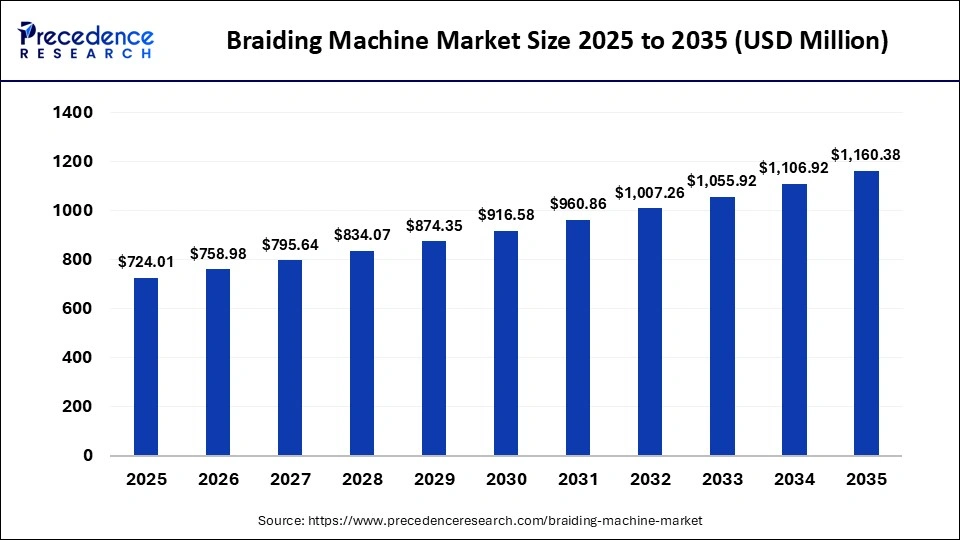
The global braiding machine market size was valued at USD 724.01 million in 2025 and is expected to grow from USD 758.98 million in 2026 to approximately USD 1,160.38 million by 2035, registering a CAGR of 4.83% during the forecast period.
The growth is primarily driven by the rising demand for advanced braided products such as wire harnesses, cables, hoses, and composite materials used in high-performance applications.
Read Also: Interventional Oncology Market
Market Highlights
- North America dominated the market with a 35% share in 2025
- Asia Pacific is expected to grow at the fastest CAGR
- Horn gear braider segment led the market in 2025
- Wardwell rapid braider segment is projected to grow rapidly
- Textile industry dominated by end-user in 2025
- Electrical segment expected to grow significantly
- Direct sales (OEM) held the largest share
- Indirect sales channel is expected to grow the fastest
Market Overview
The braiding machine market includes machinery used to interlace yarns, wires, and fibers into braided structures. These machines are widely used across industries such as automotive, aerospace, construction, medical, and textiles.
Braiding machines offer several advantages:
- High product strength and durability
- Flexibility in design and application
- Precision manufacturing of complex shapes
- Enhanced performance in demanding environments
The increasing production of automobiles and aircraft, along with the growing shift toward lightweight and durable materials such as carbon fiber and specialty yarns, is significantly boosting the demand for advanced braiding technologies.
Key Components and Working Mechanism
Braiding machines consist of several essential components:
- Carriers: Hold and transport yarn or wire
- Bobbins: Store material
- Horn gears: Drive carrier movement
- Track plates (braider head): Guide carrier paths
These machines interlace multiple strands in circular or diagonal patterns to produce cohesive braided structures. Metallic wires such as tinned copper are also used for electromagnetic compatibility (EMC) and mechanical protection in cable applications.
Role of AI in the Braiding Machine Market
Artificial intelligence is transforming the braiding machine industry by enhancing efficiency, precision, and automation.
Key AI-driven advancements include:
- Improved 3D braiding for complex shapes
- Reduction in angle errors to as low as 0.7°–1.0°
- Real-time defect detection using machine learning
- Advanced surface tracking using U-Net algorithms
- Optimization of speed profiles and production efficiency
AI integration is enabling manufacturers to achieve higher accuracy and reduce material waste.
Key Market Trends
Automation and CNC Integration
The adoption of CNC-controlled braiding machines is increasing, offering improved precision, reduced labor dependency, and enhanced productivity.
Sustainability and Energy Efficiency
Manufacturers are focusing on eco-friendly machine designs to minimize energy consumption and material waste.
Advancements in 3D Braiding Technology
Significant progress in 3D braiding is enabling the production of complex structures such as bifurcated pipes and T-profile components.
Smart Manufacturing and IoT Integration
IoT-enabled machines allow real-time monitoring, predictive maintenance, and remote diagnostics, supporting Industry 4.0 initiatives.
Collision Avoidance Systems
Advanced software and algorithms are being developed to prevent carrier collisions during complex braiding operations.
Segment Insights
Product Type Insights
Horn Gear Braider Dominates the Market
The horn gear braider segment held the largest share in 2025 due to its:
- High-speed operation
- Ability to produce complex 2D and 3D shapes
- Consistent and high-quality output
- Versatility across multiple industries
Wardwell Rapid Braider to Grow Rapidly
The Wardwell rapid braider segment is expected to witness strong growth due to:
- Enhanced durability through advanced lubrication systems
- Reduced downtime and maintenance
- Improved machine performance and reliability
End-User Industry Insights
Textile Industry Leads the Market
The textile segment dominated the market in 2025 due to rising demand for:
- Apparel and fashion products
- Home textiles
- Industrial fabrics
Countries such as China, India, Bangladesh, and Thailand are major contributors to this growth.
Electrical Industry to Grow Significantly
The electrical segment is expected to grow rapidly due to increasing demand for:
- Braided wires and cables
- Shielding components
- Power transmission systems
Distribution Channel Insights
Direct Sales (OEM) Segment Leads
Direct sales dominated the market due to:
- Better product quality assurance
- Customization options
- Strong after-sales support
- Integration of advanced technologies
Indirect Sales Segment Growing Fast
Indirect sales are expanding rapidly due to:
- Wider accessibility for SMEs
- Localized support services
- Flexible purchasing options
Regional Insights
North America Dominates the Market
North America held the largest market share in 2025, driven by:
- Strong presence of advanced manufacturing industries
- High demand from aerospace, automotive, and medical sectors
- Adoption of IoT-enabled and automated machines
The market is projected to grow from USD 253.50 million in 2025 to USD 411.93 million by 2035, at a CAGR of 4.98%.
U.S. Market Overview
The U.S. market is expected to reach USD 311.01 million by 2035, supported by innovations in braiding technologies and increasing demand for high-performance materials.
Asia Pacific: Fastest Growing Region
Asia Pacific is expected to witness the fastest growth due to:
- Rapid industrialization and urbanization
- Growing textile and manufacturing industries
- Increasing adoption of smart and IoT-enabled machines
Countries like China, India, and Japan are leading this growth.
Europe Market Outlook
Europe is experiencing steady growth due to advancements in 3D braiding technologies and strong demand for high-performance industrial applications.
Value Chain Analysis
The braiding machine market value chain includes:
- Raw Material Supply – Steel wires, fibers, and electronic components
- Manufacturing & Assembly – Machine design and production
- Technology Integration – CNC, IoT, and automation systems
- Distribution & Sales – OEM and dealer networks
- After-Sales Services – Maintenance, spare parts, and support
Competitive Landscape
The market is competitive, with key players focusing on innovation and product development.
Major Companies Include:
- Mayer & Cie. GmbH & Co. KG
- Wardwell Braiding Co.
- The Steeger USA
- Braidwell Machines Co.
- Cobra Braiding Machinery Ltd.
- TapeFormers Ltd
- Alfa Flexitubes Pvt. Ltd.
- Kyang Yhe Delicate Machine Co., Ltd.
- Talleres Ratera, S.A.
- HERZOG GmbH
Recent Developments
- In July 2025, Mayer & Cie. celebrated its 120th anniversary and introduced its fourth-generation leadership.
- In July 2025, the company delivered its first MR-15 braiding machine with 48 carriers.
- In March 2025, Greenland (Xiamen) Technology launched BFB-200L Series Vertical CNC Braiding Machines for high-pressure hose production.
Market Segmentation
By Product Type
- Horn Gear Braider
- Maypole Braider
- Square Braider
- Wardwell Rapid Braider
- 4-Track and Column Braider
- Wire Braiding Machines
By End-User Industry
- Textile
- Automotive
- Aerospace
- Medical
- Electrical
- Marine
- Others
By Distribution Channel
- Direct Sales (OEM)
- Indirect Sales
By Region
- North America
- Europe
- Asia-Pacific
- Latin America
- Middle East & Africa
Conclusion
The braiding machine market is set for steady growth over the next decade, driven by increasing demand for high-performance braided materials, technological advancements, and the adoption of automation and AI. With strong growth in emerging economies and expanding applications across industries, the market is poised to play a vital role in modern manufacturing.
Get Sample: https://www.precedenceresearch.com/sample/7705
For inquiries regarding discounts, bulk purchases, or customization requests, please contact us at sales@precedenceresearch.com

- Internet Security Market Size to Reach USD 171.61 Billion by 2035 - March 24, 2026
- Synthetic Monitoring Market Size to Reach USD 3.36 Billion by 2035 - March 24, 2026
- Adiponectin Testing Market Size to Reach USD 120.35 Billion by 2035 - March 24, 2026
