
 by
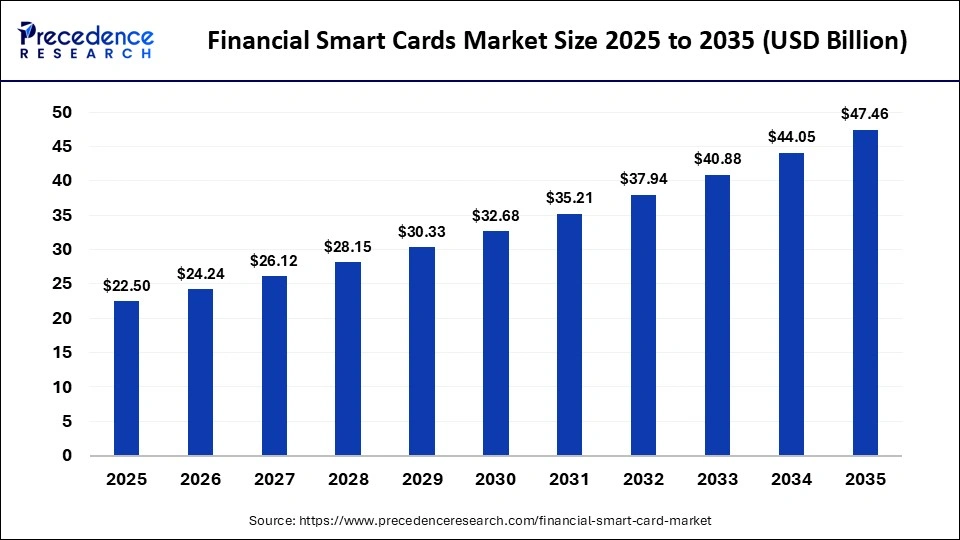
by The global financial smart cards market size was valued at USD 22.50 billion in 2025 and is projected to grow from USD 24.24 billion in 2026 to approximately USD 47.46 billion by 2035, expanding at a CAGR of 7.75% from 2026 to 2035.
The growth of the market is mainly driven by the increasing demand for secure payment systems, rapid adoption of contactless transactions, and advancements in authentication technologies such as EMV chips and biometrics.
Read Also: AI Data Labeling Market
Financial Smart Cards Market Overview
The financial smart cards market consists of integrated circuit cards embedded with microprocessors or memory chips that enable secure financial transactions and identity verification. These cards support contact-based, contactless, and dual-interface transactions, making them more secure and efficient than traditional magnetic stripe cards.
Financial smart cards are widely used for:
-
Credit and debit card transactions
-
Prepaid card payments
-
Identity verification
-
Secure authentication
The increasing shift toward cashless economies, digital banking services, and secure transaction methods is significantly boosting demand for smart card technologies across the banking and retail sectors.
How AI is Transforming the Financial Smart Cards Market
Artificial intelligence is playing an increasingly important role in enhancing security, fraud detection, and transaction efficiency in financial smart cards.
AI-powered systems analyze transactional behavior in real time, identifying suspicious activities and reducing fraudulent transactions. This technology allows financial institutions to detect anomalies quickly while minimizing false positives.
AI is also enabling behavioral biometric authentication, which analyzes unique user behavior patterns such as typing style or spending habits to create a dynamic security profile.
In addition, AI helps financial institutions:
-
Improve fraud prevention systems
-
Optimize payment routing processes
-
Manage high-volume financial transactions
-
Speed up dispute resolution
These capabilities are transforming the way banks and financial institutions secure digital payments.
Major Trends in the Financial Smart Cards Market
Growth of Contactless and Dual-Interface Cards
Contactless payments are becoming increasingly popular due to their speed, convenience, and hygiene benefits. Many banks are adopting dual-interface cards that allow users to either tap or insert the card for transactions.
Increasing Adoption of Biometric Smart Cards
Biometric-enabled smart cards with fingerprint authentication are gaining traction for high-security transactions. These cards ensure that only authorized users can perform financial transactions.
Focus on Sustainable Card Materials
Smart card manufacturers are increasingly using recycled plastics and bio-based materials to reduce environmental impact and align with corporate sustainability goals.
Rise of Multi-Application Smart Cards
Financial smart cards are increasingly being integrated into digital ecosystems, allowing users to perform multiple functions such as payments, building access, and transportation ticketing using a single card.
Financial Smart Cards Market Segment Analysis
Application Insights
Payment Cards
The payment cards segment dominated the market in 2025 due to the widespread adoption of EMV chip technology, which enhances transaction security and reduces fraud risks.
Retailers and financial institutions are increasingly shifting away from cash transactions, accelerating the issuance of smart debit and credit cards globally.
Identification Cards
The identification cards segment is expected to grow at the fastest rate during the forecast period.
Government initiatives for national ID programs, e-passports, and financial inclusion programs are driving the demand for high-security smart identification cards that combine identity verification with financial functionality.
Card Type Insights
Contactless Cards
The contactless cards segment generated the largest market share in 2025.
These cards use near-field communication (NFC) technology to enable quick and secure tap-and-go transactions. Their convenience and fast transaction speed have made them popular across retail, transportation, and hospitality sectors.
Contact Cards
The contact cards segment is expected to grow at the fastest CAGR between 2026 and 2035.
Contact cards are still widely used in secure EMV chip transactions and are supported by a well-established infrastructure of ATMs and POS terminals worldwide.
Technology Insights
EMV Technology
The EMV segment dominated the market in 2025 due to the global transition toward chip-based payment systems designed to prevent fraud.
EMV chips generate unique transaction codes for every payment, making it extremely difficult for criminals to clone or counterfeit cards.
Magnetic Stripe Technology
The magnetic stripe segment is expected to grow at a healthy CAGR during the forecast period.
Despite the rise of EMV technology, magnetic stripes remain relevant as a cost-effective backup option, particularly in developing regions where older payment infrastructure still exists.
End Use Insights
Banking Sector
The banking segment held the largest market share in 2025 and is expected to maintain its growth during the forecast period.
Financial institutions are increasingly issuing contactless and dual-interface smart cards to enhance customer convenience and transaction security.
The growing adoption of biometric-enabled smart cards is further strengthening fraud prevention in high-value financial transactions.
Retail and Government Applications
Smart cards are also gaining popularity in the retail and government sectors, where they are used for payment processing, secure identification, and access control.
Regional Insights
North America
North America dominated the financial smart cards market in 2025 due to its advanced financial infrastructure and strong adoption of secure payment technologies.
The region benefits from:
-
High adoption of contactless payment systems
-
Strong cybersecurity regulations
-
Increasing demand for biometric authentication technologies
Major industry players influencing the market include:
-
Thales Group
-
IDEMIA
-
Giesecke+Devrient
-
CPI Card Group
-
HID Global
United States Market
The United States is a major contributor to the regional market due to the rapid growth of contactless transactions and cybersecurity initiatives aimed at reducing payment fraud.
Asia Pacific
Asia-Pacific is expected to experience significant growth during the forecast period.
Rapid digital transformation and government initiatives promoting cashless economies are boosting the adoption of smart card technologies across countries such as:
-
China
-
India
-
Southeast Asia
The growing middle-class population, rising smartphone usage, and expansion of digital banking services are further driving demand for financial smart cards in the region.
Competitive Landscape
The financial smart cards market is highly competitive, with several global companies focusing on innovation, advanced chip technologies, and secure payment solutions.
Key companies operating in the market include:
-
Thales Group
-
IDEMIA
-
Giesecke+Devrient
-
Infineon Technologies
-
NXP Semiconductors
-
Samsung Electronics
-
Sony Corporation
-
STMicroelectronics
-
Identiv
-
CardLogix Corporation
For inquiries regarding discounts, bulk purchases, or customization requests, please contact us at sales@precedenceresearch.com

- Managed DNS Services Market Size to Hit USD 2,288.60 Million by 2035 - March 5, 2026
- Power EPC Market Size to Hit USD 1,376.29 Billion by 2035 - March 5, 2026
- Ursolic Acid Market Size to Hit USD 68.77 Billion by 2035 - March 5, 2026
