
 by
by What is the Generative AI in Fulfillment and Logistics Market Size in 2026?
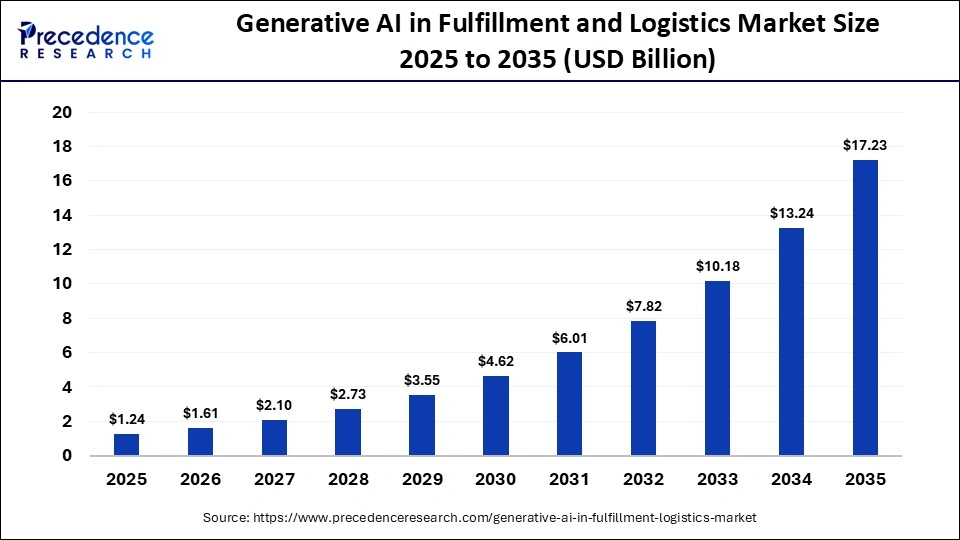
The global generative AI in fulfillment and logistics market size was valued at USD 1.24 billion in 2025 and is projected to grow from USD 1.61 billion in 2026 to approximately USD 17.23 billion by 2035, registering a remarkable CAGR of 30.10% during the forecast period.
The market is witnessing rapid expansion driven by the increasing need for efficient supply chain management, cost optimization, and warehouse automation. The integration of cloud computing and artificial intelligence is revolutionizing logistics operations by enabling real-time decision-making and automation across fulfillment networks.
Read Also: Micro Location Technology Market
Key Takeaways
- North America dominated the market with 37.6% share in 2025
- Asia-Pacific is expected to grow at the fastest CAGR
- Software segment led with 72.5% market share
- Cloud deployment dominated with 61.7% share
- Route and load optimization held 20.3% share in 2025
- E-commerce & retail emerged as the leading end-use industry
Market Overview
Generative AI in fulfillment and logistics refers to the use of advanced AI models to optimize supply chain operations, including:
- Warehouse automation
- Inventory management
- Transportation planning
- Demand forecasting
- Customer communication
These AI-driven systems enable companies to simulate logistics scenarios, automate workflows, and enhance operational efficiency, ultimately reducing costs and improving delivery performance.
With the rise of global trade and e-commerce, logistics networks are becoming increasingly complex. Generative AI provides a powerful solution by enabling predictive analytics, autonomous decision-making, and intelligent orchestration.
Role of Generative AI in Logistics
Generative AI is transforming fulfillment and logistics through several key capabilities:
1. Simulation and Risk Management
AI models create digital simulations of supply chains to identify risks and optimize operations before real-world execution.
2. Intelligent Automation
Automation of documentation, compliance checks, and workflows significantly reduces manual errors and processing time.
3. Customer Service Enhancement
AI-powered chatbots provide real-time shipment updates, resolve queries, and improve customer satisfaction.
4. Predictive Decision-Making
Generative AI enables accurate demand forecasting and resource allocation using historical and real-time data.
Market Dynamics
Driver: Operational Efficiency and Cost Reduction
Generative AI helps logistics companies:
- Reduce transportation delays
- Optimize warehouse utilization
- Lower operational costs
- Improve delivery timelines
Automated workflows and predictive insights significantly enhance supply chain responsiveness.
Restraint: High Implementation Costs
Despite its benefits, adoption is limited due to:
- High infrastructure investment
- Expensive AI software and licensing
- Need for skilled workforce
- Integration complexity with legacy systems
Opportunity: Integration with Advanced Technologies
The future of the market lies in integration with:
- Machine learning
- Computer vision
- Robotics
- IoT-enabled systems
These technologies enhance automation, predictive maintenance, and real-time analytics, creating new growth opportunities.
Key Market Trends
1. Rise of Autonomous AI Agents
AI agents are capable of managing complex logistics tasks such as planning, coordination, and execution.
2. Warehouse Automation
Automation technologies are improving picking, sorting, and inventory management efficiency.
3. Smart Route Optimization
Dynamic route planning reduces fuel consumption and enhances delivery speed.
4. AI-Powered Control Towers
Real-time monitoring systems enable proactive decision-making and disruption management.
Segmental Insights
By Component
- Software dominated the market due to its role in planning, optimization, and analytics
- Services are expected to grow fastest, driven by implementation and consulting needs
By Deployment Mode
- Cloud led the market due to scalability and cost-effectiveness
- Hybrid is the fastest-growing segment, offering flexibility and data security
By Function
- Transportation management dominated due to real-time tracking and predictive optimization
- Fulfillment orchestration is expected to grow fastest due to automation and coordination capabilities
By Application
- Route and load optimization led the market
- Control tower and simulation is the fastest-growing segment
By End-Use Industry
- E-commerce & retail dominated due to high demand for fast deliveries
- Healthcare & pharmaceuticals is the fastest-growing segment due to cold-chain and precision logistics requirements
Regional Insights
North America
North America dominated the market due to:
- Advanced technological infrastructure
- High adoption of AI and automation
- Strong presence of logistics and e-commerce giants
- Increasing demand for real-time analytics
Asia-Pacific
Asia-Pacific is expected to grow at the fastest rate due to:
- Rapid e-commerce expansion
- Increasing warehouse automation
- Growing adoption of AI and robotics
- Rising demand for efficient logistics solutions
Countries like China and India are leading growth with smart warehouses and AI-driven logistics systems.
Competitive Landscape
Major players operating in the market include:
- Microsoft Corporation
- Amazon Web Services
- Google Cloud
- Oracle Corporation
- International Business Machines Corporation
- NVIDIA Corporation
- SAP SE
These companies are focusing on AI innovation, partnerships, and cloud-based solutions to strengthen their market position.
Recent Developments
- March 2026: Yusen Logistics partnered with Rabot Inc. to deploy Vision AI technology for improving packing accuracy and productivity.
- June 2025: Amazon deployed its 1 millionth robot, enhancing warehouse automation with generative AI capabilities.
Conclusion
The generative AI in fulfillment and logistics market is set for exponential growth over the next decade. With a CAGR of over 30%, the market is being driven by the need for automation, efficiency, and intelligent decision-making.
As companies continue to adopt AI-powered logistics solutions, the industry will move towards fully autonomous, data-driven supply chains, redefining global logistics operations.
Get Sample Copy: https://www.precedenceresearch.com/sample/8236
For inquiries regarding discounts, bulk purchases, or customization requests, please contact us at sales@precedenceresearch.com

- Single Loop Controller Market Size to Hit USD 6.85 Billion by 2035 - March 31, 2026
- Surface Roughness Measurement Market Size to Hit USD 2.27 Billion by 2035 - March 31, 2026
- 8k Technology Market Size to Hit USD 657.82 Billion by 2035 - March 31, 2026
