
 by
by Lined Valve Market: Size, Trends, and Regional Outlook (2026–2035)
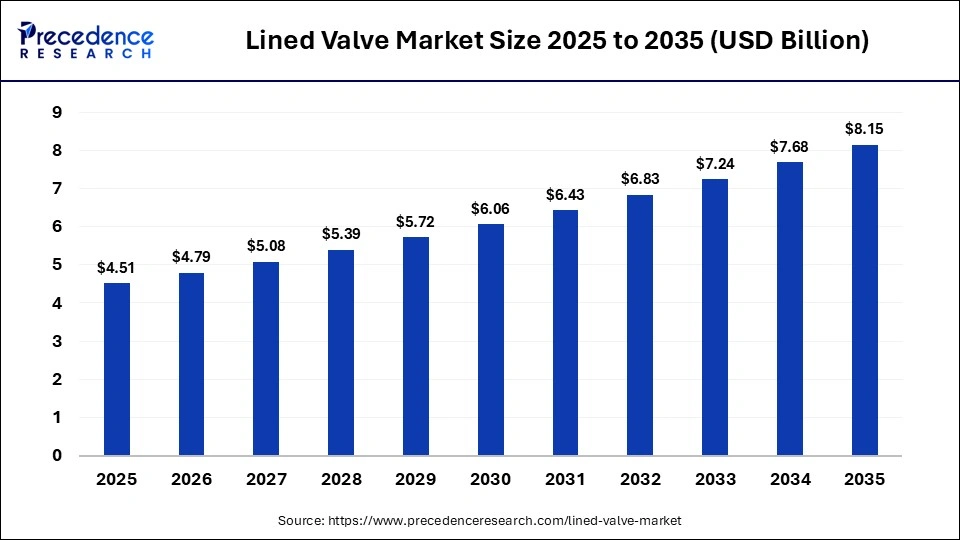
The global lined valve market is on a steady growth path, driven by rising demand for corrosion‑resistant solutions in chemical processing, pharmaceuticals, water treatment, and industrial sectors. According to market estimates, the industry was valued at USD 4.51 billion in 2025, is expected to reach USD 4.79 billion in 2026, and is projected to grow to USD 8.15 billion by 2035, expanding at a CAGR of 6.10% from 2026 to 2035.
This article explores what lined valves are, key growth drivers, market segments, and regional outlook for the global lined valve industry.
Read Also: Visible Light Range Scientific Camera Market
What Are Lined Valves?
Lined valves are industrial valves whose internal surfaces are coated with a corrosion‑resistant material such as PTFE, PFA, FEP, ETFE, or rubber linings. The lining protects the valve body from aggressive chemicals, acids, solvents, and other corrosive fluids, while enabling reliable flow control in harsh environments.
These valves are widely used in:
-
Chemical processing and petrochemical industries
-
Pharmaceutical and biotech manufacturing
-
Water and wastewater treatment plants
-
Oil & gas, pulp & paper, and mining
Lined valves help prevent equipment corrosion, fluid contamination, and leaks, improving safety and reducing maintenance costs in industrial systems.
Market Size and Growth (2025–2035)
The lined valve market is expanding gradually but consistently, supported by stricter safety regulations and the growth of process‑intensive industries.
Key figures:
-
Market size in 2025: USD 4.51 billion
-
Market size in 2026 (estimated): USD 4.79 billion
-
Market size by 2035 (projected): USD 8.15 billion
-
CAGR from 2026 to 2035: 6.10%
The forecast period is shaped by industrial modernization, infrastructure investment, and tighter environmental and safety standards, all of which are pushing industries to adopt high‑performance lined valves for leak‑free fluid control.
How AI Is Changing Lined Valve Systems
Artificial intelligence (AI) is increasingly being integrated into valve monitoring and control systems, transforming how lined valves are operated and maintained.
AI‑based applications include:
-
Smart monitoring systems that track valve status, pressure, temperature, and fluid flow in real time.
-
Predictive maintenance tools that analyze sensor data to detect early signs of wear or failure, reducing unplanned downtime.
-
Automated valve control in chemical plants and oil & gas facilities, optimizing flow and improving process efficiency.
In manufacturing, AI is also used for quality control, helping producers detect defects in valve linings and castings, which improves product reliability and reduces waste.
Key Market Trends
Several structural and technological trends are shaping the lined valve market landscape.
1. Rising Demand from Chemical and Petrochemical Industries
Chemical and petrochemical plants handle large volumes of corrosive acids, solvents, and aggressive media, which require high‑integrity lined valves. The growth of these sectors is one of the main drivers of the market, as plants seek durable, leak‑tight solutions to protect equipment and personnel.
2. Shift Toward Advanced Lining Materials
Fluoropolymer linings such as PTFE, PFA, FEP, and ETFE are gaining popularity due to their excellent chemical resistance, thermal stability, and low friction. These materials extend the service life of valves and reduce maintenance costs, especially in high‑temperature and high‑pressure environments.
3. Emphasis on Industrial Safety and Environmental Protection
Stricter safety and environmental regulations are pushing industries to replace standard valves with high‑quality lined alternatives to minimize leaks and chemical exposure. This is especially relevant in chemical processing, pharmaceuticals, and wastewater treatment, where contamination risks are high.
4. Expansion of Water and Wastewater Treatment Infrastructure
Growing investments in water and wastewater treatment plants—particularly in emerging economies—are increasing demand for lined valves that can handle chlorine, acids, and saline solutions over long periods. Governments and private operators are upgrading facilities to ensure safe, efficient water supply and treatment.
5. Adoption of Smart Monitoring and Automation
Industries are integrating smart sensors and automated valve systems to improve process control, reduce manual intervention, and lower operating costs. Lined valves are increasingly sold as part of automated flow‑control packages, especially in chemical and oil & gas plants.
Market Segments at a Glance
The lined valve market is segmented by product type, lining material, end‑user industry, distribution channel, and region.
Product Type (Market Share, 2025)
-
Ball valves dominate due to their quarter‑turn operation, simple design, and reliable shut‑off performance in corrosive and hazardous‑fluid applications.
-
Butterfly valves are popular for large‑diameter pipelines because they are lightweight, compact, and cost‑effective.
-
Plug and gate valves are used where full‑bore flow or tight shutoff is required, while diaphragm and globe valves are preferred for precise throttling and sanitary/clean‑fluid handling.
Lining Material (Market Share, 2025)
-
PTFE (Polytetrafluoroethylene) is the most widely used lining thanks to its chemical inertness, low friction, and performance in harsh media.
-
PFA is growing faster, favored in high‑pressure, high‑temperature, and semiconductor/pharma applications.
-
FEP and ETFE offer strong thermal and mechanical properties for industrial and food‑grade applications.
End‑User Industries (Key Shares)
-
Chemical processing: Led the market in 2025, handling acids, solvents, and aggressive chemicals.
-
Water and wastewater treatment: Expected to see the highest growth, driven by infrastructure projects and water‑scarcity concerns.
-
Other major segments: Oil & gas, pharmaceutical, food & beverage, petrochemical, pulp & paper, mining, and others.
Distribution Channels
-
Direct sales from manufacturers dominate because industries often require customized valves, technical support, and service contracts for critical applications.
-
Indirect channels (distributors and suppliers) help improve spare‑part availability and regional reach, especially in large infrastructure projects.
Regional Outlook
The lined valve market is analyzed across North America, Europe, Asia‑Pacific, Latin America, and the Middle East & Africa.
North America: Market Leader
-
North America held the largest market share (around 35% in 2025) and is expected to remain dominant through 2035.
-
The U.S. alone was valued at USD 1.18 billion in 2025 and is projected to reach nearly USD 2.18 billion by 2035, at a CAGR of 6.33%.
Key drivers in North America include:
-
Strong chemical, oil & gas, and pharmaceutical sectors requiring corrosion‑resistant valves.
-
Government and private investment in industrial modernization and automation.
-
Stringent environmental and safety regulations that push adoption of high‑performance lined valves.
Asia‑Pacific: Fastest‑Growing Region
-
The Asia‑Pacific region is expected to grow at the fastest CAGR (around 6.9% or higher) during 2026–2035.
-
Countries such as China, India, and Japan are expanding their chemical plants, energy infrastructure, and water‑treatment facilities, all of which consume lined valves.
China in particular is a major growth engine, driven by:
-
Large‑scale chemical and petrochemical production.
-
Rising investments in water treatment, power plants, and industrial infrastructure.
-
Growing awareness of safety and environmental compliance, encouraging adoption of lined valves.
Europe: Steady Growth
-
Europe is projected to grow at a notable CAGR, supported by a mature industrial base and strict EU environmental standards.
-
Investments in water and wastewater infrastructure, industrial automation, and advanced manufacturing are boosting demand for high‑performance valves.
The UK market, for example, is driven by needs in chemical processing, pharmaceuticals, and water treatment, where leak‑free, corrosion‑resistant valves are essential.
Value Chain and Key Companies
The lined valve value chain spans material suppliers, valve manufacturers, testing and coating specialists, distributors, and end‑user industries.
Major Players in the Market
Leading companies in the global lined valve market include:
-
Emerson Electric Co.
-
Flowserve Corporation
-
Georg Fischer Ltd.
-
KITZ Corporation
-
Crane Company
-
SAMSON AG
-
AVK Holding A/S
-
ITT Inc.
-
Bray International
-
Richter Chemie‑technik GmbH (Idex Corporation)
-
Chemvalve‑Schmid AG
-
Asahi Yukizai Corporation / Asahi/America
-
Unp Polyvalves (India) Pvt. Ltd.
-
Nivz Valves & Automation
-
Frenstar Valves Ltd
-
Aira Euro Automation Pvt. Ltd.
-
ICON Valves & Engineering Pvt. Ltd.
-
Andronaco Industries (Chemtite)
-
Chemtech Polyplast Private Limited
-
Bflon
-
Zhejiang Youfumi Valve Co., Ltd.
-
Lianke Valve Co., Ltd
-
MVS Valves Pvt. Ltd.
-
Galaxy Thermoplast
-
Flow Line Valve Pvt. Ltd.
-
Polycoat Flowchem
Recent Developments
-
In March 2024, Valworx expanded its sanitary butterfly valve line, offering a cost‑effective alternative to sanitary ball valves with polished internals and FDA‑approved seals.
-
Also in March 2024, Valworx launched a new line of V‑port stainless steel ball valves designed for precise flow control, providing a more linear flow characteristic through the V‑shaped plug.
Get Sample Report: https://www.precedenceresearch.com/sample/8269
For inquiries regarding discounts, bulk purchases, or customization requests, please contact us at sales@precedenceresearch.com

