
 by
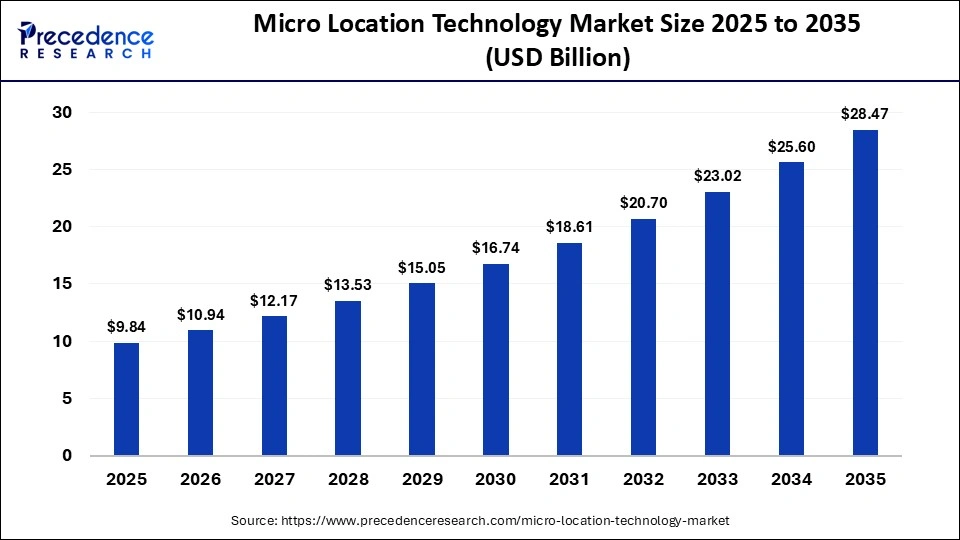
by The global micro location technology market is on a strong growth trajectory, driven by innovations in Bluetooth Low Energy (BLE), Ultra Wideband (UWB), and the Internet of Things (IoT). In 2025, the market was valued at USD 9.84 billion and is expected to grow to USD 10.94 billion in 2026, reaching approximately USD 28.47 billion by 2035 at a CAGR of 11.21%.
Technological advancements and the growing adoption of precise tracking solutions are fueling demand across industries including healthcare, retail, industrial, and consumer electronics.
Read Also: Nuclear Medicine Equipment Market
Key Takeaways from the Micro Location Technology Market
- Dominant Region (2025): North America held the largest market share at 38%.
- Fastest-Growing Region: Asia-Pacific is expected to record the highest CAGR during the forecast period.
- Technology Insights:
- BLE led the global market in 2025.
- UWB is expected to grow at the fastest rate from 2026 to 2035.
- Application Insights:
- Retail dominated the market in 2025.
- Healthcare is forecasted to grow at the highest CAGR.
- Deployment Type Insights:
- Cloud-based deployment held a dominant position in 2025.
- On-premises deployment is projected to expand rapidly.
- End-Use Insights:
- Smartphones held the largest market share in 2025.
- Wearable devices are expected to grow the fastest.
What is Micro Location Technology?
Micro-location technology enables highly precise tracking of people and assets, typically accurate within centimeters. Unlike geofencing, which creates virtual boundaries, micro-location allows real-time detection of positions and movement.
Ultra Wideband (UWB) technology is gaining traction due to its cost-effectiveness and superior accuracy, particularly in sports, retail, healthcare, and commercial applications. Additionally, it enhances accident prevention by enabling communication between pedestrians, cyclists, and connected vehicles within a 200-meter radius.
Role of Artificial Intelligence in Micro Location Technology
Artificial Intelligence (AI) is becoming integral to micro-location solutions, enabling:
- Predictive analytics for better decision-making.
- Enhanced contextual insights for operational efficiency.
- Support for green technology innovation in low-carbon production environments.
AI adoption varies across industries depending on technology intensity, regulatory requirements, and innovation capacity, influencing how micro-location technologies are integrated and optimized.
Key Market Trends
- Hybrid BLE & UWB Beacons
- Achieve high-precision tracking within ~30 cm.
- Maintain long battery life and low installation complexity.
- Ideal for industrial and asset management applications.
- Bluetooth 5.1 Advancements
- Improves accuracy and direction-finding capabilities.
- Enables reliable indoor navigation in complex environments.
- Integration with IoT
- Creates smarter, connected environments.
- Enables real-time responses to movement of people and assets.
Market Scope
| Report Coverage | Details |
|---|---|
| Market Size (2025) | USD 9.84 Billion |
| Market Size (2026) | USD 10.94 Billion |
| Market Size (2035) | USD 28.47 Billion |
| CAGR (2026–2035) | 11.21% |
| Dominant Region | North America |
| Fastest Growing Region | Asia-Pacific |
| Base Year | 2025 |
| Forecast Period | 2026–2035 |
| Segments Covered | Technology, Application, Deployment Type, End-Use, Region |
| Regions Covered | North America, Europe, Asia-Pacific, Latin America, Middle East & Africa |
Market Dynamics
Drivers:
- Innovations in UWB & BLE with advanced technology upgrades.
- Accurate, low-power, and real-time positioning across industries.
Restraints:
- Concerns around data security and privacy due to tracking without consent.
Opportunities:
- Expanding use of beacon technology in retail for personalized marketing and inventory optimization.
Segmental Insights
Technology Insights
- Bluetooth Low Energy (BLE) dominated in 2025 due to long battery life, low cost, and broad adoption.
- Ultra-Wideband (UWB) expected to grow fastest, offering high-precision positioning, low interference, strong security, and low power consumption.
Application Insights
- Retail dominated in 2025 with improved operational efficiency, in-store navigation, and theft prevention.
- Healthcare projected to grow fastest, driven by real-time tracking of medical equipment, patients, and staff.
Deployment Type Insights
- Cloud-based solutions dominate due to operational flexibility and energy efficiency.
- On-premises solutions expected to grow rapidly due to enhanced security and regulatory compliance.
End-Use Insights
- Smartphones hold the largest share, integrating BLE, UWB, NFC, and Wi-Fi.
- Wearable devices expected to grow fastest, leveraging sensors and connectivity for precise tracking.
Regional Insights
North America
- Market size: USD 3.74 billion (2025) → USD 10.96 billion (2035)
- CAGR: 11.35%
- Growth driven by healthcare, retail, industrial adoption, and strong IT infrastructure.
United States
- Market size: USD 2.80 billion (2025) → USD 8.28 billion (2035)
- Early adoption of BLE- and RFID-based RTLS solutions for patient and asset tracking.
Asia-Pacific
- Fastest-growing region due to smartphone adoption, smart city initiatives, retail modernization, and logistics demand.
- China is leading with investments in sensor networks, 5G-enabled micro-location, and smart hospital programs.
Leading Companies in the Micro Location Technology Market
- Cisco Systems, Inc.
- Aruba Networks (HPE)
- Zebra Technologies Corporation
- Siemens AG
- Ruckus Networks (CommScope)
- Kontakt.io
- Estimote, Inc.
- Ubisense Ltd.
- CenTrak, Inc.
- Sewio Networks
- BlueCats
- Humatics Corporation
- Apple Inc.
- Google LLC (Alphabet)
- HERE Technologies
Recent Developments
- Smart Dust Technology (Sept 2025): Tiny wireless sensors capable of massive data collection for industries like healthcare and environmental monitoring, raising privacy concerns.
- U.S. Embedded Tracking (Aug 2025): Authorities embedded tracking devices in high-risk chip shipments to prevent illegal diversion, highlighting security applications of micro-location technology.
Market Segmentation Summary
- By Technology: BLE, Wi-Fi Positioning, UWB, NFC
- By Application: Retail, Hospitality, Healthcare, Transport & Logistics
- By Deployment Type: On-Premises, Cloud-Based
- By End-Use: Consumer Electronics, Smartphones, Wearables, IoT Devices
- By Region: North America, Latin America, Europe, Asia-Pacific, Middle East & Africa
Conclusion
The micro location technology market is set for exponential growth over the next decade. With BLE, UWB, and IoT driving adoption, industries from healthcare to retail are leveraging precise tracking solutions to improve efficiency, safety, and customer experiences. Cloud-based solutions, AI integration, and wearable devices are emerging as key growth areas, while privacy and data security remain critical considerations.
Businesses and technology leaders investing in micro-location solutions are likely to gain a competitive edge by enhancing operational efficiency and offering smarter, personalized experiences to customers.
Get Sample Copy: https://www.precedenceresearch.com/sample/8238
For inquiries regarding discounts, bulk purchases, or customization requests, please contact us at sales@precedenceresearch.com.

- Single Loop Controller Market Size to Hit USD 6.85 Billion by 2035 - March 31, 2026
- Surface Roughness Measurement Market Size to Hit USD 2.27 Billion by 2035 - March 31, 2026
- 8k Technology Market Size to Hit USD 657.82 Billion by 2035 - March 31, 2026
