
 by
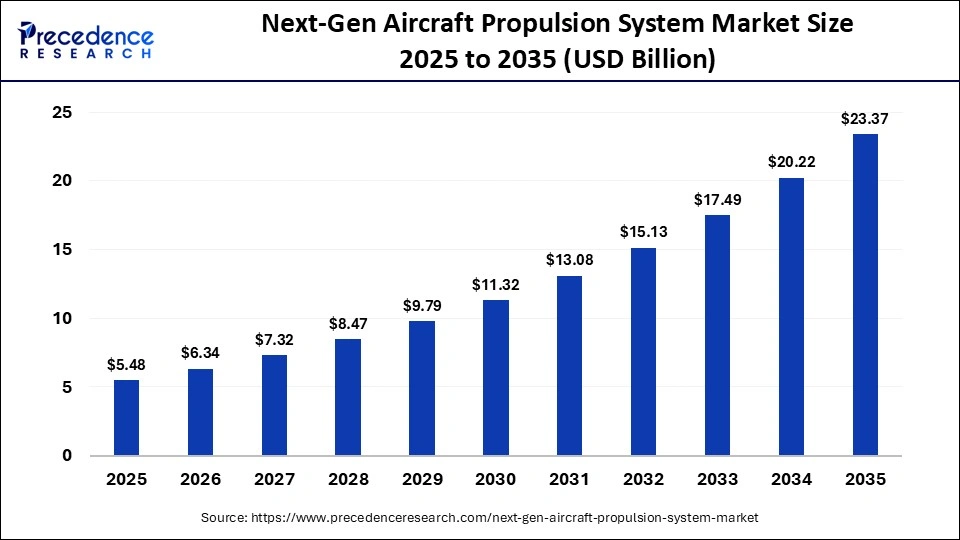
by The global next-generation aircraft propulsion system market is entering a transformative era, driven by sustainability goals, rapid technological innovation, and rising global air travel demand. The market size is projected to grow from USD 6.34 billion in 2026 to approximately USD 23.37 billion by 2035, expanding at a strong CAGR of 15.61%.
As the aviation industry shifts toward greener and more efficient operations, next-gen propulsion technologies such as hybrid-electric, hydrogen, and fully electric systems are becoming central to the future of flight.
Read Also: Electronic Control Access Systems Market
Market Overview: A Shift Toward Sustainable Aviation
The next-gen aircraft propulsion system market focuses on developing advanced engine technologies that reduce carbon emissions while improving operational efficiency. Traditional jet engines are being gradually complemented—and in some cases replaced—by innovative propulsion solutions.
Leading aerospace companies like Airbus SE and Boeing Company are heavily investing in sustainable propulsion systems, including hydrogen-powered and hybrid-electric engines.
Key growth factors include:
- Rising environmental regulations and decarbonization goals
- Increasing global air passenger traffic
- Demand for fuel-efficient and cost-effective aviation solutions
- Advancements in battery and fuel cell technologies
How AI is Transforming Aircraft Propulsion
Artificial intelligence is playing a critical role in revolutionizing aircraft propulsion systems.
Companies like General Electric are integrating AI into propulsion systems to:
- Optimize engine performance in real time
- Improve fuel efficiency and reduce emissions
- Enable predictive maintenance using IoT sensors
- Reduce operational downtime and maintenance costs
AI-driven design and analytics are accelerating innovation across hybrid, electric, and hydrogen propulsion technologies.
Key Market Trends Driving Growth
1. Push Toward Zero-Emission Flights
The aviation sector is actively working toward carbon neutrality. Hydrogen propulsion and sustainable aviation fuels (SAFs) are gaining strong traction globally.
2. Rise of Hybrid and Electric Propulsion
Hybrid-electric systems are emerging as a practical solution for near-term adoption, bridging the gap between conventional engines and fully electric aircraft.
3. Advanced Jet Engine Innovations
Next-generation engines such as advanced turbofans are improving fuel efficiency and reducing weight through materials like ceramic matrix composites.
4. Integration of AI and IoT
Real-time monitoring, predictive maintenance, and performance optimization are becoming standard features in modern propulsion systems.
Market Dynamics
Driver: Military Modernization
Global defense forces are investing heavily in next-gen propulsion systems to power 5th and 6th-generation aircraft. Organizations like the U.S. Department of Defense are driving innovation through significant R&D funding.
Restraint: Technological Limitations
Current battery technologies lack the energy density required for long-haul electric flights, limiting scalability.
Opportunity: Sustainable Aviation Engines
There is a growing opportunity in engines compatible with biofuels such as HEFA and synthetic fuels, enabling immediate emission reductions without major infrastructure changes.
Segment Insights
By Propulsion Type
- Conventional turbofan/turboprop dominated with 58% share (2025)
- Hybrid-electric propulsion is the fastest-growing segment
- Hydrogen and fully electric systems are gaining momentum
By Component
- Engine systems led with 50% share
- Energy storage systems are rapidly growing due to electrification trends
By Platform
- Commercial aircraft dominated with 52% share
- Urban Air Mobility (UAM) is the fastest-growing segment, driven by eVTOL innovation
By Technology
- Conventional propulsion still leads
- Hybrid propulsion is expected to grow the fastest due to its balanced efficiency and sustainability
Segments Covered in the Report
By Propulsion Type
- Conventional Turbofan/Turboprop
- Hybrid-Electric Propulsion
- Fully Electric Propulsion
- Hydrogen Propulsion
By Component
- Engine Systems
- Energy Storage Systems
- Power Electronics
- Thermal Management Systems
By Platform
- Commercial Aircraft
- Military Aircraft
- Urban Air Mobility (UAM)
- General Aviation
By Technology
- Conventional Propulsion
- Electric Propulsion
- Hybrid Propulsion
By Region
- North America
- Latin America
- Europe
- Asia-pacific
- Middle and East Africa
Get Sample: https://www.precedenceresearch.com/sample/8266
For inquiries regarding discounts, bulk purchases, or customization requests, please contact us at sales@precedenceresearch.com

