
 by
by What is the Power EPC Market Size in 2026?
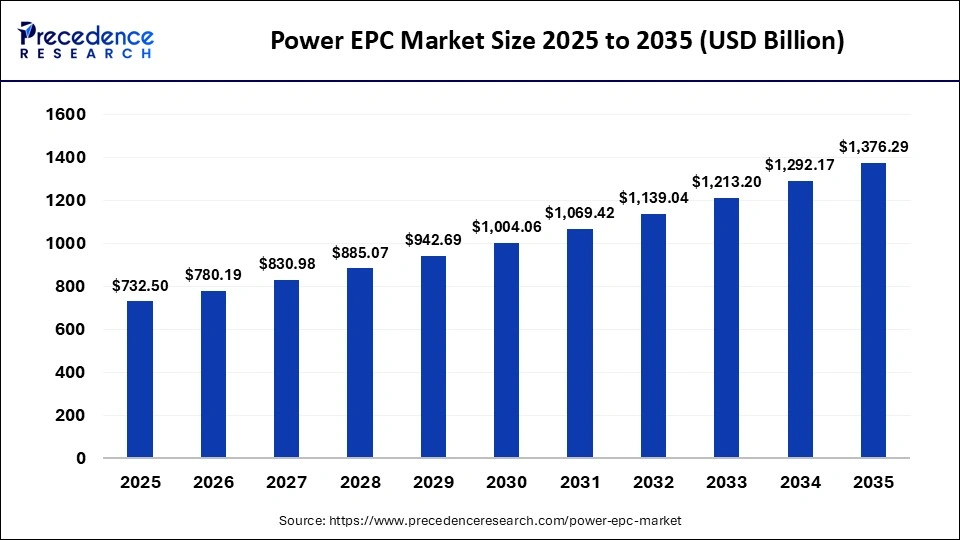
The global power EPC market size was valued at USD 732.50 billion in 2025 and is projected to grow from USD 780.19 billion in 2026 to approximately USD 1,376.29 billion by 2035, expanding at a CAGR of 6.51% from 2026 to 2035.
The market is experiencing significant growth due to increasing global energy demand, modernization of electricity grids, and a strong shift toward renewable energy sources. Rapid industrialization and urbanization worldwide are further driving investments in power infrastructure projects, creating strong opportunities for EPC contractors.
Read Also: Financial Smart Cards Market
Power EPC Market Overview
The term EPC (Engineering, Procurement, and Construction) refers to a project delivery model where a single contractor manages an entire project from design and engineering to procurement, construction, and commissioning.
Power EPC companies typically handle large-scale infrastructure projects, including:
-
Power generation plants
-
Transmission lines
-
Substations
-
Grid modernization projects
The EPC model is widely adopted in industries such as power, oil & gas, chemicals, and manufacturing, as it allows project owners to rely on specialized contractors for efficient project management while focusing on their core business operations.
Increasing investments in renewable power plants, transmission networks, and smart grid technologies are accelerating the growth of the global power EPC market.
Key Takeaways
-
Asia-Pacific dominated the market with a 38% share in 2025 and is expected to remain the fastest-growing region.
-
By power generation type, the thermal power segment held the largest market share in 2025.
-
The renewable energy segment (solar, wind, hydro) is projected to grow at the fastest CAGR during the forecast period.
-
By service type, the engineering segment accounted for the largest revenue share in 2025.
-
The procurement segment is expected to grow at the highest CAGR between 2026 and 2035.
-
By equipment type, steam turbines dominated the market in 2025, while gas turbines are expected to expand rapidly in the coming years.
Role of Artificial Intelligence in the Power EPC Market
Artificial Intelligence (AI) is transforming the EPC industry by enabling companies to predict project risks, optimize resources, and improve operational efficiency.
AI-driven EPC solutions help contractors analyze historical project data to identify potential challenges early. This enables project teams to address issues proactively and minimize schedule delays.
Key benefits of AI in the power EPC sector include:
-
Improved project planning and scheduling
-
Reduced human error in construction management
-
Automated documentation and contract analysis
-
Enhanced decision-making using predictive analytics
Advanced technologies such as machine learning and natural language processing (NLP) are also used to analyze contracts, claims, project communications, and regulatory documents. These systems extract critical information and create structured knowledge graphs that improve long-term project management and compliance.
Power EPC Market Trends
Renewable Energy Expansion
The global shift toward renewable energy is one of the strongest drivers of the power EPC market. Governments and private investors are heavily funding solar, wind, and hydropower projects to meet decarbonization goals and reduce dependence on fossil fuels.
Renewable energy infrastructure development is generating significant revenue opportunities for EPC contractors responsible for designing, building, and commissioning renewable power plants.
Digitization and Technology Adoption
Digital technologies such as Building Information Modeling (BIM) are revolutionizing the EPC workflow. BIM supports advanced 3D modeling and 7D project management, integrating cost and sustainability factors.
These technologies help companies:
-
Reduce engineering hours
-
Prevent design conflicts
-
Minimize construction delays
-
Optimize material usage
Sustainability in Project Execution
Sustainable construction practices are increasingly being adopted in EPC projects. Companies are implementing green building technologies, circular construction models, and smart energy systems to reduce environmental impact.
Many power infrastructure projects now aim to achieve global sustainability certifications such as:
-
LEED
-
WELL
-
BREEAM
These initiatives help EPC firms meet environmental regulations and client expectations while improving long-term operational efficiency.
Power EPC Market Segment Insights
Type of Power Generation Insights
Thermal Power Segment
The thermal power segment dominated the market in 2025 due to its ability to deliver reliable baseload electricity at relatively lower initial costs.
Thermal plants offer several advantages:
-
Continuous power generation
-
High efficiency for large-scale production
-
Stable grid support
In many developing economies, thermal power plants remain essential for supporting industrialization and urban electricity demand.
Renewable Energy Segment
The renewable energy segment (solar, wind, hydro) is expected to grow at the fastest CAGR during the forecast period.
Rapid technological advancements and supportive government policies have significantly improved the economic feasibility of renewable power generation. Solar and wind power are increasingly becoming more cost-effective compared to traditional fossil fuel plants.
Global efforts to combat climate change are encouraging countries to transition toward clean energy infrastructure, which is expected to drive strong EPC investments.
Service Insights
Engineering Segment
The engineering segment held the largest share of the power EPC market in 2025.
Power projects require complex planning, design, and grid integration solutions, especially with the growing adoption of renewable energy systems and smart grids.
Engineering services are essential for:
-
Site selection
-
Grid integration planning
-
Plant layout optimization
-
Energy efficiency improvements
Procurement Segment
The procurement segment is projected to grow at the highest CAGR during the forecast period.
Procurement plays a critical role in sourcing essential equipment such as turbines, generators, solar modules, and transformers. With the expansion of large-scale renewable projects, EPC firms must manage global supply chains efficiently to avoid project delays and cost overruns.
Equipment Insights
Steam Turbines Segment
The steam turbines segment dominated the market in 2025 due to its reliability and high efficiency in large-scale power generation.
Steam turbines are widely used in
-
Coal power plants
-
Nuclear facilities
-
Biomass energy systems
-
Solar thermal plants
They offer long operational lifespans and relatively low maintenance requirements.
Gas Turbines Segment
The gas turbines segment is expected to grow rapidly in the coming years.
Gas turbines provide high efficiency, lower emissions, and faster startup capabilities, making them ideal for supporting renewable energy integration and maintaining grid stability.
Combined-cycle gas turbine plants are particularly attractive due to their ability to deliver higher efficiency with reduced environmental impact.
For inquiries regarding discounts, bulk purchases, or customization requests, please contact us at sales@precedenceresearch.com

- Managed DNS Services Market Size to Hit USD 2,288.60 Million by 2035 - March 5, 2026
- Power EPC Market Size to Hit USD 1,376.29 Billion by 2035 - March 5, 2026
- Ursolic Acid Market Size to Hit USD 68.77 Billion by 2035 - March 5, 2026
