
 by
by Market Size Overview
The global single loop controller market is experiencing steady growth, driven by increasing industrial automation and demand for precise process control systems. The market size was valued at USD 4.11 billion in 2025 and is projected to grow from USD 4.33 billion in 2026 to approximately USD 6.85 billion by 2035, expanding at a CAGR of 5.24% during the forecast period.
This consistent growth highlights the critical role of single loop controllers in ensuring operational efficiency, safety, and product quality across industries such as oil & gas, manufacturing, and water treatment.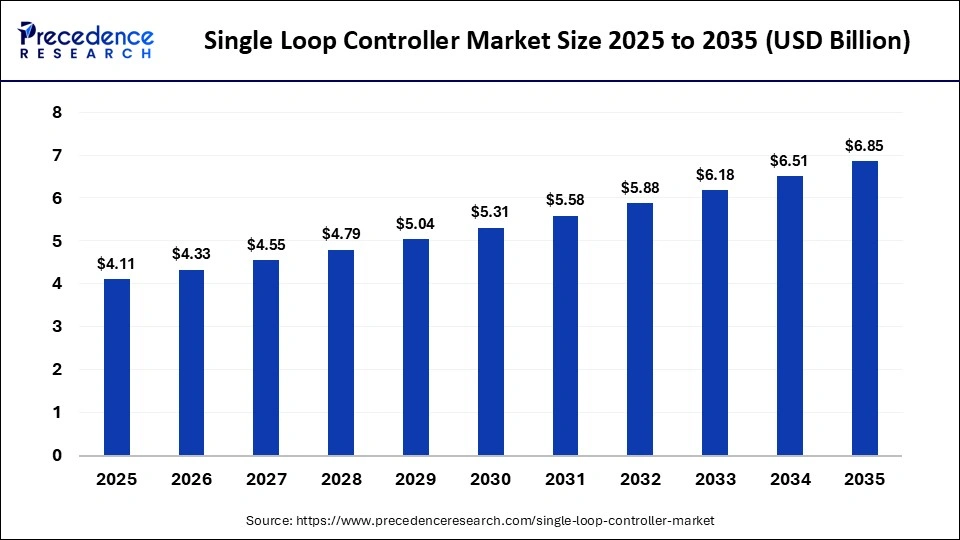
Read Also: Surface Roughness Measurement Market
What is a Single Loop Controller?
A single loop controller is an industrial control device used to regulate one process variable—such as temperature, pressure, flow, or level—within a closed-loop system. It continuously receives input from sensors, compares it with a predefined setpoint, and adjusts outputs to maintain stability.
These controllers are widely used in:
- Power plants
- Chemical processing units
- Oil refineries
- Food & beverage industries
- Water and wastewater treatment plants
Their simplicity, reliability, and cost-effectiveness make them indispensable in both traditional and modern industrial environments.
Key Market Highlights
- North America dominated the market with a 41% share in 2025
- Asia-Pacific is expected to grow at the fastest CAGR
- Temperature control led by application segment
- Pressure control is the fastest-growing application
- PID controllers held the largest market share
- Smart controllers are gaining rapid adoption
- Panel-mounted controllers dominated installation type
- Oil & gas industry remained the leading end-use segment
Role of AI in Single Loop Controllers
Artificial Intelligence is reshaping the capabilities of traditional control systems. Modern single loop controllers are no longer limited to fixed logic—they are becoming adaptive, predictive, and intelligent systems.
Key AI-driven advancements:
- Predictive Control: AI anticipates process deviations before they occur
- Self-Tuning Systems: Controllers automatically adjust parameters for optimal performance
- Anomaly Detection: Early identification of faults reduces downtime
- Remote Monitoring: Integration with cloud and IoT enables real-time control
These innovations are transforming single loop controllers into smart industrial assets, aligned with Industry 4.0 goals.
Market Dynamics
Driver: Rising Industrial Automation
The rapid adoption of automation technologies across industries is a major growth driver. Manufacturers are increasingly deploying control systems to:
- Improve production accuracy
- Reduce human intervention
- Enhance operational efficiency
- Maintain consistent product quality
Single loop controllers play a foundational role in achieving these objectives.
Restraint: High Initial and Maintenance Costs
Despite their benefits, adoption can be limited due to:
- High installation costs
- Integration challenges with legacy systems
- Ongoing maintenance and calibration expenses
These factors particularly affect small and medium-sized enterprises operating in cost-sensitive markets.
Opportunity: Advancements in Smart Manufacturing
The emergence of Industry 4.0, IoT, and smart factories is opening new growth avenues. Modern controllers now feature:
- Digital communication protocols
- Cloud connectivity
- Real-time analytics
- Seamless IoT integration
This evolution is expected to significantly boost demand for next-generation controllers.
Market Trends
1. Growing Adoption of Smart Controllers
Smart controllers with AI and IoT capabilities are replacing traditional systems, offering better efficiency and flexibility.
2. Increasing Focus on Energy Efficiency
Industries are leveraging controllers to reduce energy consumption and operational costs while maintaining optimal performance.
3. Expansion in Emerging Economies
Rapid industrialization in countries like India and China is driving demand for affordable and reliable control systems.
Segment Insights
By Application
Temperature Control (Dominant Segment)
Temperature regulation is critical across industries such as pharmaceuticals, food processing, and manufacturing. The need for precision makes this segment the largest contributor.
Pressure Control (Fastest Growing)
Demand is rising in industries like oil & gas and chemicals, where maintaining pressure is crucial for safety and efficiency.
By Controller Type
PID Controllers (Market Leader)
PID controllers remain dominant due to their reliability, simplicity, and widespread industrial use.
Smart Controllers (Fastest Growing)
These controllers offer advanced features such as predictive maintenance, remote monitoring, and adaptive control, making them ideal for modern industries.
By Installation Type
Panel-Mounted Controllers (Dominant)
Widely used due to ease of installation, centralized control, and compatibility with existing systems.
Field-Mounted Controllers (Emerging Growth)
Ideal for harsh environments, offering faster response times and reduced wiring complexity.
By End-Use Industry
Oil & Gas (Leading Segment)
High demand for precise monitoring and safety in exploration and refining operations drives adoption.
Water & Wastewater Treatment (Fastest Growing)
Increasing global focus on sustainability, water conservation, and environmental regulations is boosting demand in this sector.
Regional Insights
North America
North America leads the market due to:
- Advanced industrial infrastructure
- Strong adoption of automation technologies
- Presence of key industry players
- Strict regulatory standards
The region continues to invest heavily in smart manufacturing and digital transformation.
Asia-Pacific
Asia-Pacific is expected to witness the fastest growth due to:
- Rapid industrialization
- Government initiatives supporting automation
- Expansion of manufacturing sectors
- Increasing adoption of Industry 4.0 technologies
Countries like India, China, and Southeast Asian nations are emerging as key growth hubs.
Competitive Landscape
Leading companies operating in the market include:
- ABB
- Siemens
- Mitsubishi Electric
- Toshiba Corporation
- Texas Instruments
- Eaton Corporation
- Fujitsu
These players are focusing on:
- Product innovation
- AI integration
- Strategic partnerships
- Expansion into emerging markets
Recent Developments
- May 2025: Emerson launched Project Beyond featuring AI-integrated DeltaV IQ controllers to simplify deployment and reduce loop-tuning time.
- February 2025: Delta Electronics introduced high-precision modular temperature controllers for semiconductor applications.
- October 2024: Novus Automation launched compact PID controller N1020 for small-scale industrial applications.
Conclusion
The single loop controller market is poised for steady growth over the next decade, supported by increasing automation, advancements in AI, and the global shift toward smart manufacturing.
While challenges such as high costs and integration complexity persist, ongoing technological innovations and rising industrial demand are expected to overcome these barriers.
As industries continue to prioritize efficiency, safety, and sustainability, single loop controllers will remain a core component of modern industrial ecosystems, evolving from simple control devices to intelligent, connected systems.
Get Sample Copy: https://www.precedenceresearch.com/sample/8231
For inquiries regarding discounts, bulk purchases, or customization requests, please contact us at sales@precedenceresearch.com

- Single Loop Controller Market Size to Hit USD 6.85 Billion by 2035 - March 31, 2026
- Surface Roughness Measurement Market Size to Hit USD 2.27 Billion by 2035 - March 31, 2026
- 8k Technology Market Size to Hit USD 657.82 Billion by 2035 - March 31, 2026
