
 by
by What is the Surface Roughness Measurement Market Size in 2026?
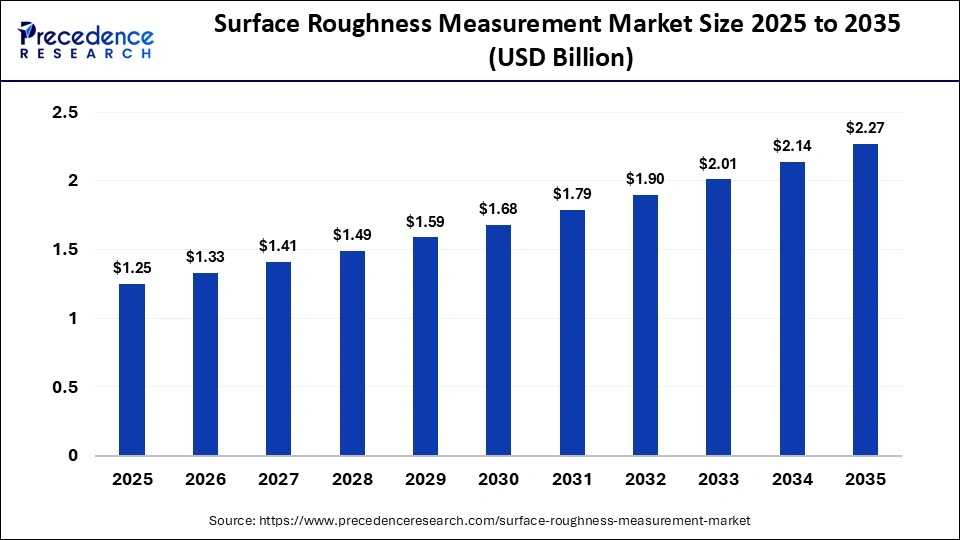
The global surface roughness measurement market was valued at USD 1.25 billion in 2025 and is projected to grow from USD 1.33 billion in 2026 to approximately USD 2.27 billion by 2035, expanding at a CAGR of 6.13% during the forecast period.
This growth is primarily driven by the increasing demand for precision manufacturing, rising adoption of non-contact metrology technologies, advancements in semiconductor fabrication, and stricter global quality standards across industries.
Read Also: 8k Technology Market
Market Overview
Surface roughness measurement refers to technologies used to analyze and quantify the texture, smoothness, and irregularities of surfaces. These measurements are critical in determining product performance, including:
- Friction and wear resistance
- Adhesion and coating performance
- Fatigue strength
- Durability and reliability
Modern manufacturing sectors such as aerospace, automotive, semiconductors, and medical devices rely heavily on surface metrology systems to ensure micron- and nanometer-level precision.
The market includes both:
- Contact-based systems (e.g., stylus profilometers)
- Non-contact optical systems (e.g., laser scanning, interferometry)
As production tolerances become tighter, surface roughness measurement is evolving from a quality-check tool into a core production control system.
Impact of Artificial Intelligence (AI)
Artificial Intelligence is significantly transforming the surface roughness measurement landscape.
Key AI Contributions:
- Predictive defect detection before failures occur
- Pattern recognition linking surface flaws to tool wear or process issues
- Real-time decision-making in automated production lines
- Continuous learning systems improving accuracy over time
AI-driven metrology systems are enabling smart manufacturing environments, where measurement tools actively contribute to process optimization, not just inspection.
Key Market Trends
1. Shift Toward Non-Contact Measurement Technologies
Optical and laser-based techniques are gaining traction due to:
- High speed
- Non-destructive measurement
- Superior accuracy for delicate components
These technologies are especially useful in semiconductor and medical device manufacturing.
2. Growing Demand for Portable Measurement Devices
Portable roughness testers are increasingly used for:
- On-site inspections
- Maintenance operations
- Field testing
Their convenience and rapid measurement capability are making them essential tools across industries.
3. Rising Quality Standards in Semiconductor and EV Industries
The rapid evolution of:
- Semiconductor fabrication
- Electric vehicle (EV) manufacturing
is pushing the demand for ultra-precise surface finishing. Even nanometer-level deviations can impact performance, increasing reliance on advanced metrology systems.
Market Dynamics
Driver: Increasing Demand for Precision Manufacturing
Modern industries require extremely tight tolerances, where even minor surface defects can lead to:
- Reduced efficiency
- Mechanical failure
- Product recalls
This is driving widespread adoption of advanced surface measurement technologies.
Restraint: High Cost of Advanced Systems
Challenges limiting adoption include:
- High initial investment
- Integration complexity with existing systems
- Need for skilled professionals
- Maintenance and calibration costs
These factors particularly impact small and mid-sized manufacturers.
Opportunity: Expansion in Semiconductor and EV Ecosystems
Rapid growth in:
- Semiconductor manufacturing
- Electric vehicles
- Microelectronics
is creating strong demand for high-resolution, non-contact measurement systems, opening new growth avenues for market players.
Segmental Insights
By Component
- Probes segment dominated in 2025 due to widespread use in traditional systems
- Software segment is fastest-growing, driven by AI-powered analytics and data interpretation
By Surface Type
- 3D measurement led the market due to its comprehensive surface analysis
- 2D measurement remains relevant for cost-effective and high-speed applications
By Technique
- Contact techniques dominated due to reliability and legacy adoption
- Non-contact techniques are growing fastest due to speed, precision, and automation compatibility
By Vertical
- Automotive sector led the market due to high-volume precision manufacturing
- Semiconductor industry is fastest-growing, driven by nanoscale precision requirements
Regional Insights
North America: Market Leader
North America dominated the market in 2025 with a 32% share, driven by:
- Advanced manufacturing infrastructure
- Early adoption of precision technologies
- Strong aerospace and semiconductor industries
The region continues to invest heavily in AI-enabled metrology solutions.
Asia-Pacific: Fastest Growing Region
Asia-Pacific is expected to witness the fastest growth due to:
- Rapid industrialization
- Expanding semiconductor manufacturing
- Growth in automotive and EV production
Countries like China and India are emerging as key growth engines, supported by government initiatives and increasing investments in advanced manufacturing.
Competitive Landscape
Key companies operating in the market include:
- Starrett
- Hexagon AB
- Nikon Corporation
- AMETEK, Inc.
- Taylor Hobson
- Mahr GmbH
- Carl Zeiss AG
- Mitutoyo Corporation
- Zygo Corporation
- JENOPTIK AG
These companies are focusing on:
- AI integration
- Product innovation
- Strategic partnerships
- Automation-enabled metrology solutions
Recent Developments
- December 2025: KEYENCE introduced AI-enhanced measurement systems capable of capturing thousands of dimensions in seconds.
- November 2025: Carl Zeiss AG upgraded its inspection software to integrate surface measurement into intelligent quality control systems.
Conclusion
The surface roughness measurement market is steadily evolving as a critical enabler of precision manufacturing. With increasing demand from semiconductor, automotive, and aerospace industries, the role of metrology systems is becoming more strategic than ever.
Advancements in AI, automation, and non-contact measurement technologies are reshaping the market, enabling faster, more accurate, and predictive quality control.
As industries move toward smart factories and Industry 4.0, surface roughness measurement systems will play a vital role in ensuring product quality, operational efficiency, and long-term reliability.
Get Sample Copy: https://www.precedenceresearch.com/sample/8232
For inquiries regarding discounts, bulk purchases, or customization requests, please contact us at sales@precedenceresearch.com

- Single Loop Controller Market Size to Hit USD 6.85 Billion by 2035 - March 31, 2026
- Surface Roughness Measurement Market Size to Hit USD 2.27 Billion by 2035 - March 31, 2026
- 8k Technology Market Size to Hit USD 657.82 Billion by 2035 - March 31, 2026
