
 by
by The global robotic simulator market is rapidly evolving as industries increasingly adopt automation, artificial intelligence (AI), and advanced robotics technologies. Robotic simulators play a crucial role in enabling developers, engineers, and researchers to design, test, and validate robotic systems in virtual environments before real-world deployment. This significantly reduces costs, improves safety, and accelerates innovation.
With growing adoption across sectors such as manufacturing, healthcare, aerospace, and autonomous systems, robotic simulation has become a cornerstone of modern digital transformation strategies.
Market Size and Forecast
The global robotic simulator market size was valued at USD 820.00 million in 2025 and is projected to grow from USD 936.44 million in 2026 to approximately USD 3,093.68 million by 2035, expanding at a strong CAGR of 14.20% from 2026 to 2035.
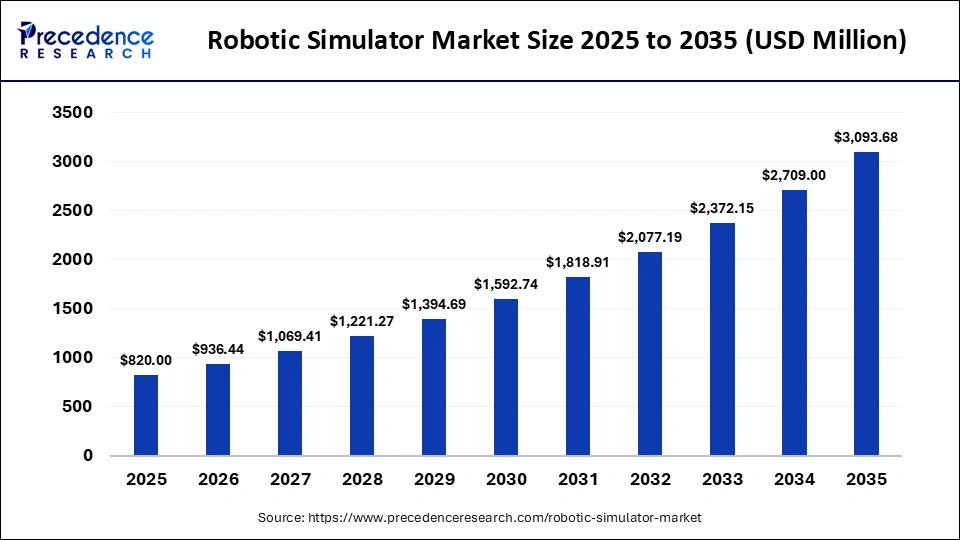
This robust growth is driven by the increasing adoption of surgical and industrial robotics, along with advancements in high-fidelity simulation technologies that enhance accuracy, safety, and operational efficiency.
Key Takeaways
- North America dominated the market with 36% share in 2025
- Asia-Pacific is expected to grow at the fastest rate
- Software segment led with 72% market share
- Services segment is expected to grow at the fastest pace
- On-premises deployment dominated with 60% share
- Cloud-based solutions are the fastest-growing
- Industrial robotics accounted for 45% market share
- Manufacturing segment led with 38% share
- Aerospace & defense segment expected to grow rapidly
Market Overview
A robotic simulator is a software platform used to model and analyze robot behavior in virtual environments without requiring physical prototypes. These simulators create digital twins of robots and their surroundings, allowing engineers to test algorithms, optimize performance, and validate system behavior in a risk-free environment.
Robotic simulation is widely used for:
- Algorithm development and testing
- Factory automation planning
- Virtual prototyping and validation
- Robotics education and training
- Remote monitoring and safety analysis
By enabling realistic simulation scenarios, this technology significantly reduces development time, minimizes errors, and improves overall system efficiency.
Impact of Artificial Intelligence on the Market
Artificial intelligence is transforming robotic simulation by enabling more adaptive, intelligent, and realistic environments. AI-driven simulators can analyze user performance in real time, provide personalized feedback, and optimize training outcomes.
Machine learning (ML) allows robotic systems to learn from data and experience rather than relying solely on pre-programmed instructions. This enhances:
- Decision-making capabilities
- Real-time data analysis
- Autonomous system behavior
- Predictive modeling for complex scenarios
AI-powered simulation is particularly valuable in surgical training, industrial automation, and autonomous systems development.
Market Trends
The robotic simulator market is witnessing several key trends shaping its growth. There is an increasing demand for predictive maintenance and remote monitoring, where simulators help anticipate system failures and reduce downtime. Additionally, organizations are moving toward customized simulation solutions tailored to specific industrial needs, improving training effectiveness and operational efficiency.
Another major trend is the integration of CAD-based simulation platforms, which enable users to easily visualize robot paths and create simulations with minimal technical expertise. These advancements are enhancing human-robot interaction and accelerating adoption across industries.
Market Scope
| Report Coverage | Details |
| Market Size in 2025 | USD 820.00 Million |
| Market Size in 2026 | USD 936.44 Million |
| Market Size by 2035 | USD 3,093.68 Million |
| Market Growth Rate from 2026 to 2035 | CAGR of 14.20% |
| Dominating Region | North America |
| Fastest Growing Region | Asia-Pacific |
| Base Year | 2025 |
| Forecast Period | 2026 to 2035 |
| Segments Covered | Component, Deployment Mode, Application, End User, and Region |
| Regions Covered | North America, Europe, Asia-Pacific, Latin America, and Middle East & Africa |
Market Dynamics
Drivers
The growing demand for virtual testing and simulation-based training is a major driver of the market. Organizations are leveraging robotic simulators to optimize design processes, reduce risks, and improve operational efficiency without relying on costly physical prototypes.
Restraints
Despite strong growth, the market faces challenges related to data security and ethical concerns, particularly in healthcare applications. Ensuring patient data privacy and regulatory compliance remains a critical issue.
Opportunities
Expanding applications in healthcare and industrial automation present significant growth opportunities. In healthcare, robotic simulators enable surgeons to practice complex procedures safely, improving precision and patient outcomes. In industrial environments, they help train operators, optimize workflows, and accelerate automation adoption.
Segment Analysis
Component Insights
The software segment dominated the market in 2025 with a 72% share, driven by the adoption of digital twins, AI-based simulation, and real-time modeling platforms. Simulation software enables users to design, analyze, and validate complex robotic systems efficiently.
The services segment, accounting for 28% share, is expected to grow at the fastest rate due to increasing demand for integration, customization, training, and consulting services.
Deployment Mode Insights
The on-premises segment led the market with a 60% share in 2025, as organizations prefer greater control, data security, and low-latency performance. These systems are ideal for large-scale, high-fidelity simulations.
Meanwhile, cloud-based solutions are growing rapidly due to their scalability, cost efficiency, and ability to support remote collaboration and real-time updates.
Application Insights
The industrial robotics segment dominated the market with a 45% share, driven by increasing automation in manufacturing processes such as assembly, welding, and material handling.
The autonomous vehicles & drones segment is expected to grow at the fastest rate, fueled by advancements in AI, stricter safety regulations, and the need for extensive virtual testing environments.
Other key applications include medical robotics and research & education, where simulators are used for training, experimentation, and innovation.
End User Insights
The manufacturing sector led the market with a 38% share, driven by Industry 4.0 adoption and the growing use of automation in production processes.
The aerospace & defense segment is expected to grow at the fastest rate due to increasing use of robotics in defense operations, space exploration, and mission-critical simulations.
Other key end users include healthcare, automotive, and education & research institutions.
Regional Insights
North America
North America dominated the market with a 36% share in 2025, supported by strong R&D investments, advanced robotics ecosystem, and early adoption of AI and automation technologies. The presence of major players such as NVIDIA and Rockwell Automation further strengthens the region’s leadership.
Asia-Pacific
Asia-Pacific is the fastest-growing region, driven by rapid industrialization, increasing robotics adoption, and government initiatives promoting automation and smart manufacturing. Countries like China are leading growth with strong manufacturing capabilities and technological advancements.
Europe
Europe is the second-largest market, supported by a well-established automation industry, strong regulatory framework, and increasing adoption of robotics technologies across sectors.
Competitive Landscape
The robotic simulator market is highly competitive, with key players focusing on innovation, partnerships, and technological advancements. Major companies include:
- ABB Ltd.
- KUKA AG
- FANUC Corporation
- Yaskawa Electric Corporation
- Siemens AG
- Dassault Systèmes
- NVIDIA Corporation
- Rockwell Automation
- Autodesk, Inc.
- Universal Robots
Recent Developments
- March 2026: PTC introduced a cloud-native robotics design-to-simulation workflow integrated with NVIDIA Isaac Sim
- March 2026: ABB Robotics integrated NVIDIA Omniverse into RobotStudio, achieving up to 99% simulation accuracy
Conclusion
The robotic simulator market is poised for significant growth through 2035, driven by increasing adoption of automation, AI integration, and the need for efficient and safe robotic system development. With expanding applications across manufacturing, healthcare, aerospace, and autonomous systems, robotic simulation is becoming an essential tool for innovation and operational excellence.
As technology continues to evolve, robotic simulators will play a crucial role in shaping the future of robotics by enabling faster development, reducing risks, and enhancing system performance.

