
 by
by The global machine automation controller market is projected to grow from USD 49.04 billion in 2026 to USD 94.18 billion by 2035 at a CAGR of 7.52%. Explore market trends, AI-driven automation, segment analysis, regional insights, and key industry players shaping industrial automation.
Machine Automation Controller Market Size, Share, Trends and Forecast 2026 to 2035
The global machine automation controller market is experiencing strong growth due to increasing industrial automation, rising adoption of Industry 4.0 technologies, and growing demand for intelligent manufacturing systems. Businesses across manufacturing, oil & gas, automotive, power generation, and packaging industries are increasingly integrating automation controllers to improve operational efficiency, reduce downtime, and enhance production accuracy.
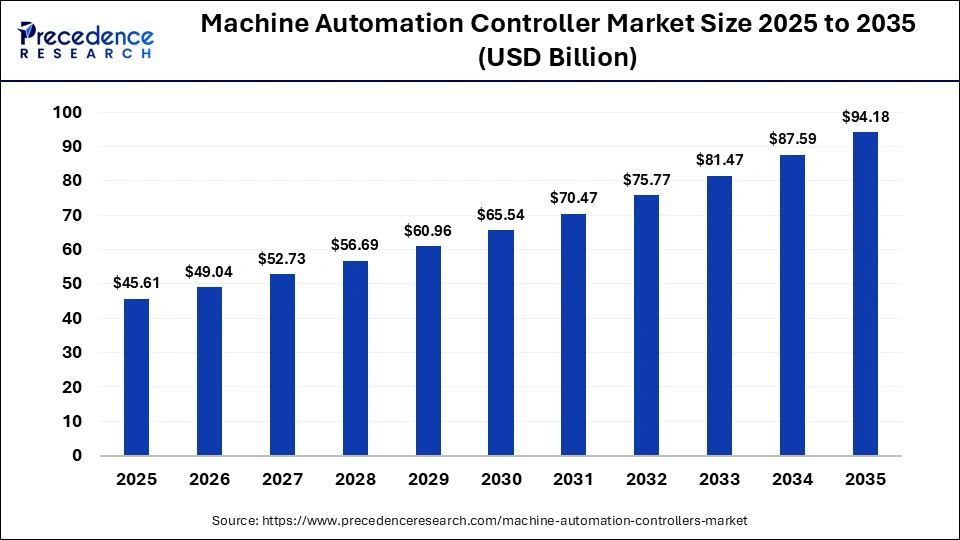
According to industry analysis, the global machine automation controller market size was valued at USD 45.61 billion in 2025 and is projected to increase from USD 49.04 billion in 2026 to approximately USD 94.18 billion by 2035, expanding at a CAGR of 7.52% during the forecast period. Increased productivity, enhanced safety, reduced operational costs, and improved process efficiency are among the key factors driving market expansion globally.
Read Also: Fantasy Sports Market
Market Overview
Machine automation controllers are industrial control systems designed to automate machinery, production processes, and manufacturing operations. These controllers manage industrial equipment, monitor operational data, execute automated commands, and facilitate seamless communication between machines.
Machine automation controllers are extensively used in:
- Manufacturing plants
- Smart factories
- Automated production lines
- Energy management systems
- Oil & gas facilities
- Packaging operations
- Semiconductor manufacturing
The market includes several controller technologies such as:
- Programmable Logic Controllers (PLCs)
- Programmable Automation Controllers (PACs)
- Distributed Control Systems (DCS)
- Dedicated Motion Controllers
- CNC Controllers
Asia-Pacific dominated the global machine automation controller market with a 40% share in 2025, while North America is expected to witness the fastest growth during the forecast period.
How Artificial Intelligence is Transforming Machine Automation Controllers
Artificial intelligence (AI) is becoming a major growth catalyst in industrial automation systems. AI-powered automation controllers can analyze real-time industrial data, identify machine irregularities, optimize production processes, and support predictive maintenance strategies.
Modern AI-integrated machine automation controllers help industries:
- Detect equipment failures early
- Improve operational efficiency
- Optimize machine performance
- Reduce manufacturing defects
- Enable predictive maintenance
- Enhance quality control
According to industry analysis, AI-driven automation controllers can collect high-fidelity machine data and instantly trigger corrective actions to prevent operational disruptions.
Machine learning algorithms are increasingly being integrated into automation systems to improve:
- Production scheduling
- Energy management
- Real-time monitoring
- Industrial analytics
- Robotic automation
The rapid adoption of AI-enabled manufacturing ecosystems is expected to reshape industrial production processes over the next decade.
Key Market Drivers
Rising Adoption of Industry 4.0
The growing implementation of Industry 4.0 technologies is one of the primary factors driving machine automation controller demand worldwide.
Modern smart factories increasingly rely on:
- Industrial IoT (IIoT)
- Cloud-based automation
- Robotics
- AI-powered analytics
- Edge computing
- Connected manufacturing systems
Machine automation controllers serve as the backbone of these intelligent industrial environments by enabling seamless process coordination and machine communication.
The growing trend toward digital manufacturing transformation is accelerating automation investments globally.
Increasing Demand for Operational Efficiency
Manufacturers are continuously seeking ways to improve productivity and reduce operational costs.
Automation controllers help organizations:
- Minimize human error
- Reduce production downtime
- Improve manufacturing precision
- Increase throughput
- Enhance workplace safety
Industries facing labor shortages and rising operational costs are increasingly deploying advanced automation systems to maintain competitiveness.
Expansion of Industrial Robotics
The rapid adoption of industrial robots is significantly contributing to market growth.
Robotic systems require highly advanced automation controllers capable of:
- Motion control
- Process synchronization
- Precision automation
- Multi-axis coordination
- Real-time communication
Industries such as automotive, electronics, and semiconductor manufacturing remain major adopters of industrial robotics solutions.
Community discussions on Reddit increasingly highlight the strong long-term growth potential of industrial automation and robotics sectors due to productivity improvements and AI integration.
Emerging Market Trends
Focus on Energy-Efficient Automation
Energy-efficient manufacturing is emerging as a major trend in the industrial automation landscape.
Companies are increasingly investing in automation systems that help optimize:
- Energy consumption
- Resource utilization
- Production efficiency
- Equipment performance
The growing emphasis on sustainability and environmental compliance is expected to accelerate the deployment of energy-efficient automation technologies globally.
Increasing Integration of Industrial IoT (IIoT)
IIoT integration is transforming industrial automation ecosystems by enabling real-time data collection and remote operational monitoring.
IIoT-enabled controllers provide:
- Real-time analytics
- Predictive maintenance alerts
- Remote diagnostics
- Enhanced operational visibility
- Cloud connectivity
The increasing demand for connected manufacturing systems is significantly boosting the adoption of intelligent machine automation controllers.
Rising Focus on Cybersecurity
As industrial automation systems become increasingly connected, cybersecurity is emerging as a critical concern.
Industrial control systems such as PLCs, DCS, and SCADA networks face rising risks related to:
- Data breaches
- Malware attacks
- Operational disruptions
- Network vulnerabilities
Manufacturers are increasingly investing in cybersecurity-enabled automation platforms to protect critical infrastructure and maintain operational continuity.
Market Restraints
High Initial Deployment Costs
One of the key challenges facing the machine automation controller market is the substantial upfront investment required for implementation.
Automation system deployment costs include:
- Hardware installation
- Software integration
- Infrastructure upgrades
- Employee training
- Maintenance services
Small and medium-sized enterprises may face financial barriers when adopting advanced industrial automation systems.
Complex Integration with Legacy Systems
Integrating modern automation controllers with existing industrial infrastructure can be technically complex.
Challenges include:
- Software compatibility issues
- Legacy machine integration
- Data synchronization
- Network standardization
Older industrial facilities may require extensive modernization before deploying advanced automation systems.
Shortage of Skilled Workforce
The increasing complexity of industrial automation systems has created demand for highly skilled technical professionals.
A shortage of trained automation engineers and industrial cybersecurity specialists may slow implementation in certain industries.
Segment Analysis
Controller Type Insights
Distributed Control Systems (DCS) Dominated the Market
The distributed control systems segment held the largest market share in 2025 due to rising demand for centralized process control and large-scale industrial automation.
DCS solutions are widely used across:
- Oil & gas
- Chemicals
- Power generation
- Water treatment
- Heavy manufacturing
These systems provide:
- High operational reliability
- Process optimization
- Real-time monitoring
- Advanced analytics
Programmable Automation Controllers (PACs) to Grow Fastest
The programmable automation controllers segment is expected to witness the fastest growth during the forecast period due to increasing demand for flexible automation systems.
PACs offer advantages such as:
- Modular architecture
- Scalability
- Advanced computing capabilities
- Integration flexibility
Machine Operation Type Insights
Discrete Manufacturing Led the Market
The discrete manufacturing segment accounted for the largest market share in 2025 due to increasing automation across automotive, electronics, and machinery manufacturing industries.
Batch Process Segment Growing Rapidly
The batch process segment is projected to grow at the fastest CAGR due to rising demand across pharmaceutical, food processing, and chemical industries.
End-Use Industry Insights
Oil & Gas Segment Dominated the Market
The oil & gas industry held the largest market share in 2025 due to growing investments in industrial process automation and remote monitoring systems.
Automation controllers help oil & gas operators improve:
- Operational safety
- Process efficiency
- Remote asset monitoring
- Production optimization
Power Generation and Utilities Segment Expanding Rapidly
The power generation and utilities sector is expected to witness rapid growth due to increasing investments in smart grids, renewable energy infrastructure, and automated power management systems.
Regional Analysis
Asia-Pacific Dominated the Global Market
Asia-Pacific accounted for the largest market share of 40% in 2025 due to rapid industrialization, expanding manufacturing infrastructure, and strong adoption of smart factory technologies.
Key growth countries include:
- China
- Japan
- South Korea
- India
China Market Trends
China remains a major manufacturing hub and continues investing heavily in:
- Industrial robotics
- AI-powered automation
- Semiconductor manufacturing
- Smart factory infrastructure
Government initiatives promoting industrial modernization are accelerating automation adoption across the country.
North America to Witness Fastest Growth
North America is projected to grow at the fastest CAGR during the forecast period due to rising investments in advanced manufacturing, AI-enabled automation, and industrial cybersecurity solutions.
United States Market Trends
The United States remains a major market due to increasing adoption of:
- Smart manufacturing systems
- Industrial IoT platforms
- Robotics automation
- Predictive maintenance technologies
Manufacturing reshoring initiatives are also contributing to industrial automation investments across the region.
Competitive Landscape
The machine automation controller market is highly competitive, with leading industrial automation companies focusing on AI integration, industrial IoT, cloud automation, and robotics solutions.
Key Companies Operating in the Market
- Siemens AG
- ABB Ltd.
- Schneider Electric SE
- Rockwell Automation, Inc.
- Mitsubishi Electric Corporation
- Honeywell International Inc.
- Emerson Electric Co.
- Omron Corporation
- FANUC Corporation
- Yokogawa Electric Corporation
- Bosch Rexroth
- Keyence Corporation
These companies are investing heavily in:
- AI-enabled industrial automation
- Edge computing
- Robotics integration
- Cloud-connected manufacturing
- Industrial cybersecurity
Recent Developments
- Industrial automation providers are increasingly launching AI-powered controllers capable of predictive maintenance and real-time industrial analytics.
- Companies are focusing on cloud-connected programmable logic controllers to support Industry 4.0 and smart factory deployments.
- Rising investments in cybersecurity for industrial control systems are reshaping automation infrastructure development globally.
Future Outlook
The future of the machine automation controller market appears highly promising due to increasing industrial digitalization, AI integration, and expansion of connected manufacturing systems.
Emerging technologies expected to reshape the market include:
- Artificial intelligence
- Industrial IoT
- Edge computing
- Cloud automation
- Digital twins
- Smart robotics
Asia-Pacific is expected to remain the dominant manufacturing hub, while North America is projected to emerge as a major growth engine for AI-driven industrial automation.
Conclusion
The global machine automation controller market is witnessing strong and sustained growth driven by Industry 4.0 adoption, industrial robotics expansion, AI integration, and increasing demand for operational efficiency.
Distributed control systems, programmable automation controllers, and AI-powered industrial analytics are transforming manufacturing and industrial operations worldwide.
With Asia-Pacific leading the market and North America experiencing rapid technological advancement, the machine automation controller industry is expected to witness substantial innovation and long-term expansion through 2035.
Get a Sample Copy: https://www.precedenceresearch.com/sample/8228
For inquiries regarding discounts, bulk purchases, or customization requests, please contact us at sales@precedenceresearch.com

