
 by
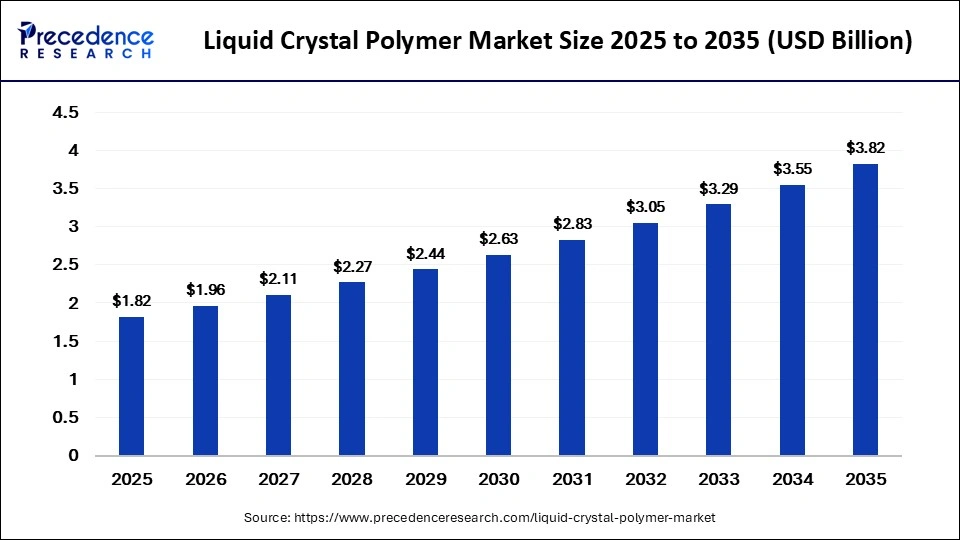
by The global liquid crystal polymer market is projected to grow from USD 1.96 billion in 2026 to USD 3.82 billion by 2035, driven by rising demand in electronics, semiconductors, automotive applications, 5G infrastructure, and advanced medical devices.
Read Also: AI in Product Lifecycle Management Market
Liquid Crystal Polymer Market Size 2026 to 2035
The global Liquid Crystal Polymer (LCP) Market is witnessing strong momentum as industries increasingly seek lightweight, high-performance, and heat-resistant materials capable of meeting the demands of next-generation technologies.
According to industry estimates, the global liquid crystal polymer market was valued at USD 1.82 billion in 2025 and is expected to increase from USD 1.96 billion in 2026 to approximately USD 3.82 billion by 2035, expanding at a CAGR of 7.90% during the forecast period. Rising applications in electronics, semiconductors, automotive systems, aerospace components, and medical devices are creating substantial growth opportunities for market participants.
What is Driving the Growth of the Liquid Crystal Polymer Market?
Liquid crystal polymers are advanced thermoplastic materials that combine exceptional mechanical strength, chemical resistance, dimensional stability, and thermal performance. Unlike conventional engineering plastics, LCPs maintain their structural integrity even under extreme operating conditions.
These unique characteristics make them indispensable in applications such as:
- Semiconductor packaging
- High-frequency connectors
- Automotive sensors
- Medical devices
- Aerospace communication systems
- Flexible electronics
- 5G infrastructure
As industries move toward miniaturization, electrification, and high-performance manufacturing, demand for LCP-based solutions continues to accelerate.
Key Market Highlights
- Market expected to reach USD 3.82 billion by 2035
- CAGR of 7.90% from 2026 to 2035
- Asia Pacific dominated with 46% market share in 2025
- Thermotropic LCP segment accounted for 91% share
- Resin segment captured 62% market share
- Electrical & Electronics segment held 48% share
- Electronics & Semiconductor industry contributed 52% of total revenue
- Films segment projected to witness the fastest growth at 9.3% CAGR
- Asia Pacific expected to remain the fastest-growing regional market at 9.2% CAGR
How Artificial Intelligence is Influencing the LCP Industry
Artificial Intelligence is increasingly playing a vital role in material science and polymer development.
AI-driven modeling tools enable researchers to predict:
- Material properties
- Thermal behavior
- Chemical resistance
- Molecular alignment
- Performance under extreme conditions
Advanced technologies such as machine learning, convolutional neural networks (CNNs), and predictive simulations are helping manufacturers accelerate material development while reducing research costs and product development timelines. AI is also supporting innovation in sensor technologies and next-generation electronic components that utilize liquid crystal polymers.
Major Trends Reshaping the Liquid Crystal Polymer Market
Rising Demand for Miniaturized Electronics
The global electronics industry is undergoing rapid miniaturization, creating strong demand for materials that offer excellent dimensional stability and high electrical performance.
LCPs are increasingly used in:
- Connectors
- Sensors
- Chip carriers
- Mobile devices
- Wearable technologies
- Semiconductor packaging
Their ability to maintain performance in compact and high-frequency applications makes them a preferred material for next-generation electronic systems.
Expansion of 5G Infrastructure
The deployment of 5G networks is creating new opportunities for liquid crystal polymers.
LCP films possess:
- Low dielectric constants
- High-frequency signal transmission capabilities
- Excellent moisture resistance
- Superior thermal stability
These properties make them ideal for antennas, communication modules, and advanced networking equipment used in 5G ecosystems.
Growing Applications in Aerospace and Defense
Aerospace manufacturers increasingly rely on LCP materials for advanced communication systems and lightweight structural components.
The material’s ability to withstand harsh environments while maintaining signal integrity has increased its use in:
- RF antennas
- Aircraft communication systems
- Defense electronics
- Satellite technologies
As global aerospace investments continue to rise, demand for advanced polymers is expected to strengthen further.
Market Dynamics
Driver: Rapid Expansion of the Electronics Industry
The electronics sector remains the largest growth catalyst for the liquid crystal polymer market.
The growing production of:
- Smartphones
- Consumer electronics
- Semiconductor devices
- High-performance computing systems
- IoT devices
is driving demand for high-performance materials capable of supporting miniaturization and advanced functionality. Additionally, LCPs provide excellent dielectric properties, chemical resistance, and low moisture absorption, making them ideal for precision electronic applications.
Restraint: High Material Costs
Despite their performance advantages, liquid crystal polymers remain significantly more expensive than traditional engineering plastics such as ABS and polyphthalamide.
The high production cost can limit adoption in price-sensitive applications and create barriers for small and medium-sized manufacturers. This remains one of the major challenges affecting broader market penetration.
Opportunity: Advanced Circuit Substrates
The growing use of multilayer resin substrates in advanced electronic circuit boards presents a major opportunity for market expansion.
LCP-based substrates offer:
- Enhanced reliability
- Moisture resistance
- Support for complex circuit architectures
- Improved signal transmission
As electronic devices become increasingly sophisticated, demand for advanced substrate materials is expected to surge.
Segment Analysis
Thermotropic Liquid Crystal Polymer Leads the Market
The thermotropic liquid crystal polymer segment dominated the market with an impressive 91% share in 2025 and is expected to maintain leadership throughout the forecast period.
Thermotropic LCPs exhibit liquid crystalline behavior when heated, enabling superior processing characteristics and exceptional performance in precision electronics.
Their widespread use in:
- Connectors
- Consumer electronics
- Automotive electronics
- Industrial sensors
continues to fuel market growth.
Resin Segment Remains the Largest Form Category
The resin segment accounted for 62% of total market revenue in 2025.
LCP resins are extensively utilized in:
- Injection molded components
- Electrical assemblies
- Automotive systems
- Precision engineering applications
The segment continues to benefit from growing demand for heat-resistant and lightweight materials across multiple industries.
Films Segment Emerges as a High-Growth Opportunity
Among all form categories, the films segment is projected to witness the fastest growth, expanding at a CAGR of 9.3% through 2035.
LCP films are gaining traction because of their:
- Stability at high frequencies
- Flexibility
- Thermal resistance
- Reliability in communication systems
The rapid rollout of 5G networks and advanced display technologies is expected to significantly boost demand for LCP films over the coming decade.
End-Use Industry Insights
Electronics & Semiconductor Industry Leads Demand
The electronics and semiconductor segment accounted for 52% of market revenue in 2025, making it the largest end-use industry.
LCP materials are widely used in:
- Semiconductor packaging
- High-speed connectors
- Advanced sensors
- Electronic modules
Their excellent electrical and thermal properties make them essential for next-generation semiconductor manufacturing and electronic device development.
Automotive Industry Accelerating Adoption
The automotive sector is expected to remain a major growth contributor as manufacturers seek lightweight materials that improve vehicle performance and energy efficiency.
LCPs are increasingly used in:
- Electric vehicle systems
- Radar modules
- Connectors
- Autonomous driving sensors
- Power electronics
The global transition toward electric and autonomous mobility is expected to further strengthen demand.
Regional Insights
Asia Pacific Dominates the Global Market
Asia Pacific held the largest market share of 46% in 2025 and is expected to grow at the fastest CAGR of 9.2% during the forecast period.
The region benefits from:
- Rapid industrialization
- Expanding electronics manufacturing
- Strong semiconductor production
- Growing automotive industry
- Rising investments in advanced materials
Countries such as China, Japan, South Korea, and Taiwan continue to drive regional market expansion.
China Remains a Key Growth Engine
China’s dominance in electronics manufacturing and semiconductor production has positioned it as one of the most important markets for liquid crystal polymers.
The country’s increasing focus on advanced manufacturing, electric vehicles, and high-frequency communication technologies continues to support robust demand for LCP materials.
Europe Benefits from EV and Aerospace Growth
Europe accounted for 21% of market share in 2025 and continues to witness strong adoption of liquid crystal polymers.
Key growth drivers include:
- Rising electric vehicle production
- Aerospace innovation
- Sustainability initiatives
- Lightweight material adoption
Germany remains a leading regional market due to its strong automotive and industrial manufacturing sectors.
Competitive Landscape
The liquid crystal polymer market remains moderately consolidated, with leading companies focusing on technological innovation, strategic partnerships, and advanced material development.
Key players include:
- Celanese Corporation
- Sumitomo Chemical
- Toray Industries
- Polyplastics Co.
- SABIC
- Solvay
- Kuraray
- RTP Company
Manufacturers are increasingly investing in sustainable materials, advanced processing technologies, and next-generation applications to strengthen their market positions.
Recent Industry Developments
A notable industry development occurred in April 2026 when Z-Polymers Inc. received a strategic investment from the U.S. subsidiary of Kureha Corporation. The partnership aims to accelerate commercialization of Z-Polymers’ proprietary Tullomer liquid crystal polymer platform, highlighting the growing industry focus on advanced polymer innovation and high-performance materials.
Conclusion
The global liquid crystal polymer market is entering a period of sustained expansion as industries increasingly require lightweight, durable, and high-performance materials capable of supporting next-generation technologies. Growing adoption in semiconductors, electronics, automotive systems, aerospace applications, and 5G infrastructure will continue to drive market growth over the next decade.
With the market projected to grow from USD 1.96 billion in 2026 to USD 3.82 billion by 2035, liquid crystal polymers are poised to play a crucial role in shaping the future of advanced manufacturing, intelligent electronics, and high-frequency communication technologies.
Get a Sample Copy: https://www.precedenceresearch.com/sample/8441
For inquiries regarding discounts, bulk purchases, or customization requests, please contact us at sales@precedenceresearch.com

