
 by
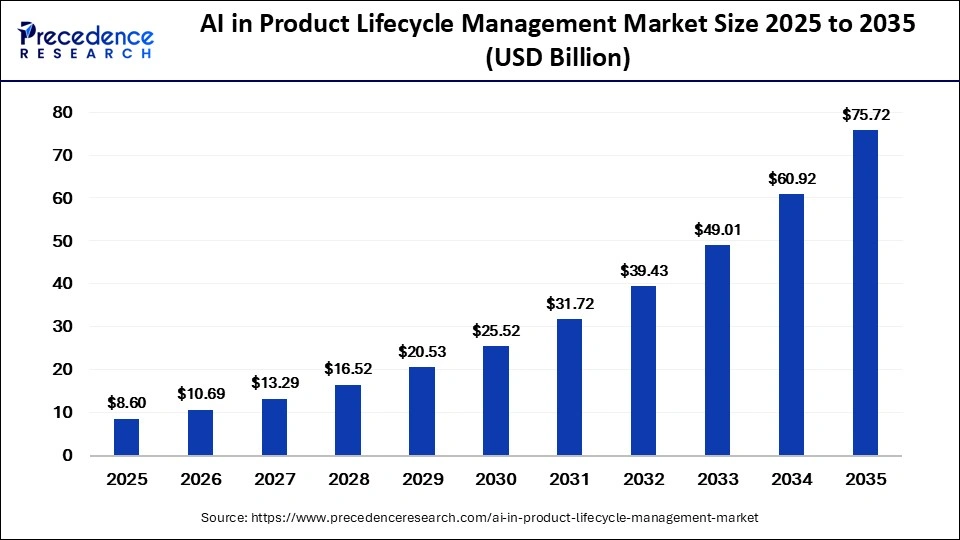
by The global AI in Product Lifecycle Management market is projected to grow from USD 10.69 billion in 2026 to USD 75.72 billion by 2035, driven by Industry 4.0 adoption, generative AI innovation, cloud-based PLM platforms, and digital transformation across manufacturing industries.
Read Also: Human Centric Lighting Market
AI in Product Lifecycle Management Market Size 2026 to 2035
The global AI in Product Lifecycle Management (PLM) market is entering a transformative phase as organizations increasingly leverage artificial intelligence to accelerate innovation, optimize product development, and streamline operations across the entire product lifecycle.
The market was valued at USD 8.60 billion in 2025 and is projected to grow from USD 10.69 billion in 2026 to approximately USD 75.72 billion by 2035, registering an impressive CAGR of 24.30% during the forecast period. The rapid adoption of AI-powered PLM software, growing Industry 4.0 initiatives, and increasing digital transformation efforts across manufacturing sectors are driving this remarkable growth.
The Future of Product Development is AI-Powered
Product Lifecycle Management has evolved far beyond traditional data management systems. Today’s AI-enabled PLM platforms help businesses manage everything from product ideation and engineering design to manufacturing, maintenance, and end-of-life management.
By integrating artificial intelligence, organizations can:
- Automate engineering workflows
- Improve product quality
- Reduce time-to-market
- Predict product failures
- Enhance collaboration across teams
- Optimize supply chain operations
- Accelerate product innovation
As businesses face increasing pressure to launch smarter products faster, AI-powered PLM solutions are becoming a strategic necessity rather than a competitive advantage.
Key Market Highlights
- North America dominated the market with a 38% share in 2025
- Asia Pacific is expected to expand at the fastest CAGR of 29.6%
- Software segment captured 76% market share in 2025
- Cloud-based deployment accounted for 56% share
- Machine Learning held the largest technology share at 31%
- Generative AI is forecast to grow at the highest CAGR of 37.2%
- Product Design & Development led applications with 29% share
- Electronics & Semiconductor industry is expected to witness the fastest growth at 29.4% CAGR
Why AI is Revolutionizing Product Lifecycle Management
Accelerating Product Innovation
Modern manufacturing demands rapid innovation cycles. AI helps engineering teams generate product concepts, automate design iterations, analyze performance data, and identify optimal configurations faster than traditional approaches.
With AI-driven insights, companies can reduce development timelines while improving product quality and performance.
Digital Twins are Transforming Product Development
One of the most significant trends shaping the market is the growing adoption of digital twin technology.
AI-powered digital twins enable manufacturers to create virtual replicas of products and systems, allowing engineers to:
- Simulate real-world performance
- Predict maintenance requirements
- Test design modifications
- Reduce development risks
- Optimize operational efficiency
These capabilities are becoming increasingly important as products become more complex and connected.
Predictive Analytics Enhancing Decision-Making
AI-powered predictive analytics enables organizations to forecast product performance, identify potential defects, and improve lifecycle planning.
Manufacturers are leveraging predictive intelligence to:
- Prevent equipment failures
- Improve product reliability
- Optimize maintenance schedules
- Reduce operational costs
- Enhance customer satisfaction
As predictive technologies mature, their role within PLM ecosystems continues to expand.
Generative AI is Reshaping Product Engineering
Generative AI represents one of the fastest-growing opportunities within the AI in PLM market.
The technology allows engineers and product teams to generate:
- Product designs
- Technical specifications
- Engineering documentation
- Simulation models
- Manufacturing recommendations
By automating repetitive design tasks and accelerating concept generation, generative AI is helping organizations bring innovative products to market faster than ever before. The segment is expected to grow at a remarkable CAGR of 37.2% through 2035.
Key Market Trends
Cloud-Based PLM Adoption Accelerates
Cloud-native PLM solutions are becoming the preferred deployment model for enterprises seeking scalability, flexibility, and real-time collaboration.
Cloud-based platforms offer:
- Remote access to product data
- Faster software deployment
- Reduced infrastructure costs
- Enhanced collaboration
- Seamless AI integration
The cloud-based segment held 56% market share in 2025 and is expected to maintain strong momentum throughout the forecast period.
AI-Driven Knowledge Management
Organizations are increasingly using AI-powered knowledge management systems to centralize and analyze vast amounts of product information.
These systems help teams:
- Access critical information quickly
- Improve collaboration
- Reduce inefficiencies
- Accelerate decision-making
- Enhance engineering productivity
This trend is becoming especially important in complex manufacturing environments where large volumes of product data must be managed effectively.
Quality Management and Compliance Automation
AI is playing a growing role in quality assurance and regulatory compliance.
Advanced AI systems can:
- Detect anomalies automatically
- Monitor product quality in real time
- Identify manufacturing defects
- Ensure regulatory compliance
- Reduce operational risks
As regulations become increasingly stringent, AI-driven compliance management is expected to become a critical component of modern PLM strategies.
Segment Analysis
Software Segment Maintains Market Leadership
The software segment dominated the market with 76% share in 2025.
Organizations continue to invest heavily in AI-powered PLM software platforms that support:
- Product data management
- Engineering collaboration
- Digital design workflows
- Product intelligence
- Lifecycle optimization
The software segment is projected to exceed USD 54 billion by 2035, reflecting strong enterprise demand for intelligent product management solutions.
Services Segment Growing Rapidly
As AI adoption increases, organizations require specialized services to support implementation, integration, consulting, and training.
The services segment is forecast to grow at the fastest CAGR of 27.1%, driven by increasing deployment complexity and enterprise digital transformation initiatives.
Machine Learning Leads AI Technologies
Machine Learning remained the dominant technology segment in 2025, accounting for 31% market share.
Its widespread adoption is driven by its ability to:
- Forecast product performance
- Optimize manufacturing operations
- Improve engineering decisions
- Reduce operational errors
- Enhance predictive capabilities
Machine learning continues to serve as the foundation for many advanced AI applications within PLM environments.
Application Insights
Product Design & Development Dominates
The Product Design & Development segment accounted for 29% of market revenue in 2025.
Organizations are increasingly adopting AI-powered design tools that:
- Accelerate product creation
- Improve design accuracy
- Enable collaborative engineering
- Reduce development costs
- Shorten time-to-market
As competition intensifies across industries, AI-assisted product development is becoming a key differentiator.
Product Portfolio Management Emerging as a High-Growth Area
AI is helping organizations make smarter portfolio decisions by analyzing market trends, product performance, and profitability metrics.
The Product Portfolio Management segment is expected to grow at a CAGR of 28.1%, making it one of the fastest-expanding application areas in the market.
Industry Analysis
Industrial Manufacturing Leads Adoption
Industrial manufacturing accounted for the largest end-use share, driven by widespread adoption of Industry 4.0 technologies and smart factory initiatives.
Manufacturers are utilizing AI-powered PLM systems to:
- Improve operational efficiency
- Enhance product quality
- Streamline production processes
- Support predictive maintenance
The sector continues to serve as a primary growth engine for the market.
Electronics & Semiconductor Industry to Witness Fastest Growth
The electronics and semiconductor segment is projected to grow at the highest CAGR of 29.4% through 2035.
Increasing product complexity, rapid innovation cycles, and growing demand for advanced engineering tools are fueling adoption of AI-enabled PLM solutions across semiconductor manufacturing environments.
Regional Insights
North America Maintains Market Leadership
North America held the largest market share of 38% in 2025, supported by the presence of leading technology companies, advanced manufacturing infrastructure, and early AI adoption.
The region continues to benefit from:
- Strong investment in digital transformation
- Growing Industry 4.0 initiatives
- Advanced cloud infrastructure
- Significant R&D spending
The United States remains the primary contributor to regional growth.
Asia Pacific Emerging as the Fastest-Growing Market
Asia Pacific is expected to grow at the fastest CAGR of 29.6% during the forecast period.
Rapid industrialization, smart manufacturing initiatives, and increasing investments in AI technologies are creating significant opportunities across:
- China
- Japan
- South Korea
- India
- Southeast Asia
The region’s expanding manufacturing ecosystem is expected to drive substantial market growth over the next decade.
Europe Strengthens AI Manufacturing Initiatives
Europe accounted for 29% market share in 2025 and remains a major hub for industrial innovation.
Strong regulatory frameworks, advanced manufacturing capabilities, and increasing adoption of AI-powered engineering tools are supporting regional market expansion.
Competitive Landscape
Leading companies operating in the AI in Product Lifecycle Management market are focusing on AI integration, cloud innovation, digital twins, predictive analytics, and generative AI capabilities to strengthen their market position.
Industry participants continue to invest heavily in:
- AI-powered design automation
- Intelligent simulation platforms
- Cloud-native PLM solutions
- Advanced analytics engines
- Smart manufacturing technologies
These innovations are expected to define the next generation of product lifecycle management platforms.
Conclusion
The AI in Product Lifecycle Management market is undergoing a profound transformation as organizations embrace intelligent technologies to improve product innovation, operational efficiency, and business agility. With generative AI, machine learning, predictive analytics, and digital twins reshaping the future of product development, AI-powered PLM solutions are becoming essential for manufacturers seeking competitive advantage.
Get a Sample Copy: https://www.precedenceresearch.com/sample/8440
For inquiries regarding discounts, bulk purchases, or customization requests, please contact us at sales@precedenceresearch.com

