
 by
by The U.S. Vehicle-to-Grid Technology market is entering a transformative phase as electric vehicles evolve beyond transportation to become critical components of the nation’s energy infrastructure. The market is estimated at USD 1.85 billion in 2025 and is projected to reach approximately USD 30.84 billion by 2035, expanding at a CAGR of 32.49% from 2026 to 2035.
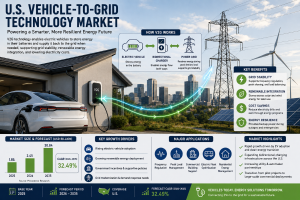
The rapid adoption of electric vehicles, modernization of the power grid, increasing integration of renewable energy, and growing investments in bidirectional charging infrastructure are creating significant opportunities for V2G technology across the United States. Utilities, automakers, charging infrastructure providers, and technology companies are collaborating to transform EVs into distributed energy resources capable of storing electricity and supplying power back to the grid during peak demand.
Furthermore, supportive government initiatives, advancements in AI-powered energy management, smart grid technologies, cloud-based monitoring systems, and virtual power plant (VPP) platforms are accelerating commercial deployment. As utilities seek more flexible and resilient energy systems, V2G technology is expected to play a central role in balancing electricity demand, improving grid stability, and reducing carbon emissions.
U.S. Vehicle-to-Grid Technology Market Overview
Vehicle-to-Grid (V2G) technology enables electric vehicles (EVs) equipped with bidirectional charging systems to exchange electricity with the power grid. Instead of functioning solely as energy consumers, EVs can temporarily return stored electricity to the grid during periods of high demand or grid instability. This capability transforms electric vehicles into mobile energy storage assets while helping utilities improve energy reliability.
The technology supports several grid services including peak shaving, frequency regulation, demand response, renewable energy storage, emergency backup power, and energy arbitrage. As renewable energy generation from solar and wind continues to expand across the U.S., V2G is becoming increasingly valuable in addressing intermittency challenges and supporting grid flexibility.
Continuous improvements in bidirectional chargers, battery management systems, AI-powered grid optimization, and cloud-based energy management platforms are making V2G solutions more efficient, scalable, and commercially viable.
U.S. Vehicle-to-Grid Technology Market at a Glance
| Market Scope | Details |
|---|---|
| Market Size 2025 | USD 1.85 Billion |
| Market Size 2026 | USD 2.45 Billion |
| Market Size 2035 | USD 30.84 Billion |
| CAGR (2026–2035) | 32.49% |
| Largest State | California |
Download Sample Report: https://www.precedenceresearch.com/sample/3738
10 Trends Reshaping the U.S. Vehicle-to-Grid Technology Market in 2026 and Beyond
Trend #1: Rapid Electric Vehicle Adoption is Driving V2G Deployment
Electric vehicle ownership continues to rise across the United States as consumers, businesses, and government fleets transition toward sustainable transportation. Every additional EV represents a potential distributed energy resource capable of supporting the electricity grid.
Growing EV penetration is expanding the installed base of batteries that can participate in V2G programs, making large-scale grid integration increasingly feasible.
Growth is supported by:
- Rising EV sales
- Commercial fleet electrification
- Consumer sustainability awareness
- Corporate decarbonization initiatives
- Expanding charging infrastructure
Trend #2: Bidirectional Charging Infrastructure is Expanding Nationwide
Bidirectional charging systems form the backbone of vehicle-to-grid technology by allowing electricity to flow between EV batteries and the grid.
Utilities, charging network providers, and infrastructure developers are investing heavily in next-generation AC and DC bidirectional chargers capable of supporting residential, commercial, and fleet applications.
Infrastructure developments include:
- DC bidirectional chargers
- Smart charging stations
- Fleet charging hubs
- Residential V2G chargers
- Public charging networks
Trend #3: Smart Grid Modernization is Accelerating Market Growth
Utilities are modernizing aging electricity infrastructure through digital technologies, advanced sensors, AI-powered grid management, and distributed energy resources.
Vehicle-to-grid technology complements smart grids by providing flexible electricity storage that improves load balancing and grid resilience.
Smart grid advancements include:
- Grid automation
- AI-based load forecasting
- Advanced metering infrastructure
- Digital substations
- Distributed energy integration
Trend #4: Renewable Energy Integration is Increasing Demand
The expansion of solar and wind energy is increasing demand for flexible energy storage solutions.
Electric vehicles participating in V2G programs absorb surplus renewable electricity during periods of excess generation and discharge stored energy during peak demand, improving renewable energy utilization.
Renewable integration benefits include:
- Solar energy storage
- Wind power balancing
- Peak load reduction
- Grid flexibility
- Lower carbon emissions
Trend #5: AI is Revolutionizing Energy Management
Artificial intelligence is transforming how utilities manage distributed energy resources.
AI-powered platforms analyze electricity demand, battery health, weather conditions, and charging behavior to optimize energy exchange between EVs and the grid.
AI applications include:
- Predictive energy forecasting
- Automated charging optimization
- Battery lifecycle management
- Demand response automation
- Grid balancing
Trend #6: Fleet Electrification is Creating New Revenue Opportunities
Commercial fleets including school buses, logistics vehicles, municipal transportation, and delivery fleets are becoming major participants in V2G programs.
Fleet operators can generate additional revenue by selling stored electricity back to utilities during periods of peak demand.
Fleet applications include:
- School buses
- Transit buses
- Delivery fleets
- Corporate fleets
- Municipal vehicles
Trend #7: Virtual Power Plants are Becoming Mainstream
Virtual Power Plants (VPPs) aggregate thousands of connected EVs into a single distributed energy resource.
Utilities increasingly use VPPs to manage peak demand, improve grid reliability, and participate in wholesale electricity markets.
VPP capabilities include:
- Grid stabilization
- Energy trading
- Demand response
- Renewable balancing
- Frequency regulation
Trend #8: Government Support is Accelerating Commercial Adoption
Federal and state governments continue investing heavily in EV charging infrastructure, clean transportation, and grid modernization.
Programs funded through the Infrastructure Investment and Jobs Act (IIJA) and Department of Energy initiatives are accelerating V2G commercialization.
Government support includes:
- Infrastructure grants
- Tax incentives
- Utility pilot projects
- Clean transportation programs
- Smart grid investments
Trend #9: Software Platforms are Becoming Critical
While charging hardware remains essential, software platforms are emerging as one of the fastest-growing segments.
Cloud-based V2G software enables real-time monitoring, billing, battery optimization, and energy trading while improving interoperability between utilities and charging systems.
Software innovations include:
- Cloud energy management
- Grid analytics
- Battery monitoring
- Remote diagnostics
- Energy optimization
Trend #10: Utilities and Automakers are Forming Strategic Partnerships
Leading automakers, utility providers, charging companies, and software developers are collaborating to accelerate commercialization. These partnerships improve interoperability while expanding nationwide V2G ecosystems.
Strategic collaborations focus on:
- Joint pilot programs
- Shared charging infrastructure
- AI-enabled grid services
- Standardized communication protocols
- Commercial deployment
What Opportunities Lie Ahead?
Expansion of Virtual Power Plants (VPPs)
- As utilities increasingly adopt decentralized energy systems, virtual power plants are expected to become one of the largest growth opportunities for V2G technology. Aggregating thousands of connected electric vehicles into a unified energy resource enables utilities to improve grid reliability, optimize renewable energy integration, and reduce peak electricity costs. Companies developing scalable VPP platforms will be well positioned to capitalize on the growing demand for distributed energy management.
Commercial Fleet Electrification
- The rapid electrification of commercial fleets, including logistics vehicles, municipal buses, school buses, and delivery fleets, presents significant opportunities for V2G providers. Fleet operators can generate recurring revenue by participating in grid services while improving fleet sustainability and reducing operational costs. Large fleet deployments also provide predictable charging patterns that simplify energy management and grid integration.
AI-Powered Energy Optimization
- Artificial intelligence will play a growing role in optimizing bidirectional charging, predicting electricity demand, managing battery performance, and automating grid interactions. Companies investing in AI-driven software platforms can enhance charging efficiency, reduce battery degradation, improve forecasting accuracy, and create more intelligent energy ecosystems for utilities and consumers.
Residential Energy Management Solutions
- The increasing adoption of rooftop solar systems and home battery storage creates new opportunities for residential V2G integration. Homeowners can use electric vehicles as backup power sources while participating in demand response programs and lowering household electricity costs. Integrated home energy management systems are expected to become a key area of innovation over the forecast period.
Expansion of Utility Partnerships
- Utilities across the United States are actively seeking new distributed energy resources to strengthen grid resilience and reduce dependence on fossil-fuel-based peaking plants. Strategic collaborations between utilities, automakers, charging infrastructure providers, and software developers will accelerate commercial deployment while creating long-term revenue opportunities across the V2G ecosystem.
Recent Developments in the U.S. Vehicle-to-Grid Technology Market
- March 2026: Xos announced plans to begin production of new vehicles with integrated Vehicle-to-Grid (V2G) capability, starting with a major North American electric school bus platform.
- February 2026: Tesla introduced the Powershare Grid Support Program in select Texas markets, allowing Cybertruck owners to export electricity back to the grid and receive energy bill credits.
- August 2025: Eaton and ChargePoint jointly launched the ChargePoint Express Grid, a high-power DC V2X charging solution supporting passenger EVs and heavy-duty commercial fleets.
- January 2025: Nuvve Holding Corp. introduced a new portfolio of bidirectional and unidirectional chargers ranging from 20 kW to 360 kW for fleet and microgrid applications.
Read More: Non-Invasive Prenatal Testing Market
U.S. Vehicle-to-Grid Technology Market Companies
Leading companies continue investing in bidirectional charging technologies, AI-powered energy platforms, smart grid integration, and strategic partnerships to strengthen their market position.
Major market participants include:
- ABB
- AC Propulsion, Inc.
- Edison International
- EV Grid, Inc.
- Fermata Energy
- Hitachi, Ltd.
- Honda Motor Co., Ltd.
- NRG Energy, Inc.
- Nuvve Holding Corp.
- Wallbox Inc.
Looking Ahead
The U.S. Vehicle-to-Grid Technology market is positioned for exceptional growth as electric vehicles become an integral part of the nation’s evolving energy ecosystem. Rising EV adoption, expansion of bidirectional charging infrastructure, rapid smart grid modernization, and increasing renewable energy integration are creating strong momentum across the market.
Continuous advancements in artificial intelligence, cloud-based energy management, virtual power plants, and battery optimization technologies are making V2G solutions more efficient, commercially viable, and scalable. At the same time, favorable government policies, utility investments, and strategic industry partnerships are accelerating the transition from pilot projects to widespread commercial deployment.
As the United States continues its shift toward a cleaner, more resilient, and decentralized energy system, companies that prioritize innovation, interoperability, software intelligence, and grid integration will be well positioned to capitalize on the significant opportunities emerging in the U.S. Vehicle-to-Grid Technology market through 2035.
You can place an order or ask any questions. Please feel free to contact us at sales@precedenceresearch.com | +1 804 441 9344

