
 by
by The global Non-Invasive Prenatal Testing market is entering a period of accelerated expansion as healthcare systems increasingly adopt advanced genetic screening technologies to improve maternal and fetal health outcomes. The market was valued at USD 7.18 billion in 2025 and is projected to reach approximately USD 20.89 billion by 2035, growing at a CAGR of 11.27% from 2026 to 2035.
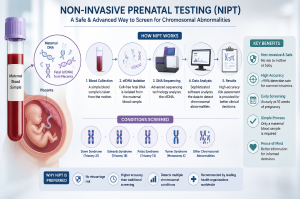
The increasing prevalence of chromosomal abnormalities, rising maternal age, growing awareness of early prenatal diagnosis, and rapid advancements in next-generation sequencing (NGS) and cell-free DNA (cfDNA) analysis continue to fuel global demand for NIPT. Healthcare providers are increasingly recommending non-invasive prenatal testing due to its high accuracy, early detection capability, and reduced risk compared to invasive procedures such as amniocentesis.
Furthermore, artificial intelligence, cloud-based genomic analytics, automated sequencing platforms, and expanded reimbursement policies are transforming prenatal screening into a more accessible, personalized, and efficient diagnostic solution. Growing investments in precision medicine, maternal healthcare infrastructure, and genetic counseling services are expected to create significant growth opportunities throughout the forecast period.
Non-Invasive Prenatal Testing Market Overview
Non-invasive prenatal testing (NIPT) is an advanced genetic screening method that analyzes cell-free fetal DNA (cfDNA) circulating in maternal blood to identify chromosomal abnormalities without risking the pregnancy. Unlike invasive diagnostic procedures, NIPT requires only a maternal blood sample, making it one of the safest prenatal screening methods available. The technology is widely used to screen for conditions including Down syndrome (Trisomy 21), Edwards syndrome (Trisomy 18), Patau syndrome (Trisomy 13), Turner syndrome, and several other chromosomal abnormalities.
Growing awareness among expectant parents, improvements in sequencing technologies, declining testing costs, and stronger physician recommendations are making NIPT an increasingly important component of modern prenatal care worldwide. Continuous innovation in artificial intelligence, bioinformatics, machine learning, and genomic data interpretation is further improving test accuracy while reducing turnaround times and false-positive rates.
Non-Invasive Prenatal Testing Market at a Glance
| Market Scope | Details |
|---|---|
| Market Size 2025 | USD 7.18 Billion |
| Market Size 2026 | USD 8.05 Billion |
| Market Size 2035 | USD 20.89 Billion |
| CAGR (2026–2035) | 11.27% |
| Largest Region | North America |
Download the Sample: https://www.precedenceresearch.com/sample/3362
10 Trends Reshaping the Non-Invasive Prenatal Testing Market in 2026 and Beyond
Trend #1: Rising Maternal Age Is Increasing Demand for Prenatal Genetic Screening
- The global trend toward delayed pregnancies has significantly increased demand for prenatal genetic screening. Women choosing to have children later in life face a higher risk of chromosomal abnormalities, making early prenatal diagnosis increasingly important.
- Healthcare providers now routinely recommend NIPT for high-risk pregnancies because of its excellent detection accuracy and non-invasive nature.
- Growing awareness regarding maternal health, expanding prenatal care programs, and increasing physician recommendations continue driving adoption worldwide.
Growth is supported by:
- Increasing maternal age
- Rising high-risk pregnancies
- Growing awareness of genetic disorders
- Higher physician recommendations
- Demand for early diagnosis
Trend #2: AI is Transforming Genetic Data Interpretation
- Artificial intelligence is dramatically improving the speed and accuracy of prenatal genetic analysis.
- AI-powered bioinformatics platforms analyze enormous genomic datasets, identify chromosomal abnormalities more efficiently, reduce false positives, and improve clinical interpretation.
- Machine learning algorithms also assist physicians by providing predictive insights, risk assessment, and automated quality control throughout sequencing workflows.
AI applications include:
- Automated genomic analysis
- Predictive risk assessment
- Improved diagnostic accuracy
- Reduced false positives
- Faster clinical decision-making
Trend #3: Next-Generation Sequencing Continues to Improve Testing Accuracy
- Continuous innovation in next-generation sequencing (NGS) technology has significantly improved the sensitivity and specificity of NIPT.
- Modern sequencing platforms require smaller DNA samples while delivering faster results and detecting a broader range of chromosomal abnormalities.
- Improved sequencing technologies are making NIPT increasingly reliable and clinically accepted across developed and emerging healthcare markets.
NGS advancements provide:
- Higher testing accuracy
- Faster turnaround time
- Expanded genetic screening
- Improved sequencing efficiency
- Better clinical confidence
Trend #4: Expansion Beyond Common Chromosomal Disorders
- Originally focused on detecting Down syndrome, NIPT now screens for a much broader range of genetic conditions.
- Manufacturers continue expanding testing panels to include sex chromosome abnormalities, microdeletions, single-gene disorders, and inherited genetic diseases.
- Broader testing capabilities allow physicians to provide more comprehensive prenatal risk assessments while supporting personalized pregnancy management.
Expanded screening includes:
- Turner syndrome
- Microdeletion disorders
- Single-gene diseases
- Rare chromosomal abnormalities
- Comprehensive fetal health assessment
Trend #5: Growing Demand for Personalized Prenatal Care
- Expectant parents increasingly seek personalized healthcare solutions that provide detailed genetic insights while minimizing clinical risks.
- NIPT supports individualized pregnancy management by enabling physicians to tailor follow-up care based on each patient’s genetic profile.
- The combination of genetic counseling, AI-assisted analysis, and precision medicine is improving patient confidence and healthcare outcomes.
Personalized care includes:
- Individual genetic risk assessment
- Precision medicine
- Tailored pregnancy management
- Enhanced counseling services
- Better patient engagement
Trend #6: Hospitals Continue Leading Clinical Adoption
- Hospitals remain the largest end-user segment due to their ability to provide integrated prenatal care, genetic counseling, diagnostic confirmation, and pregnancy management under one healthcare system.
- Increasing numbers of high-risk pregnancies and improved maternal healthcare infrastructure continue strengthening hospital adoption worldwide.
Hospital demand is supported by:
- Comprehensive prenatal services
- Advanced diagnostic facilities
- Integrated patient care
- Higher testing volumes
- Growing maternal healthcare investment
Trend #7: Diagnostic Laboratories are Expanding Rapidly
Specialized diagnostic laboratories are becoming one of the fastest-growing segments within the NIPT market.
High-throughput sequencing equipment, automation, and specialized molecular diagnostics enable laboratories to process large testing volumes with exceptional accuracy.
Growing outsourcing by hospitals further supports laboratory expansion.
Laboratory growth is driven by:
- High-throughput sequencing
- Automation technologies
- Outsourced testing services
- Faster result delivery
- Improved operational efficiency
Trend #8: Emerging Markets Are Becoming Growth Engines
- Asia-Pacific, Latin America, and the Middle East are experiencing rapid adoption of prenatal genetic screening.
- Growing healthcare investments, rising disposable incomes, expanding maternal healthcare programs, and greater awareness of prenatal diagnosis continue accelerating demand across developing economies.
- Governments are also investing heavily in maternal and child healthcare initiatives.
Growth drivers include:
- Healthcare infrastructure expansion
- Rising healthcare spending
- Urbanization
- Growing middle class
- Government maternal health programs
Trend #9: Declining Testing Costs are Improving Accessibility
- Technological advancements and larger testing volumes have significantly reduced the cost of NIPT over recent years.
- Improved reimbursement policies, strategic partnerships, and laboratory automation are making prenatal genetic screening accessible to a broader patient population.
- Greater affordability is expected to remain a major growth driver over the coming decade.
Accessibility improves through:
- Lower sequencing costs
- Better reimbursement
- Automation
- Public healthcare support
- Competitive pricing
Trend #10: Digital Healthcare Integration is Enhancing Prenatal Screening
- Digital healthcare platforms, electronic medical records, telemedicine, and cloud-based genomic analytics are streamlining the entire prenatal testing journey.
- Healthcare providers can now securely share results, provide virtual genetic counseling, and monitor pregnancies more efficiently.
- Digital integration is expected to significantly improve patient experience and healthcare efficiency.
Digital innovations include:
- Cloud genomic platforms
- Tele-genetic counseling
- Electronic health records
- Remote patient support
- Secure data management
What Opportunities Lie Ahead?
Expansion of AI-Powered Prenatal Diagnostics
- Artificial intelligence is expected to play an increasingly important role in the future of non-invasive prenatal testing by improving the speed, accuracy, and reliability of genetic data analysis. AI-powered algorithms can quickly identify chromosomal abnormalities, reduce false-positive rates, and assist clinicians in interpreting complex genomic information. As healthcare providers continue adopting AI-driven decision support systems, NIPT companies have significant opportunities to develop smarter diagnostic platforms that deliver personalized risk assessments, automated reporting, and enhanced clinical outcomes.
Growing Adoption in Emerging Markets
- Emerging economies across Asia Pacific, Latin America, the Middle East, and Africa present substantial growth opportunities for the NIPT market. Rising healthcare investments, expanding access to prenatal care, improving diagnostic infrastructure, and increasing awareness of genetic screening are encouraging greater adoption of non-invasive testing. As disposable incomes continue to rise and governments strengthen maternal healthcare programs, manufacturers can expand their presence by offering affordable, region-specific testing solutions tailored to local healthcare needs.
Expansion of Genetic Counseling Services
- As prenatal genetic testing becomes more comprehensive, the demand for professional genetic counseling is growing rapidly. Healthcare providers increasingly recognize the importance of helping expectant parents understand test results, evaluate potential risks, and make informed pregnancy decisions. This creates significant opportunities for NIPT companies to integrate pre-test and post-test counseling services, tele-genetic consultation platforms, and personalized patient education into their diagnostic offerings, enhancing both patient experience and clinical value.
Broader Genetic Screening Capabilities
- Advancements in genomic technologies are enabling NIPT to detect a wider range of genetic conditions beyond common chromosomal abnormalities such as Down syndrome. Future testing panels are expected to include microdeletion syndromes, rare genetic disorders, inherited single-gene diseases, and expanded carrier screening. Companies investing in broader and more comprehensive testing portfolios can strengthen their competitive position while meeting the growing demand for personalized prenatal healthcare.
Strategic Collaborations and Precision Medicine
- Partnerships between diagnostic companies, biotechnology firms, pharmaceutical manufacturers, research institutions, and healthcare providers are creating new opportunities across the prenatal diagnostics ecosystem. Collaborative efforts in genomic research, biomarker discovery, AI-enabled diagnostics, and precision medicine can accelerate product innovation and improve clinical outcomes. In addition, integrating NIPT into personalized healthcare strategies will support the development of targeted therapies and individualized pregnancy management, opening new long-term revenue opportunities for market participants.
Recent Developments in the Non-Invasive Prenatal Testing Market
- August 2025: Natera introduced Fetal Focus, a non-invasive prenatal test designed to detect inherited genetic conditions using advanced cell-free DNA technology.
- June 2025: NHS England announced plans to expand DNA-based newborn screening supported by genomic sequencing and AI technologies.
- February 2025: Researchers reported a breakthrough in prenatal gene therapy for Spinal Muscular Atrophy (SMA Type 1), demonstrating the growing role of genomic medicine in fetal healthcare.
Non-Invasive Prenatal Testing Market Companies
Leading companies continue investing in genomic innovation, AI integration, sequencing technologies, and strategic collaborations to strengthen their market position.
Major market participants include:
- Illumina, Inc.
- Natera, Inc.
- F. Hoffmann-La Roche Ltd.
- Laboratory Corporation of America Holdings (Labcorp)
- Quest Diagnostics, Inc.
- BGI Genomics
- Qiagen
- Eurofins LifeCodexx GmbH
- Myriad Women’s Health
- MedGenome Labs Ltd.
- Genesis Genetics (CooperSurgical)
- Centogene N.V.
Read More: Water Purifier Market
Regional Outlook
North America
- North America accounted for over 43% of global market revenue in 2025, supported by advanced healthcare infrastructure, widespread adoption of prenatal screening, favorable reimbursement policies, and strong biotechnology innovation.
Europe
- Europe continues to experience steady growth due to expanding prenatal screening programs, strong healthcare systems, and increasing awareness of early genetic diagnosis.
Asia Pacific
- Asia Pacific is expected to register the fastest CAGR during the forecast period, driven by rising healthcare investments, expanding prenatal care services, growing awareness, and increasing disposable incomes.
Middle East & Africa
- Healthcare modernization, increasing maternal health programs, and growing investments in diagnostic infrastructure are supporting regional market growth.
Latin America
- Improving healthcare accessibility, growing awareness of prenatal screening, and expanding private healthcare services continue driving adoption across Latin America.
Looking Ahead
The global Non-Invasive Prenatal Testing (NIPT) market is poised for robust growth as prenatal healthcare increasingly shifts toward safer, earlier, and more accurate genetic screening solutions. Rising maternal age, growing awareness of chromosomal disorders, and continuous advances in next-generation sequencing, artificial intelligence, and bioinformatics are reshaping prenatal diagnostics worldwide.
Expanding reimbursement coverage, declining testing costs, and improvements in healthcare infrastructure are making NIPT more accessible across both developed and emerging markets. At the same time, ongoing innovations in precision medicine, cloud-based genomic analytics, and integrated genetic counseling are enhancing clinical decision-making and improving patient outcomes.
As prenatal care becomes increasingly personalized and technology-driven, companies that focus on innovation, affordability, clinical accuracy, digital integration, and global market expansion will be well positioned to capitalize on the significant growth opportunities in the Non-Invasive Prenatal Testing market through 2035.
You can place an order or ask any questions. Please feel free to contact us at sales@precedenceresearch.com | +1 804 441 9344

