
 by
by The U.S. concierge medicine market is entering a transformative growth phase as consumers increasingly seek personalized, preventive, and technology-enabled healthcare services. The market was valued at USD 6.55 billion in 2025 and is projected to reach approximately USD 12.75 billion by 2035, expanding at a CAGR of 6.88% from 2026 to 2035.
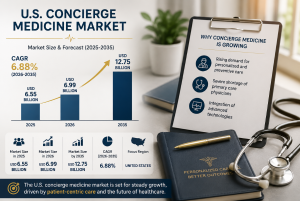
Driven by physician shortages, rising chronic disease prevalence, increasing demand for preventive healthcare, and rapid digital health innovation, concierge medicine has emerged as one of the fastest-growing healthcare delivery models in the United States. Patients are increasingly willing to pay membership-based fees in exchange for enhanced physician access, longer consultations, proactive wellness planning, and customized treatment experiences.
Artificial intelligence, telemedicine, wearable health technologies, remote patient monitoring, and precision medicine are further transforming concierge care into an integrated, patient-centric healthcare ecosystem. As healthcare shifts toward value-based care and individualized treatment, concierge medicine is expected to play an increasingly important role in shaping the future of American healthcare.
U.S. Concierge Medicine Market Overview
Concierge medicine is a membership-based healthcare model that offers patients personalized medical services beyond the scope of traditional primary care. Patients pay annual or monthly membership fees in return for benefits such as same-day appointments, extended physician consultations, direct communication with doctors, preventive wellness programs, and coordinated specialty care. Unlike conventional healthcare systems, concierge medicine emphasizes stronger physician-patient relationships, proactive disease prevention, chronic disease management, and continuous health monitoring. Physicians also benefit from smaller patient panels, reduced administrative burdens, greater clinical autonomy, and improved work-life balance.
The market has evolved significantly in recent years with the integration of digital health technologies, artificial intelligence, telehealth platforms, wearable devices, and multidisciplinary healthcare teams. Concierge practices increasingly include physician assistants, nurse practitioners, nutritionists, mental health professionals, and wellness coaches to deliver comprehensive healthcare experiences tailored to individual patient needs.
U.S. Concierge Medicine Market at a Glance
| Market Scope | Details |
|---|---|
| Market Size 2025 | USD 6.55 Billion |
| Market Size 2026 | USD 6.99 Billion |
| Market Size 2035 | USD 12.75 Billion |
| CAGR (2026–2035) | 6.88% |
| Largest Market | United States |
Download the Sample: https://www.precedenceresearch.com/sample/3521
10 Trends Reshaping the U.S. Concierge Medicine Market in 2026 and Beyond
Trend #1: Personalized Healthcare Is Becoming the New Standard
American consumers increasingly expect healthcare services that are tailored to their individual medical history, lifestyle, and long-term wellness goals. Concierge medicine addresses these expectations by offering highly personalized care that focuses on prevention rather than reactive treatment.
Unlike traditional practices that often manage thousands of patients, concierge physicians typically maintain smaller patient panels. This allows physicians to spend significantly more time with each patient, resulting in comprehensive health assessments, individualized treatment plans, and stronger long-term physician-patient relationships.
Growing dissatisfaction with overcrowded healthcare systems, rushed appointments, and fragmented care continues to encourage patients to transition toward membership-based healthcare models.
Personalized concierge care offers:
- Extended physician consultations
- Same-day or next-day appointments
- Individualized wellness planning
- Preventive health screenings
- Strong physician-patient relationships
Trend #2: Artificial Intelligence Is Revolutionizing Concierge Healthcare
Artificial intelligence has rapidly become one of the most transformative technologies in concierge medicine. AI-powered platforms enable physicians to analyze large volumes of patient data, improve diagnostic accuracy, identify disease risks earlier, and develop highly personalized treatment strategies.
Virtual health assistants now support patients around the clock by answering health questions, scheduling appointments, monitoring medication adherence, and providing lifestyle recommendations. AI also automates administrative functions such as billing, documentation, scheduling, and electronic medical record management, allowing physicians to spend more time focusing on patient care.
Wearable devices integrated with AI analytics enable continuous monitoring of heart rate, sleep quality, blood glucose, activity levels, and other vital health indicators. These technologies support proactive intervention before health conditions become severe.
AI is transforming concierge medicine through:
- Clinical decision support
- Predictive diagnostics
- Virtual patient assistants
- Administrative automation
- Remote health monitoring
Trend #3: Preventive Care Is Replacing Reactive Treatment
Preventive healthcare has become a major priority among both healthcare providers and consumers. Rather than waiting until illness develops, patients increasingly seek ongoing health assessments, lifestyle coaching, chronic disease prevention, and wellness optimization. Concierge medicine aligns perfectly with this shift by emphasizing early intervention, regular screenings, nutritional counseling, exercise planning, stress management, and long-term health monitoring.
The aging U.S. population, combined with increasing rates of diabetes, cardiovascular disease, obesity, hypertension, and other chronic conditions, has accelerated demand for healthcare models focused on prevention rather than treatment.
Employers are also recognizing the financial benefits of preventive healthcare by incorporating concierge medicine into executive wellness and employee healthcare programs, helping reduce long-term healthcare costs while improving workforce productivity.
Preventive healthcare services include:
- Annual executive health assessments
- Chronic disease monitoring
- Personalized nutrition planning
- Lifestyle coaching
- Long-term wellness management
Trend #4: Telemedicine Is Expanding the Reach of Concierge Care
Telemedicine has become a cornerstone of modern concierge medicine, enabling physicians to provide personalized care beyond the traditional clinic setting. Patients increasingly expect healthcare services that are available whenever and wherever they need them, and virtual consultations have become an essential component of membership-based healthcare.
Concierge practices now combine video consultations, secure messaging, electronic prescriptions, remote diagnostics, and virtual follow-up visits to deliver seamless patient experiences. These digital services reduce travel time, improve appointment flexibility, and provide faster access to medical professionals, particularly for busy executives, seniors, and individuals living in underserved areas.
The widespread adoption of telehealth technologies since the COVID-19 pandemic has permanently changed patient expectations, making virtual healthcare an integral part of concierge medicine.
Telemedicine enables:
- Virtual physician consultations
- Secure messaging with healthcare providers
- Electronic prescriptions
- Remote follow-up appointments
- Greater healthcare accessibility
Trend #5: Mental Healthcare Is Becoming a Major Growth Opportunity
Mental health has become one of the fastest-growing specialties within concierge medicine as patients increasingly seek personalized, confidential, and continuous behavioral healthcare services. Rising awareness of anxiety, depression, stress-related disorders, burnout, and other mental health conditions has significantly increased demand for premium psychiatric care.
Unlike conventional psychiatric practices that often face long waiting lists and brief consultations, concierge psychiatry offers extended appointments, individualized treatment plans, and direct communication with mental health specialists. This personalized approach enables providers to better understand each patient’s unique emotional, psychological, and lifestyle needs.
Growing demand is driven by:
- Rising mental health awareness
- Personalized psychiatric treatment
- Telepsychiatry adoption
- Integrated wellness programs
- Greater focus on preventive mental healthcare
Trend #6: Digital Health Ecosystems Are Enhancing Patient Engagement
Digital transformation is reshaping how concierge medicine providers interact with patients throughout their healthcare journey. Advanced electronic health records, patient portals, mobile applications, wearable devices, and AI-powered analytics are creating connected healthcare ecosystems that improve patient engagement and care coordination.
Patients can now monitor health metrics, access medical records, schedule appointments, receive medication reminders, communicate directly with physicians, and track wellness goals through integrated digital platforms. Healthcare providers benefit from real-time patient data that enables early intervention and more informed clinical decision-making.
Remote patient monitoring technologies are becoming increasingly valuable for managing chronic diseases such as diabetes, hypertension, cardiovascular disorders, and obesity. Continuous monitoring allows physicians to identify health risks earlier and intervene before complications develop.
Digital health innovations include:
- Electronic health records
- Mobile health applications
- Remote patient monitoring
- Wearable health devices
- AI-powered patient engagement tools
Trend #7: Membership-Based Healthcare Is Gaining Mainstream Acceptance
Membership-based healthcare models are becoming increasingly popular among both patients and physicians. Consumers are willing to pay recurring membership fees in exchange for enhanced healthcare experiences, while physicians appreciate reduced administrative burdens and the opportunity to provide more meaningful patient care.
For patients, concierge medicine offers predictable healthcare costs, greater physician accessibility, longer appointment times, and comprehensive wellness planning. Employers are also beginning to incorporate concierge healthcare into executive health programs and employee wellness benefits as a strategy to improve workforce productivity and reduce long-term healthcare expenditures.
Physicians are increasingly transitioning from traditional insurance-based practices to concierge medicine in response to growing administrative complexity, physician burnout, and declining reimbursement rates. Smaller patient panels allow providers to focus more on clinical care and less on paperwork, improving both physician satisfaction and patient outcomes.
Membership-based healthcare provides:
- Enhanced physician accessibility
- Longer appointment times
- Reduced waiting periods
- Personalized preventive care
- Improved patient satisfaction
Trend #8: Government Policies and Healthcare Innovation Are Supporting Market Expansion
Government initiatives aimed at improving healthcare accessibility, promoting preventive medicine, and accelerating digital health adoption are creating a favorable environment for the growth of concierge medicine across the United States.
Federal and state policymakers continue to explore frameworks that support alternative healthcare delivery models while ensuring affordability, transparency, and regulatory compliance. Discussions around expanding the use of Health Savings Accounts (HSAs) for concierge medicine and Direct Primary Care (DPC) memberships could significantly improve patient access to personalized healthcare services.
In parallel, government agencies are investing heavily in healthcare modernization, interoperability, AI adoption, and medical research. Programs supporting digital therapeutics, chronic disease management, and technology-enabled healthcare are encouraging concierge practices to integrate advanced diagnostic tools, virtual care platforms, and preventive health solutions into everyday clinical practice.
Government support is driving:
- Healthcare modernization
- Digital health adoption
- Preventive care initiatives
- Medical innovation
- Expanded patient access
Trend #9: Rising Chronic Disease Burden Is Increasing Demand for Concierge Care
The growing prevalence of chronic diseases is becoming one of the strongest long-term drivers of the U.S. concierge medicine market. Conditions such as diabetes, hypertension, cardiovascular disease, obesity, and metabolic disorders require continuous monitoring, lifestyle modifications, and personalized treatment strategies that traditional healthcare systems often struggle to provide.
Concierge medicine enables physicians to closely monitor patients through regular consultations, personalized care plans, remote monitoring technologies, and proactive interventions. Longer appointment times allow physicians to address underlying lifestyle factors rather than simply treating symptoms.
The increasing number of aging Americans further strengthens market demand. Older adults typically require more frequent physician interaction, medication management, preventive screenings, and coordinated specialist care all of which align closely with the concierge healthcare model.
Growing demand is supported by:
- Rising diabetes prevalence
- Aging population
- Cardiovascular disease management
- Preventive chronic care
- Continuous patient monitoring
Trend #10: Precision Medicine and Longevity Care Are Creating Premium Healthcare Opportunities
Healthcare is rapidly evolving from disease treatment toward longevity, wellness optimization, and precision medicine. Concierge practices are increasingly incorporating genomic testing, biomarker analysis, advanced diagnostics, personalized nutrition, hormone optimization, and lifestyle medicine into their service offerings.
Rather than delivering standardized treatment protocols, physicians use patient-specific health data to develop individualized wellness strategies designed to improve long-term health outcomes and extend healthy lifespan.
Artificial intelligence, wearable technologies, laboratory diagnostics, and precision health analytics are enabling concierge physicians to identify disease risks earlier and recommend highly customized interventions. This premium healthcare approach is particularly attractive to executives, entrepreneurs, aging adults, and health-conscious consumers seeking comprehensive preventive care and long-term wellness management.
Precision healthcare includes:
- Genomic screening
- Personalized wellness plans
- Longevity medicine
- Advanced health diagnostics
- Lifestyle optimization
What Opportunities Lie Ahead?
- Expansion of Preventive Healthcare: Growing consumer awareness regarding disease prevention, healthy aging, and long-term wellness will continue driving demand for personalized healthcare services.
- Digital Health Integration: Artificial intelligence, wearable devices, telemedicine, and remote patient monitoring will further strengthen concierge medicine by enabling continuous, data-driven healthcare delivery.
- Corporate Wellness Programs: Employers increasingly recognize concierge medicine as a valuable employee benefit that improves workforce productivity while reducing long-term healthcare expenditures.
- Mental Health Services: Rising demand for personalized psychiatric care creates significant opportunities for concierge practices specializing in behavioral health and wellness.
- Precision and Longevity Medicine: Consumers are increasingly investing in personalized health optimization, creating new revenue opportunities for premium concierge healthcare providers offering advanced diagnostics and individualized treatment plans.
Read More: Whey Protein Market
Recent Developments in the U.S. Concierge Medicine Market
- February 2026: MedStar Health launched Signature by MedStar, a premium concierge medicine practice offering personalized healthcare, dedicated physician teams, and enhanced patient support.
- June 2025: Sun Life partnered with concierge care provider Wellthy to improve end-of-life care services and provide members with personalized healthcare guidance.
- January 2025: MDVIP expanded its behavioral wellness services by partnering with mental health providers to integrate psychology into concierge healthcare.
- December 2024: SignatureMD introduced a hybrid concierge model designed specifically for rural physician practices, improving flexibility and expanding patient access.
- October 2024: Forward Health secured USD 100 million in Series D funding to expand AI-powered virtual clinics and remote diagnostic technologies, accelerating digital transformation within concierge medicine.
Leading Companies in the U.S. Concierge Medicine Market
Several organizations are driving innovation through personalized care models, digital health integration, preventive healthcare services, and physician practice management.
Key companies include:
- Priority Physicians, Inc.
- Castle Connolly Private Health Partners
- PartnerMD
- Concierge Consultants and Cardiology
- MDVIP
- SignatureMD
- Specialdocs Consultants
- Crossover Health
- One Medical
- Sollis Health
Looking Ahead
The U.S. concierge medicine market is transforming the future of healthcare by shifting the focus from reactive treatment to personalized, preventive, and technology-enabled care. Rising consumer expectations for better physician access, longer consultations, proactive wellness planning, and individualized treatment are driving sustained market growth.
Advancements in artificial intelligence, telehealth, wearable technologies, remote patient monitoring, and precision medicine are enabling concierge healthcare providers to deliver smarter, more connected, and highly customized patient experiences. At the same time, growing physician burnout within traditional healthcare systems is encouraging more providers to adopt membership-based practice models that emphasize quality of care over patient volume.
As chronic diseases become more prevalent, the population ages, and digital healthcare continues to evolve, concierge medicine is expected to become an increasingly important component of the U.S. healthcare ecosystem. Organizations that successfully combine clinical excellence, innovative technology, preventive care, and patient-centered service models will be well positioned to capitalize on the market’s long-term growth opportunities through 2035.
You can place an order or ask any questions. Please feel free to contact us at sales@precedenceresearch.com | +1 804 441 9344

