
 by
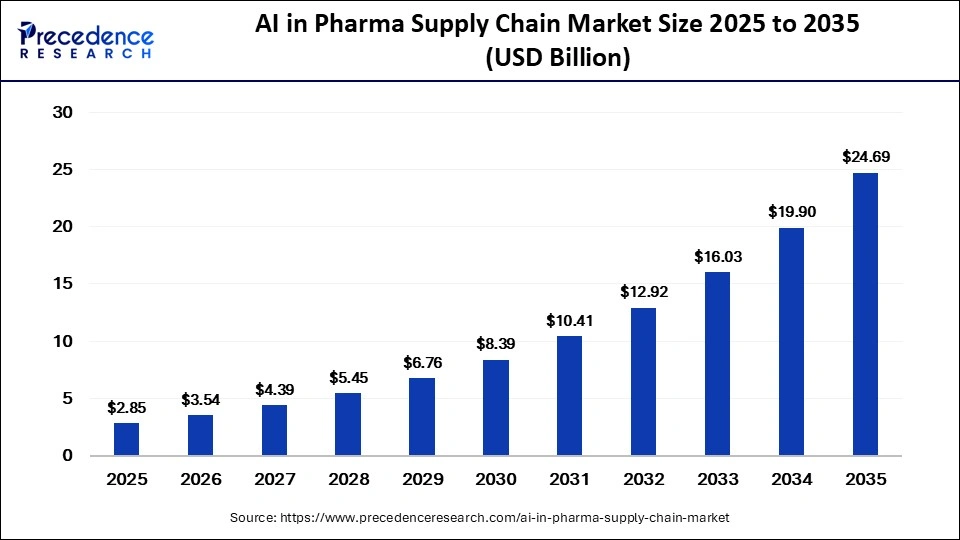
by The global AI in pharma supply chain market is projected to grow from USD 4.62 billion in 2026 to USD 34.82 billion by 2035 at a CAGR of 25.20%. Explore market trends, drivers, regional analysis, opportunities, and key industry players.
Introduction
Artificial intelligence is rapidly transforming pharmaceutical supply chains by improving visibility, operational efficiency, demand forecasting, inventory management, and regulatory compliance. As pharmaceutical companies face increasing pressure to optimize global logistics networks, reduce supply disruptions, and ensure drug safety, AI-powered supply chain technologies are becoming essential across manufacturing, warehousing, transportation, and distribution operations.
The pharmaceutical industry operates within highly regulated and complex supply chains that involve temperature-sensitive products, strict compliance standards, and large-scale global distribution networks. AI technologies such as machine learning, predictive analytics, computer vision, and automation are helping organizations improve supply chain resilience while reducing costs and operational inefficiencies.
According to Precedence Research, the global AI in pharma supply chain market size was valued at USD 3.70 billion in 2025 and is expected to increase from USD 4.62 billion in 2026 to approximately USD 34.82 billion by 2035, growing at a CAGR of 25.20% during the forecast period.
Read Also: Multilingual LLM Market
AI in Pharma Supply Chain Market Overview
AI in pharma supply chain refers to the integration of artificial intelligence technologies into pharmaceutical logistics, procurement, manufacturing, warehouse management, transportation, cold chain monitoring, and demand planning systems.
Pharmaceutical companies increasingly rely on AI-driven analytics platforms to improve forecasting accuracy, optimize inventory levels, automate procurement workflows, monitor cold-chain compliance, and predict potential supply disruptions. These technologies enable organizations to reduce waste, prevent drug shortages, and improve patient access to medications.
The growing complexity of global pharmaceutical distribution networks, coupled with rising demand for personalized medicine and biologics, is accelerating the adoption of intelligent supply chain systems. AI-enabled automation and predictive analytics are now considered critical components of modern pharmaceutical operations.
Key Market Statistics
Major Market Highlights
- The AI in pharma supply chain market is projected to grow at a CAGR of 25.20% from 2026 to 2035.
- North America accounted for 41% of the global market share in 2025.
- Asia-Pacific is expected to witness the fastest CAGR of 27.8% during the forecast period.
- Software solutions dominated the component segment with 66% share in 2025.
- Cloud-based deployment accounted for 69% of market share in 2025.
- Machine learning technology held 34% market share in 2025.
- Demand forecasting represented 24% of application share in 2025.
- Pharmaceutical manufacturers contributed 44% of end-user market share in 2025.
Key Market Drivers
Rising Need for Supply Chain Visibility and Resilience
The pharmaceutical industry continues to face supply chain disruptions caused by geopolitical tensions, raw material shortages, pandemics, and transportation bottlenecks.
AI-powered analytics platforms provide real-time visibility into inventory levels, shipment tracking, supplier performance, and logistics operations. These capabilities help pharmaceutical companies proactively manage risks and maintain operational continuity.
AI systems can identify potential disruptions before they occur, enabling organizations to implement contingency plans and optimize inventory allocation.
Growing Demand for Predictive Analytics
Predictive analytics has become one of the most valuable applications of AI in pharmaceutical supply chains.
Machine learning algorithms analyze historical sales patterns, patient demand trends, weather conditions, epidemiological data, and logistics performance to improve forecasting accuracy and inventory planning.
Demand forecasting accounted for 24% market share in 2025 because of increasing industry focus on minimizing stockouts and reducing excess inventory.
Expansion of Cold Chain Logistics
The rapid growth of biologics, vaccines, cell therapies, and temperature-sensitive pharmaceuticals is driving demand for advanced cold-chain monitoring systems.
AI-enabled sensors and IoT platforms help pharmaceutical companies monitor temperature, humidity, and transportation conditions in real time to ensure product quality and regulatory compliance.
The increasing global demand for biologic drugs is accelerating investment in intelligent cold-chain infrastructure.
Rising Adoption of Automation and Smart Warehousing
Pharmaceutical manufacturers and distributors are increasingly integrating robotics, AI-powered warehouse management systems, and autonomous logistics technologies into supply chain operations.
AI automation improves picking accuracy, inventory management, route optimization, and warehouse productivity while reducing labor costs and human error.
Market Trends
Integration of Generative AI in Supply Chain Management
Generative AI is emerging as a powerful tool for pharmaceutical supply chain optimization.
Companies are using generative AI models to simulate supply chain scenarios, automate documentation, optimize procurement strategies, and improve logistics planning.
AI copilots are also being integrated into enterprise resource planning systems to support decision-making and operational efficiency.
Growth of Digital Twin Technology
Digital twin technology is gaining popularity across pharmaceutical manufacturing and logistics operations.
AI-powered digital twins enable organizations to create virtual replicas of supply chain systems for simulation, monitoring, predictive maintenance, and performance optimization.
These systems improve supply chain transparency and operational decision-making.
Increasing Adoption of Blockchain and AI Integration
Pharmaceutical companies are increasingly integrating blockchain technology with AI to improve traceability, authentication, and compliance monitoring.
These combined technologies help prevent counterfeit drugs, improve transaction transparency, and strengthen pharmaceutical supply chain security.
Market Restraints
Data Privacy and Cybersecurity Concerns
Pharmaceutical supply chains handle highly sensitive patient, manufacturing, and logistics data.
The growing use of AI and cloud-based platforms increases exposure to cybersecurity risks, ransomware attacks, and data privacy concerns.
Organizations must invest heavily in cybersecurity infrastructure, encryption technologies, and regulatory compliance systems to protect critical information.
High Implementation Costs
Deploying AI-powered pharmaceutical supply chain infrastructure requires significant investment in cloud systems, software platforms, IoT sensors, analytics tools, and workforce training.
Small and mid-sized pharmaceutical companies may face challenges related to technology adoption and budget limitations.
Integration Challenges with Legacy Systems
Many pharmaceutical organizations still rely on outdated enterprise systems and fragmented supply chain infrastructure.
Integrating AI platforms with legacy ERP systems, warehouse management solutions, and logistics software can be technically complex and time-consuming.
Emerging Opportunities
Personalized Medicine and Precision Healthcare
The growing adoption of personalized medicine is creating new supply chain complexities that require advanced AI-driven logistics management.
Precision therapies often involve smaller batch sizes, customized production schedules, and specialized transportation requirements.
AI technologies help pharmaceutical companies optimize these highly complex supply chain operations efficiently.
Expansion in Emerging Markets
Emerging economies are increasingly investing in healthcare infrastructure, pharmaceutical manufacturing, and digital transformation initiatives.
Asia-Pacific is expected to witness the fastest CAGR of 27.8% during the forecast period because of expanding pharmaceutical production and rising healthcare digitization across China, India, Japan, and Southeast Asia.
Sustainability and Green Logistics
Pharmaceutical companies are increasingly adopting AI-driven sustainability initiatives to reduce carbon emissions, optimize transportation routes, and minimize energy consumption.
AI-enabled logistics optimization tools help organizations improve fuel efficiency and reduce environmental impact across global supply chain networks.
Segmental Analysis
By Component
Software Segment Dominance
The software segment dominated the market with 66% share in 2025 due to increasing demand for AI analytics platforms, warehouse management systems, and supply chain monitoring software.
Services Segment Growth
The services segment continues to grow steadily because of rising demand for consulting, integration, cybersecurity, and AI deployment support services.
By Deployment Mode
Cloud-Based Deployment Leadership
Cloud-based deployment accounted for 69% market share in 2025 because of scalability, flexibility, and centralized data management capabilities.
On-Premise Deployment
On-premise systems remain important for pharmaceutical companies requiring greater control over sensitive operational data and regulatory compliance.
By Technology
Machine Learning Dominance
Machine learning held 34% market share in 2025 and remains the core technology behind predictive analytics, inventory optimization, and logistics forecasting systems.
Computer Vision and IoT Expansion
Computer vision systems are increasingly used for quality inspection, packaging verification, and warehouse automation.
IoT-enabled devices help organizations monitor environmental conditions and shipment integrity in real time.
Regional Analysis
North America
North America dominated the market with 41% share in 2025 due to advanced pharmaceutical manufacturing infrastructure, rapid AI adoption, and strong digital transformation initiatives.
Major pharmaceutical companies in the United States are heavily investing in predictive analytics, intelligent logistics, and automated warehouse technologies.
Europe
Europe continues to witness strong growth because of increasing pharmaceutical automation, stringent regulatory requirements, and rising focus on supply chain transparency.
Countries such as Germany, Switzerland, and the United Kingdom are major contributors to regional market expansion.
Asia-Pacific
Asia-Pacific is projected to experience the fastest growth during the forecast period due to expanding pharmaceutical manufacturing, healthcare digitization, and government investments in AI infrastructure.
China and India are emerging as key regional hubs for AI-driven pharmaceutical logistics and supply chain innovation.
Latin America and Middle East & Africa
These regions are gradually adopting AI-powered pharmaceutical supply chain technologies as healthcare infrastructure and pharmaceutical manufacturing capabilities expand.
Key Companies in the AI in Pharma Supply Chain Market
Major companies operating in the market include:
- IBM
- Microsoft
- SAP SE
- Oracle Corporation
- Amazon Web Services
- Google Cloud
- Blue Yonder
- Kinaxis
- Manhattan Associates
- Siemens
These companies are focusing on predictive analytics, intelligent automation, blockchain integration, and AI-driven logistics optimization solutions.
Get a Sample Copy: https://www.precedenceresearch.com/sample/8408
For inquiries regarding discounts, bulk purchases, or customization requests, please contact us at sales@precedenceresearch.com

- Hexanal Market Size to Reach USD 412.98 Billion by 2035 - June 26, 2026
- Cubeb Oil Market Size to Reach USD 122.93 Billion by 2035 - June 26, 2026
- U.S. Battery Logistics Market Size to Reach USD 11.43 Billion by 2035 - June 25, 2026
