
 by
by The global electronic data capture systems market size is calculated at USD 1.92 billion in 2025 and is predicted to increase at USD 2.17 billion in 2026 to approximately USD 6.42 billion by 2035, expanding at a CAGR of 12.83% from 2026 to 2035. Increasing digitization and the necessity for efficient data management across various industries such as healthcare, finance, and research are driving the EDC system market globally.
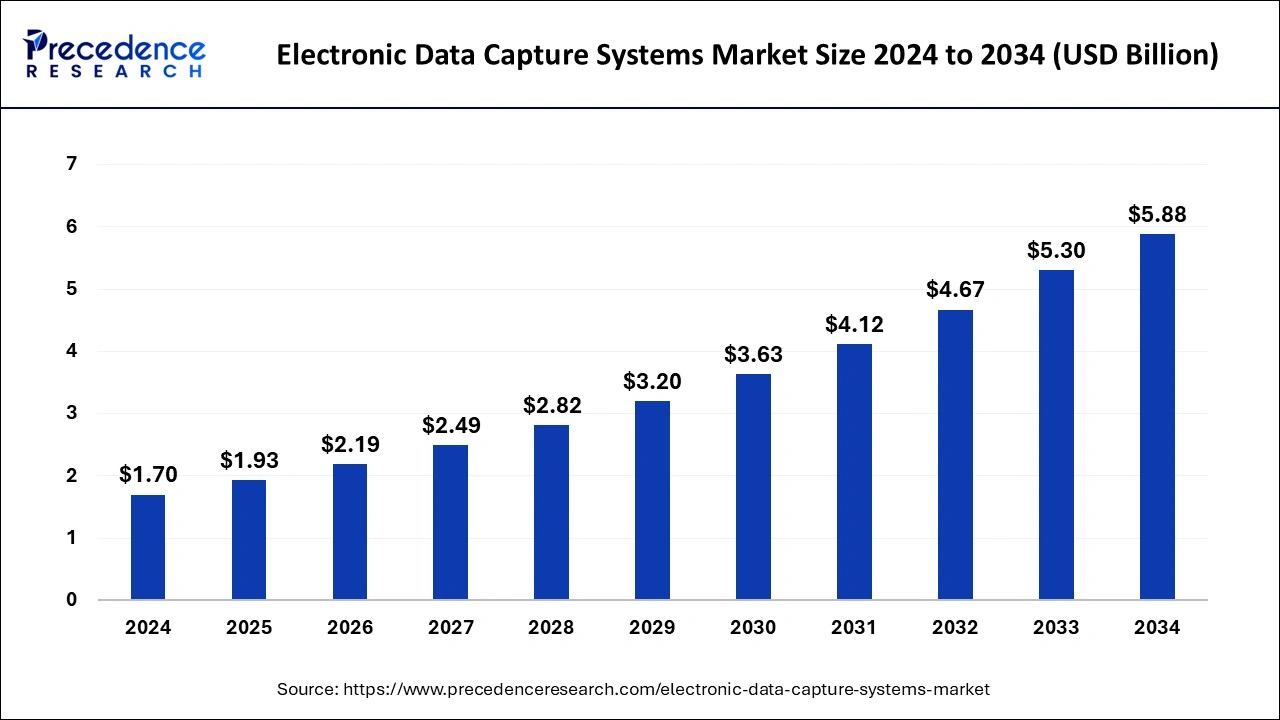
Electronic Data Capture Systems Market Key Takeaways
- North America emerged as the leading regional market, accounting for approximately 50% of the global market share in 2025.
- Based on development phase, the Phase III segment dominated the market, contributing around 54% of the total revenue in 2025.
- Among end users, Contract Research Organizations (CROs) held the largest market share of nearly 36% in 2025.
- The hospitals and healthcare providers segment is anticipated to register strong growth throughout the forecast period.
- By delivery mode, web- and cloud-based systems led the market with a 53% revenue share in 2025, reflecting the growing adoption of digital and remote data management solutions.
- In terms of components, the services segment captured the largest share of the global market and maintained its dominant position in 2025.
- The software segment is expected to experience substantial growth during the forecast period, driven by ongoing technological advancements and increasing demand for efficient data management platforms.
What is an Electronic Data Capture System?
An Electronic Data Capture (EDC) system is a specialized software platform designed to collect, validate, and manage data generated during clinical trials and healthcare research studies. Instead of using paper case report forms, researchers enter patient information directly into a secure digital system. EDC platforms provide automated validation checks, audit trails, real-time monitoring, and reporting capabilities, ensuring data accuracy and integrity throughout the research process. These systems support regulatory compliance while making clinical data more accessible and easier to analyze.
Get Sample Link: https://www.precedenceresearch.com/sample/4090
Importance of EDC Systems in Clinical Research
Clinical research depends heavily on accurate and timely data collection. EDC systems play a critical role in ensuring the quality and reliability of research data. By reducing manual data entry and minimizing errors, these platforms help researchers make informed decisions more quickly. EDC systems also enable real-time data access, allowing sponsors, investigators, and regulatory authorities to monitor study progress efficiently. Additionally, they simplify data management across multiple research sites, improve patient safety monitoring, and reduce the time required to complete clinical trials. As a result, EDC systems have become essential tools for pharmaceutical companies, biotechnology firms, contract research organizations, and healthcare providers.
Role of Artificial Intelligence in EDC Systems
Artificial intelligence is becoming an important component of modern Electronic Data Capture systems. AI-powered technologies can automatically detect data inconsistencies, identify missing information, and predict potential issues before they affect clinical studies. Machine learning algorithms help improve data quality by analyzing large datasets and recognizing patterns that may not be visible through manual review. AI also supports automated workflow management, reducing administrative burdens for research teams. As AI capabilities continue to evolve, EDC systems are becoming smarter, enabling faster decision-making and more efficient clinical trial management.
Importance of EDC Systems in Clinical Research
Clinical research relies heavily on accurate and reliable data. Even minor data errors can impact study outcomes, delay regulatory approvals, and increase research costs. EDC systems address these challenges by providing a centralized platform for data collection and management.
- Improved Data Accuracy: One of the biggest advantages of EDC systems is their ability to reduce manual errors. Built-in validation rules automatically identify missing or inconsistent data during entry, ensuring higher-quality datasets. Studies have shown that electronic data collection can significantly reduce transcription errors compared to paper-based methods.
- Faster Clinical Trial Execution: Clinical trials often involve multiple research sites across different countries. EDC systems allow researchers to access and review study data in real time, improving collaboration and accelerating decision-making. This helps sponsors identify issues early and keep studies on schedule.
- Regulatory Compliance: Regulatory agencies such as the U.S. Food and Drug Administration (FDA) and the European Medicines Agency (EMA) require strict documentation and audit trails. Modern EDC systems support compliance with standards such as FDA 21 CFR Part 11, ICH E6 Good Clinical Practice guidelines, and EU Annex 11 requirements.
- Cost Reduction: Paper-based studies require significant resources for printing, storage, monitoring, and data verification. EDC platforms automate many of these processes, reducing administrative costs and improving operational efficiency.
Role of Artificial Intelligence in EDC Systems
Artificial Intelligence (AI) is becoming one of the most transformative technologies in the EDC industry. AI-powered capabilities are helping organizations improve data quality, enhance operational efficiency, and generate actionable insights from clinical trial data.
- Automated Data Validation: AI algorithms can automatically identify anomalies, missing values, and inconsistencies in clinical datasets. This reduces the burden on research teams and improves overall data quality.
- Predictive Analytics: Machine learning models can analyze historical and real-time data to predict patient recruitment challenges, protocol deviations, and potential study risks. This enables proactive intervention and better trial management.
- Intelligent Monitoring: AI-powered monitoring tools can prioritize high-risk sites and patients, allowing research teams to focus their attention where it is needed most.
Key Benefits of Electronic Data Capture Systems
- Improved Data Quality: Built-in validation tools help identify errors and inconsistencies during data entry, ensuring higher-quality research data.
- Faster Clinical Trials: Automated workflows reduce administrative burdens and accelerate data processing, helping researchers bring treatments to market faster.
- Enhanced Regulatory Compliance: EDC platforms are designed to meet strict regulatory requirements, including data security, audit trails, and documentation standards.
- Cost Savings: Reducing paper usage, manual data entry, and data correction efforts lowers operational costs throughout the clinical trial process.
Emerging Trends Shaping the Electronic Data Capture System Market
- Artificial Intelligence Integration: Artificial intelligence (AI) is increasingly being integrated into EDC platforms to improve data quality, automate workflows, and identify potential issues before they impact clinical studies. AI-driven analytics can help researchers uncover patterns and trends more efficiently.
- Decentralized Clinical Trials: The rise of decentralized and hybrid clinical trials is creating new opportunities for EDC providers. Researchers need flexible digital platforms that support remote patient participation and virtual data collection.
- Mobile-Based Data Collection: Mobile-friendly EDC systems allow patients and healthcare professionals to submit information through smartphones and tablets, improving convenience and engagement.
Key Electronic Data Capture System Market Players
The Electronic Data Capture Systems market is highly competitive, with major technology providers continuously investing in innovation.
Leading companies include:
- Oracle Corporation
- IQVIA
- Veeva Systems
- Medidata Solutions
- IBM
- Clario
- Castor
- OpenClinica
Competition is centered around cloud capabilities, AI integration, cybersecurity, interoperability, and support for decentralized clinical trials. Strategic acquisitions and partnerships continue to reshape the competitive landscape.
Read More: Cryptocurrency Mining Market
Recent Industry Developments in the Electronic Data Capture System Market
Recent innovations are making EDC platforms more powerful and user-friendly than ever before.
Key developments include:
- AI-driven data quality monitoring
- Automated risk-based monitoring tools
- Real-time analytics dashboards
- Integration with electronic health records (EHRs)
- Enhanced mobile applications
- Cloud-native platform architectures
- Support for hybrid and decentralized trials
- Advanced cybersecurity and privacy controls
Vendors are increasingly developing unified clinical research platforms that combine EDC, analytics, patient engagement, and compliance management into a single ecosystem.
Electronic Data Capture System Market Future Outlook
The future of the Electronic Data Capture Systems market looks highly promising. As clinical trials become increasingly complex and data-intensive, organizations will continue adopting advanced EDC platforms to improve efficiency, compliance, and patient outcomes. The integration of artificial intelligence, cloud computing, and decentralized trial technologies is expected to further accelerate market growth over the next decade.
With healthcare organizations prioritizing digital transformation and real-time data management, electronic data capture systems will remain a cornerstone of modern clinical research and pharmaceutical development.
𝐘𝐨𝐮 𝐜𝐚𝐧 𝐩𝐥𝐚𝐜𝐞 𝐚𝐧 𝐨𝐫𝐝𝐞𝐫 𝐨𝐫 𝐚𝐬𝐤 𝐚𝐧𝐲 𝐪𝐮𝐞𝐬𝐭𝐢𝐨𝐧𝐬, 𝐩𝐥𝐞𝐚𝐬𝐞 𝐟𝐞𝐞𝐥 𝐟𝐫𝐞𝐞 𝐭𝐨 𝐜𝐨𝐧𝐭𝐚𝐜𝐭 𝐮𝐬 𝐚𝐭 𝐬𝐚𝐥𝐞𝐬@𝐩𝐫𝐞𝐜𝐞𝐝𝐞𝐧𝐜𝐞𝐫𝐞𝐬𝐞𝐚𝐫𝐜𝐡.𝐜𝐨𝐦

