
 by
by The global eyewear market is rapidly evolving as consumers increasingly seek technologically advanced, fashion-forward, and health-focused vision solutions. Rising cases of vision impairment, increasing digital screen exposure, and growing consumer preference for premium lifestyle accessories are significantly reshaping the future of the eyewear industry worldwide.
According to industry analysis by Precedence Research, the global eyewear market size was estimated at USD 160.00 billion in 2025 and is projected to increase from USD 170.24 billion in 2026 to approximately USD 297.53 billion by 2035, growing at a CAGR of 6.40% during the forecast period.
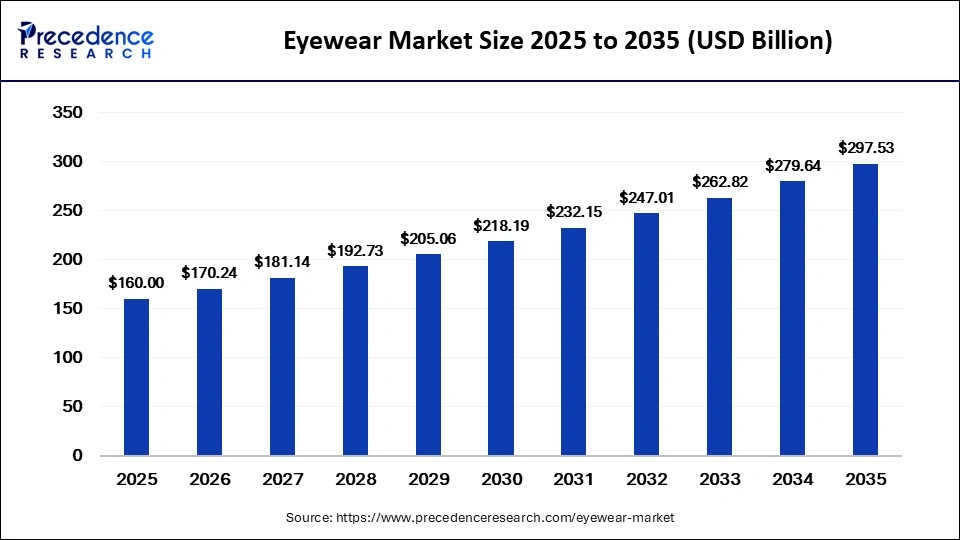
The market is experiencing strong momentum due to increasing awareness regarding eye health, rising adoption of AI-enabled smart glasses, rapid e-commerce growth, and ongoing innovations in advanced lens technologies.
Read Also: Apparel Market
Quick Insights: What is Driving the Eyewear Market Growth?
- The global eyewear market is projected to reach USD 297.53 billion by 2035, expanding at a CAGR of 6.40% from 2026 to 2035.
- North America dominated the market with a 35% share in 2025 because of high consumer spending, strong optical retail infrastructure, and growing premium eyewear adoption.
- Asia Pacific is expected to grow at the fastest CAGR of 8% owing to rising myopia prevalence, increasing disposable income, and expanding digital retail ecosystems.
- Prescription eyewear accounted for 50% of the market share in 2025 due to increasing vision correction requirements worldwide.
- The online distribution segment is projected to witness the fastest CAGR of 10% as AI-powered virtual try-on solutions revolutionize digital eyewear shopping.
- Photochromic lenses are emerging as one of the fastest-growing segments because consumers increasingly prefer adaptive and multifunctional eyewear solutions.
How is Artificial Intelligence Transforming the Eyewear Industry?
Artificial intelligence is significantly reshaping the eyewear industry by enhancing eye diagnostics, improving customer experiences, and accelerating smart wearable innovation.
AI-powered virtual try-on systems are enabling consumers to digitally preview eyewear styles using facial recognition and augmented reality technologies. These solutions analyze facial geometry to recommend frames that best match the consumer’s facial structure, improving satisfaction and reducing product returns.
Modern AI-enabled smart glasses are also integrating:
- Real-time navigation
- Voice assistance
- Object recognition
- Language translation
- Health monitoring
- Fitness tracking
AI is additionally improving eye care diagnostics by enabling faster and more accurate detection of vision disorders and retinal abnormalities.
As wearable AI ecosystems continue evolving, smart eyewear is expected to become a major segment within the broader consumer electronics and healthcare industries.
What are the Major Growth Drivers of the Eyewear Market?
Why is Digital Screen Exposure Increasing Eyewear Demand?
The growing use of smartphones, tablets, laptops, and gaming devices has significantly increased cases of digital eye strain and myopia globally.
Extended screen exposure commonly causes:
- Dry eyes
- Headaches
- Blurred vision
- Eye fatigue
- Blue light sensitivity
As a result, demand for:
- Blue-light-blocking glasses
- Prescription eyewear
- Anti-glare lenses
- Computer glasses
is rising rapidly across both adult and younger populations.
Hybrid work models and digital learning trends are expected to further strengthen long-term market growth.
How is Fashion Influencing Consumer Eyewear Purchases?
Eyewear has evolved into a powerful fashion and lifestyle statement.
Consumers increasingly prioritize:
- Designer frames
- Premium sunglasses
- Luxury branding
- Lightweight materials
- Personalized styling
Social media influencers, celebrity endorsements, and digital fashion culture are significantly accelerating premium eyewear adoption globally.
Luxury eyewear brands are also introducing limited-edition collections and sustainable fashion lines to strengthen brand differentiation.
Why are Technological Innovations Accelerating Market Expansion?
Continuous innovation in lens and frame technologies is significantly improving product functionality and consumer convenience.
Advanced eyewear innovations include:
- Photochromic lenses
- Progressive lenses
- UV-protection coatings
- Lightweight polycarbonate materials
- Smart wearable integration
These technologies are improving visual comfort while expanding the adoption of multifunctional and premium eyewear solutions.
What Opportunities are Emerging in the Eyewear Market?
Can Smart Glasses Become the Next Major Consumer Wearable?
Yes. Smart glasses are rapidly emerging as one of the most promising wearable technology categories.
Modern smart eyewear integrates:
- AI assistants
- Navigation systems
- Health tracking
- Augmented reality
- Voice commands
- Fitness monitoring
These features are creating strong demand across healthcare, enterprise, gaming, fitness, and consumer lifestyle applications.
As production costs decline and technology improves, smart eyewear adoption is expected to accelerate significantly over the next decade.
Will E-Commerce Continue Transforming Eyewear Retail?
Absolutely. The eyewear market is witnessing a major shift toward online purchasing platforms.
Digital eyewear retailers now offer:
- AI-powered virtual try-ons
- Personalized frame recommendations
- Prescription uploads
- Home delivery
- Competitive pricing
Consumers increasingly prefer digital retail experiences because of convenience and broader product availability.
The rapid integration of AR visualization and AI personalization tools is expected to continue strengthening online eyewear sales.
Which Regions are Leading the Global Eyewear Market?
Why Does North America Continue to Dominate the Market?
North America accounted for the largest market share in 2025 due to:
- High disposable income
- Advanced optical retail networks
- Rising eye health awareness
- Strong luxury eyewear demand
- Increasing screen exposure
The United States remains one of the world’s largest premium eyewear markets driven by fashion-conscious consumers and strong healthcare infrastructure.
Why is Asia Pacific Emerging as the Fastest-Growing Market?
Asia Pacific is expected to grow at the fastest CAGR of 8% during the forecast period due to:
- Rising urbanization
- Increasing myopia prevalence
- Growing middle-class population
- Expanding digital commerce
- Rising healthcare awareness
Countries such as China, India, and Japan are witnessing strong growth in both prescription and fashion eyewear segments.
The region is also becoming a major innovation hub for smart eyewear manufacturing and advanced lens development.
Segmentation Analysis of the Eyewear Market
By Product Type
- Prescription Eyewear
- Sunglasses
- Contact Lenses
- Sports Eyewear
Prescription eyewear dominated the market with a 50% share in 2025 because of increasing vision correction requirements globally.
The sunglasses segment is expected to witness strong growth driven by fashion trends and UV protection awareness.
By Lens Type
- Single Vision Lenses
- Bifocal Lenses
- Progressive Lenses
- Photochromic Lenses
- Anti-reflective Lenses
Photochromic lenses are projected to witness the fastest CAGR of 7.2% owing to increasing demand for adaptive and multifunctional vision solutions.
By Distribution Channel
- Offline Optical Stores
- Online E-Commerce Platforms
Offline retail remained dominant in 2025 because consumers continue preferring physical frame trials and professional consultations.
However, online channels are rapidly expanding due to AI-driven shopping experiences and virtual try-on technologies.
By End-Use
- Adults
- Children
Adults accounted for 80% of the market share in 2025 because of increasing age-related vision issues and premium eyewear spending.
The children segment is expected to witness rapid growth due to rising digital device usage and increasing cases of childhood myopia.
Which Companies are Leading Innovation in the Eyewear Industry?
Several major companies are aggressively investing in smart glasses, premium fashion collections, and AI-powered customer engagement platforms.
Major Companies in the Eyewear Market
- EssilorLuxottica
- Johnson & Johnson Vision Care
- Ray-Ban
- Fossil Group
- Marchon Eyewear
- Maui Jim
- Safilo Group
- Kering Eyewear
- Warby Parker
- Oakley
- CooperVision
- Bausch & Lomb
- Prada Eyewear
- Tom Ford Eyewear
These companies are heavily focused on:
- AI-enabled smart glasses
- Sustainable eyewear production
- Digital retail expansion
- Lightweight lens innovation
- Premium fashion branding
Recent Breakthroughs and Industry Developments
The eyewear market is rapidly evolving through:
- AI-powered virtual try-ons
- Smart glasses innovation
- Sustainable frame manufacturing
- Augmented reality integration
- Advanced lightweight lens technologies
In December 2025, Innovative Eyewear partnered with SmartBuyGlasses to expand global access to prescription-enabled Reebok smart eyewear.
In November 2025, Authentic Brands Group signed a licensing agreement with RobSol Indústria Óptica to strengthen Reebok eyewear distribution across Brazil.
These strategic developments highlight the growing convergence of fashion, technology, and digital retail within the global eyewear industry.
What Challenges are Affecting the Eyewear Market?
Why Do Counterfeit Products Remain a Major Industry Challenge?
Counterfeit and low-cost unbranded eyewear products continue affecting:
- Consumer trust
- Brand reputation
- Product quality
- Premium pricing strategies
Low-quality counterfeit eyewear can also pose serious risks to consumer eye health.
How Does Pricing Competition Impact Market Profitability?
The rise of online retail and direct-to-consumer brands has intensified global pricing competition.
Manufacturers must balance:
- Innovation investment
- Product quality
- Brand positioning
- Competitive pricing
while maintaining long-term profitability and customer loyalty.
Case Study: How AI Virtual Try-On Improved Online Eyewear Sales
Several eyewear retailers implementing AI-powered virtual try-on systems reported improvements in:
- Customer engagement
- Online conversion rates
- Product recommendation accuracy
- Customer satisfaction
- Return reduction
Consumers using augmented reality fitting technologies demonstrated greater purchasing confidence and improved product selection accuracy.
These successful implementations are accelerating global investment in AI-driven eyewear retail platforms.
Future Outlook: What’s Next for the Eyewear Industry?
The future of the eyewear market will likely be shaped by:
- Smart wearable ecosystems
- AI-powered personalization
- AR-enabled shopping experiences
- Sustainable eyewear manufacturing
- Advanced digital diagnostics
- Multifunctional smart lenses
As consumer lifestyles become increasingly digital and health-focused, eyewear is expected to evolve into an essential intersection of healthcare, fashion, and wearable technology.
Companies investing in AI innovation, smart glasses, and sustainable premium products are expected to secure major competitive advantages across the global eyewear market over the coming decade.
For inquiries regarding discounts, bulk purchases, or customization requests, please contact us at sales@precedenceresearch.com

- Procurement as a Service Market to Reach USD 29.58 Billion by 2035 - May 18, 2026
- Eyewear Market to Surpass USD 297.53 Billion by 2035 - May 18, 2026
- Apparel Market Size to Reach USD 3.21 Trillion by 2035 - May 18, 2026
