 by
by The global hybrid packaging market is witnessing steady growth as industries increasingly adopt sustainable, lightweight, and high-performance packaging formats. Rising environmental regulations, the shift toward recyclable materials, and increasing demand for durable packaging across food, pharmaceutical, and consumer goods sectors are supporting long-term market expansion.
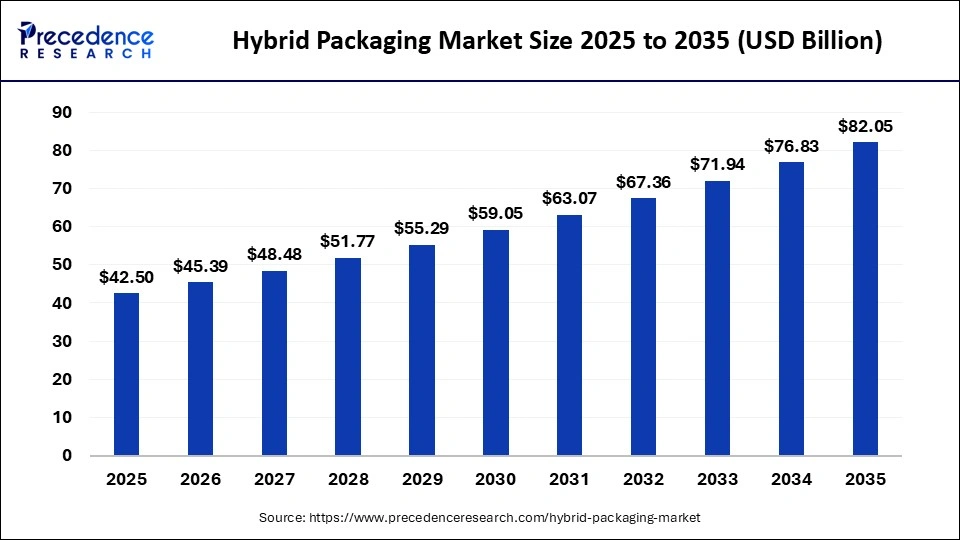
The global hybrid packaging market size accounted for USD 42.50 billion in 2025 and is predicted to increase from USD 45.39 billion in 2026 to approximately USD 82.05 billion by 2035, expanding at a CAGR of 6.80% from 2026 to 2035. The market is being driven by regulatory pressure to reduce plastic waste, increasing consumer demand for sustainable packaging, and rapid adoption of high-performance multi-material packaging solutions.
Read Also: Air Cargo Security Screening Systems Market
Market Overview
Hybrid packaging refers to packaging solutions that combine two or more materials such as plastic, paper, metal, glass, and bio-based coatings to create packaging with better durability, shelf life, barrier protection, and recyclability. These multi-material packaging formats are increasingly used because they combine the strengths of each material while reducing overall packaging weight and environmental impact.
Hybrid packaging is becoming popular in industries such as food and beverage, pharmaceuticals, personal care, industrial goods, and consumer products because it offers superior resistance to moisture, oxygen, light, and contamination. It also helps businesses comply with stricter sustainability regulations and evolving consumer preferences for environmentally friendly packaging.
Key Takeaways
- North America dominated the hybrid packaging market with a 30% share in 2025.
- Asia Pacific is expected to grow at the fastest CAGR of 7.8% between 2026 and 2035.
- By material type, the plastic segment held the largest share of 40% in 2025.
- Paper and paperboard held a 30% market share in 2025 and are expected to grow at the fastest CAGR of 7.8%.
- By packaging type, rigid hybrid packaging dominated the market with a 55% share in 2025.
- Flexible hybrid packaging held a 45% share and is projected to grow at a CAGR of 7.5%.
- By application, food and beverage accounted for the highest market share of 40% in 2025.
- Pharmaceuticals held a 20% share in 2025 and are expected to grow at a CAGR of 6.8%.
- By end-use, consumer goods dominated the market with a 50% share in 2025.
- Healthcare held a 25% share in 2025 and is expected to grow significantly during the forecast period.
Major Market Trends
Growing Focus on Sustainable and Recyclable Packaging
Governments worldwide are enforcing stricter packaging regulations aimed at reducing plastic waste and increasing recyclability. This is encouraging manufacturers to adopt hybrid packaging formats that use less plastic while maintaining functionality and durability.
Paper-based hybrid packaging combined with recyclable barrier coatings is becoming increasingly common in foodservice, retail, and e-commerce packaging. Businesses are focusing on packaging formats that align with existing recycling infrastructure and circular economy goals. According to the Ellen MacArthur Foundation, organizations representing 20% of global plastic packaging production have committed to circular packaging targets by 2025.
Expansion of E-Commerce and Logistics
The rapid growth of e-commerce is increasing demand for packaging that is lightweight, durable, and resistant to damage during shipping and handling. Hybrid packaging solutions are becoming more important because they provide strong protection while reducing transportation costs.
E-commerce companies increasingly prefer flexible pouches, laminated paper packaging, and hybrid rigid containers that can withstand environmental stress and ensure product safety during transit. This trend is especially strong in food delivery, consumer goods, healthcare, and industrial shipping.
Advances in Smart Materials and Barrier Coatings
The hybrid packaging industry is increasingly using advanced barrier coatings, smart materials, digital printing, and customized production techniques to improve packaging performance. These innovations help packaging resist moisture, oxygen, light, and contamination while remaining recyclable and lightweight.
Manufacturers are also integrating plant-based polymers, fiber materials, and high-performance coatings to replace traditional aluminum and plastic-heavy structures. Recent developments in multi-layer co-extrusion and web-to-print technology are further improving packaging efficiency and product protection.
Impact of Artificial Intelligence on the Hybrid Packaging Market
Artificial intelligence is transforming the hybrid packaging market by improving packaging design, material optimization, and recycling efficiency. AI-powered systems can analyze consumer preferences, forecast demand, and help companies create packaging solutions that balance performance with sustainability.
AI is also being used in recycling facilities to sort and separate multi-material packaging more effectively. Machine learning tools can improve waste management processes, increase recycling rates, and support circular economy initiatives. These capabilities are helping packaging companies reduce waste, lower costs, and improve compliance with environmental regulations.
Material Type Insights
The plastic segment dominated the market with a 40% share in 2025 because plastic offers lightweight performance, flexibility, waterproofing, and strong barrier properties. Plastic also combines easily with other materials, improving durability and shelf life for packaging applications. Established recycling infrastructure and low processing costs further support plastic’s dominance in the market.
The paper and paperboard segment held a 30% share in 2025 and is expected to grow at the fastest CAGR of 7.8% between 2026 and 2035. This growth is driven by increasing demand for sustainable packaging and stricter regulations on packaging waste. Paper-based hybrid packaging formats are widely used in retail, e-commerce, and foodservice because they offer both recyclability and strong barrier protection when combined with coatings or polymers.
The metal segment held a 15% share in 2025 because it provides superior protection against oxygen, moisture, and contamination. Metal-based hybrid packaging is commonly used for retort containers, aerosols, and specialty industrial products. The glass segment also accounted for 15% of the market because of its premium appearance, inert nature, and ability to preserve sensitive food, beverage, and cosmetic products.
Packaging Type Insights
The rigid hybrid packaging segment led the market with a 55% share in 2025 because it provides strong structural integrity, product protection, and safe transportation for fragile goods. Rigid packaging formats are widely used in food, beverage, pharmaceutical, and industrial applications where product safety is essential.
The flexible hybrid packaging segment held a 45% share in 2025 and is expected to grow at the fastest rate during the forecast period. Flexible packaging formats are increasingly popular because they are lightweight, require less raw material, reduce transportation costs, and offer improved convenience.
The broader flexible packaging industry is also growing steadily, driven by strong demand for pouches, laminates, coatings, and high-barrier packaging films. Flexible packaging solutions are increasingly used in food, pharmaceutical, and personal care products because they improve shelf life and reduce packaging waste.
Application Insights
The food and beverage segment dominated the market with a 40% share in 2025 because hybrid packaging helps extend shelf life, maintain freshness, and improve convenience for packaged foods and beverages. Ready meals, processed foods, beverages, and snacks rely heavily on multi-material packaging formats to preserve product quality.
The pharmaceutical segment held a 20% share in 2025 and is expected to grow at a CAGR of 6.8% through 2035. Pharmaceutical companies require packaging that protects against moisture, contamination, and light exposure while meeting strict safety regulations. Growing production of specialty drugs and biologics is creating stronger demand for advanced hybrid packaging solutions.
The personal care and cosmetics segment accounted for 15% of the market in 2025 and is expected to grow at the fastest CAGR of 7.2%. This is because premium beauty and personal care brands increasingly prefer packaging that is both visually appealing and protective. Hybrid packaging allows companies to create premium-looking packaging while maintaining functionality and sustainability.
Regional Insights
North America dominated the hybrid packaging market with a 30% share in 2025 due to its advanced recycling infrastructure, strong packaging industry, and rising demand for sustainable consumer packaging. The region is also benefiting from government regulations focused on waste reduction and increased investment in packaging innovation. According to the Flexible Packaging Association, flexible and hybrid packaging contributed more than USD 151 billion to the U.S. economy in 2025.
Asia Pacific is expected to grow at the fastest CAGR of 7.8% through 2035 because of rising consumption of packaged foods, beverages, and personal care products. Countries such as China and India are seeing strong demand for cost-effective and sustainable packaging solutions, supported by industrial growth, urbanization, and expanding e-commerce activity.
Europe held a 25% market share in 2025 and is expected to grow steadily due to strong environmental regulations and a greater focus on recyclability and circular economy goals. The European Union introduced the Packaging and Packaging Waste Regulation in February 2025, which is expected to further accelerate the adoption of hybrid packaging solutions across the region.
Hybrid Packaging Market Companies
- Amcor plc
- Berry Global Inc.
- Constantia Flexibles Group GmbH
- Coveris Holdings S.A.
- DS Smith Plc
- Huhtamaki Oyj
- Mondi Group
- ProAmpac LLC
- Sealed Air Corporation
- Smurfit Kappa Group
- Sonoco Products Company
- Stora Enso Oyj
- Tetra Pak International S.A.
- UFlex Limited
- WestRock Company
Segments Covered in the Report
By Material Type
- Plastic
- Paper & Paperboard
- Metal
- Glass
By Packaging Type
- Rigid Hybrid Packaging
- Flexible Hybrid Packaging
By Application
- Food & Beverage
- Pharmaceuticals
- Personal Care & Cosmetics
- Industrial Goods
- Others
By End-Use
- Consumer Goods
- Healthcare
- Industrial
- Others
By Region
- North America
- Latin America
- Europe
- Asia-pacific
- Middle and East Africa
Get Sample Link: https://www.precedenceresearch.com/sample/8294
For inquiries regarding discounts, bulk purchases, or customization requests, please contact us at sales@precedenceresearch.com

