
 by
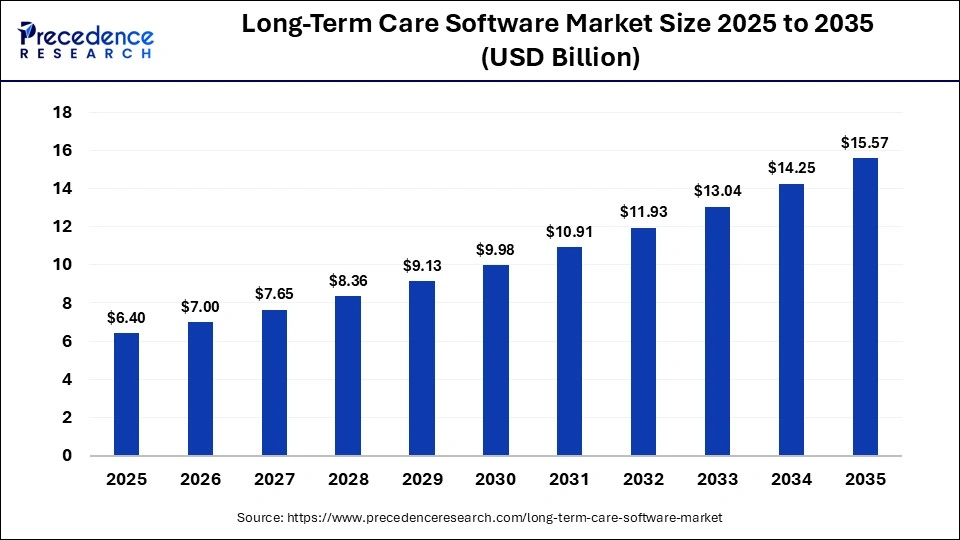
by The global long-term care software market is witnessing steady expansion as healthcare providers increasingly adopt digital platforms to enhance patient care, improve operational efficiency, and manage the growing elderly population. The market was valued at USD 6.40 billion in 2025 and is projected to grow from USD 7.00 billion in 2026 to USD 15.57 billion by 2035, expanding at a CAGR of 9.30% during the forecast period.
The increasing demand for efficient patient management, rising prevalence of chronic diseases, and the shift toward value-based care models are driving the adoption of long-term care software globally. These solutions are enabling healthcare providers to streamline workflows, ensure regulatory compliance, and deliver improved patient outcomes.
Read Also: Multichannel Order Management Market
Quick Insights
The long-term care software market generated USD 6.40 billion in 2025 and is expected to reach USD 15.57 billion by 2035, growing at a CAGR of 9.30%. North America dominated the market with around 40% share, while Asia Pacific is expected to grow at the fastest CAGR of 12.5%. Electronic health records (EHR) led with 30% share, cloud-based deployment accounted for 65%, nursing homes held 35% share, and patient health monitoring & documentation emerged as the leading application with 30% share.
How is Artificial Intelligence Transforming Long-Term Care Software?
Artificial intelligence is playing a transformative role in long-term care software by enabling predictive analytics and data-driven care planning. AI-powered systems analyze patient data to identify health risks, predict disease progression, and support personalized treatment strategies, improving patient outcomes and reducing hospital readmissions.
Additionally, AI is automating administrative tasks such as documentation, scheduling, and billing, significantly reducing the workload on healthcare professionals. This allows caregivers to focus more on patient-centric activities while improving operational efficiency across long-term care facilities.
What are the Key Growth Drivers of the Long-Term Care Software Market?
The primary growth driver is the rapidly increasing aging population, which is creating significant demand for long-term care services and efficient care management systems. Healthcare providers are adopting software solutions to manage complex care requirements and improve service delivery.
Another key factor is the growing digitalization of healthcare systems. Investments in healthcare IT infrastructure, particularly in developed and emerging economies, are accelerating the adoption of long-term care software solutions.
What Opportunities and Trends are Shaping the Market?
Is Remote Patient Monitoring Driving Market Expansion?
Yes, the rise of telehealth and home-based care is significantly boosting demand for software that enables real-time patient monitoring and remote care management.
Are Cloud-Based Platforms Accelerating Adoption?
Absolutely. Cloud-based solutions offer scalability, cost-efficiency, and remote accessibility, making them the preferred choice for healthcare providers.
Is Interoperability Becoming a Critical Requirement?
Yes, seamless integration with electronic health records and other healthcare systems is becoming essential for improving care coordination and data exchange.
Regional Analysis
North America dominated the market in 2025 with a 40% share, supported by advanced healthcare infrastructure, high adoption of digital health technologies, and strong regulatory frameworks.
Asia Pacific is expected to witness the fastest growth due to increasing healthcare investments, rapid digitalization, and rising demand for elderly care services in countries such as India and China.
Europe also holds a significant share, driven by strong healthcare systems and growing focus on improving elderly care services.
Segmental Analysis
By Software Type
| Software Type | 2025 Share | Growth Outlook |
|---|---|---|
| Electronic Health Records (EHR) | 30% | Dominant |
| Billing & Revenue Cycle Management | 20% | Stable |
| Resident Care & Clinical Management | 20% | Fastest Growing |
| Workforce & Staff Management | 15% | Growing |
| Medication Management | 15% | Moderate |
EHR systems dominate due to their role in regulatory compliance and patient data management, while clinical management software is expected to grow rapidly due to demand for integrated care solutions.
By Deployment Mode
| Deployment Mode | 2025 Share | 2035 Share |
|---|---|---|
| Cloud-Based | 65% | 70% |
| On-Premise | 20% | 15% |
| Hybrid | 15% | 15% |
Cloud-based solutions lead due to scalability, remote access, and cost efficiency.
By Facility Type
| Facility Type | 2025 Share | Growth Trend |
|---|---|---|
| Nursing Homes | 35% | Dominant |
| Assisted Living Facilities | 25% | Growing |
| Home Healthcare Agencies | 20% | Fastest Growing |
| Hospice & Palliative Care | 10% | Stable |
| Rehabilitation Centers | 10% | Moderate |
Nursing homes dominate due to high patient volumes, while home healthcare agencies are witnessing rapid growth due to rising demand for remote care services.
By Application
| Application | 2025 Share | Growth Trend |
|---|---|---|
| Patient Monitoring & Documentation | 30% | Dominant |
| Care Coordination & Workflow Automation | 20% | Fastest Growing |
| Regulatory Compliance & Reporting | 20% | Stable |
| Financial & Billing Management | 15% | Growing |
| Staff Scheduling | 15% | Moderate |
Patient monitoring leads due to increasing need for continuous health tracking and compliance requirements.
Competitive Landscape and Key Companies
The long-term care software market is competitive, with key players focusing on AI integration, cloud-based platforms, and interoperability solutions. Leading companies include:
- PointClickCare
- MatrixCare
- Netsmart Technologies
- Cerner Corporation
- McKesson Corporation
- Epic Systems Corporation
- Allscripts Healthcare Solutions
- ResMed Inc.
These companies are investing in advanced analytics, AI-driven platforms, and strategic partnerships to enhance their product offerings and expand market reach.
What Challenges are Impacting Market Growth?
Are High Implementation Costs Limiting Adoption?
Yes, high deployment and integration costs remain a major barrier, particularly for small healthcare providers.
Are Data Security and Privacy Concerns a Challenge?
Ensuring compliance with healthcare regulations and protecting sensitive patient data remains a critical challenge for market players.
Case Study: Digital Transformation in Elderly Care
Healthcare organizations implementing long-term care software have improved patient outcomes through real-time monitoring, better care coordination, and efficient data management. These solutions enable personalized care plans and reduce administrative burdens, highlighting the transformative impact of digital healthcare technologies.
Conclusion
The long-term care software market is becoming a cornerstone of modern healthcare systems. With the integration of AI, cloud computing, and digital health technologies, the market is poised for sustained growth through 2035, driven by the increasing need for efficient and patient-centric care solutions.
Get Sample Copy: https://www.precedenceresearch.com/sample/8350
For inquiries regarding discounts, bulk purchases, or customization requests, please contact us at sales@precedenceresearch.com

- Digital Infrastructure Market to Reach USD 1.32 Trillion by 2035 - June 10, 2026
- Ethoxyquin Market Size to Reach USD 446 Million by 2035 - June 10, 2026
- Liquid Crystal Polymer Market Poised to Reach USD 3.82 Billion by 2035 - June 3, 2026
