
 by
by The global Magnetoresistive Random Access Memory (MRAM) market was valued at USD 1.52 billion in 2025 and is projected to grow from USD 2.19 billion in 2026 to approximately USD 16.46 billion by 2035, registering a robust CAGR of 25.1% during the forecast period from 2026 to 2035.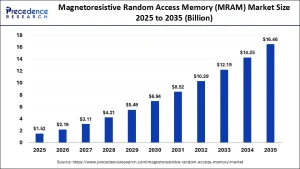
Understanding Magnetoresistive Random Access Memory Market
MRAM is a non-volatile memory technology that stores information using magnetic states instead of electrical charges. Unlike conventional memory technologies that lose stored data when power is removed, MRAM retains information even during power outages.
The technology relies on magnetic tunnel junctions (MTJs), which consist of two magnetic layers separated by an insulating barrier. Data is stored based on the relative orientation of these magnetic layers, allowing information to be preserved without continuous power supply.
Key characteristics of MRAM include:
- Non-volatile data storage
- High-speed read and write operations
- Exceptional endurance
- Low power consumption
- High reliability in harsh environments
- Instant-on capability
Role of MRAM in Artificial Intelligence and Edge Computing
Artificial Intelligence (AI) and edge computing are transforming how data is processed, analyzed, and utilized across industries. These technologies require memory solutions that can deliver high-speed performance, low power consumption, and reliable data retention. MRAM is emerging as a strong candidate to meet these demands due to its unique combination of non-volatility and rapid read/write capabilities.
In AI applications, large volumes of data must be processed in real time. MRAM helps accelerate machine learning inference by enabling faster access to stored data while reducing energy consumption. Unlike traditional memory technologies that require continuous power to maintain information, MRAM retains data even when power is removed, making it ideal for AI-driven edge devices.
Read More: Portable Monitor Market
Major Advantages of Magnetoresistive Random Access Memory Market Technology
Faster Data Access
MRAM delivers read and write speeds comparable to traditional RAM technologies while retaining data after power loss. This combination enables faster system boot times and improved application performance.
Superior Endurance
Unlike flash memory, which experiences wear after repeated write cycles, MRAM offers significantly higher endurance. This characteristic makes it suitable for applications involving frequent data updates.
Reduced Power Consumption
Because MRAM does not require constant refreshing of stored data, it consumes substantially less power than DRAM. This advantage is particularly valuable for battery-powered devices.
Impact of IoT Expansion on Magnetoresistive Random Access Memory Market Adoption
The rapid growth of the Internet of Things (IoT) ecosystem is creating significant opportunities for advanced memory technologies. Billions of connected devices are being deployed across smart homes, healthcare systems, industrial facilities, transportation networks, and smart cities. These devices require memory solutions that provide reliable performance while minimizing energy consumption.
MRAM addresses many of the challenges associated with IoT deployments. Its low-power operation helps extend battery life in sensors and wearable devices, while its non-volatile nature ensures that critical data remains secure even during power failures. Additionally, MRAM’s high endurance enables frequent data updates without experiencing significant degradation over time.
Applications of Magnetoresistive Random Access Memory Market in Consumer Electronics
Consumer electronics represent one of the most promising application areas for MRAM technology. Modern devices require memory solutions that can support faster processing speeds, lower power consumption, and enhanced user experiences. MRAM’s advanced capabilities make it well suited for a wide range of electronic products.
Smartphones and tablets can benefit from MRAM’s fast boot times and energy-efficient operation, helping improve battery performance and overall device responsiveness. Wearable devices such as smartwatches and fitness trackers can leverage MRAM to maintain data integrity while extending battery life.
Gaming consoles and portable entertainment systems also benefit from MRAM’s high-speed performance, enabling quicker data access and smoother user experiences. In smart home devices, including security systems, voice assistants, and connected appliances, MRAM provides reliable data storage and instant recovery after power interruptions.
Technological Innovations Shaping the MRAM Industry
Continuous technological advancements are driving the evolution of the MRAM market. Researchers and semiconductor manufacturers are investing heavily in improving memory density, reducing power requirements, and enhancing overall performance.
One of the most significant innovations is the development of Spin-Transfer Torque MRAM (STT-MRAM), which offers improved scalability and lower energy consumption compared to earlier MRAM technologies. STT-MRAM has become a preferred solution for many commercial applications due to its ability to deliver high-speed performance while supporting advanced semiconductor manufacturing processes.
Regional Magnetoresistive Random Access Memory Market Insights
Asia Pacific currently holds the largest share of the MRAM market. The region benefits from strong semiconductor manufacturing capabilities, expanding data center infrastructure, increasing cloud adoption, and growing demand for advanced consumer electronics. Countries such as China, Japan, South Korea, and Taiwan are major contributors to regional growth.
North America continues to play a critical role in MRAM research, development, and commercialization. The presence of leading semiconductor companies, technology firms, and defense contractors supports ongoing innovation in memory technologies.
Europe’s strong automotive manufacturing sector is encouraging increased adoption of MRAM in advanced vehicle electronics and industrial automation systems.
Challenges Facing the Magnetoresistive Random Access Memory Market
Despite its promising future, MRAM faces several challenges:
High Manufacturing Costs
MRAM production remains more expensive than some traditional memory technologies, limiting widespread adoption in cost-sensitive applications.
Complex Fabrication Processes
Manufacturing MRAM requires sophisticated semiconductor processes and specialized expertise, which can increase production complexity.
Competition from Alternative Technologies
MRAM competes with several emerging memory technologies, including Resistive RAM (ReRAM), Phase Change Memory (PCM), and advanced NAND solutions.
Scalability Challenges
Although significant progress has been achieved, further improvements in density and cost efficiency are necessary for MRAM to replace conventional memory technologies on a broader scale.
Magnetoresistive Random Access Memory Market Competitive Landscape
The MRAM market features several major technology developers and semiconductor manufacturers, including:
- Everspin Technologies
- Samsung Electronics
- Avalanche Technology
- Intel Corporation
- IBM Corporation
- Toshiba Corporation
- SK Hynix
- Fujitsu
These companies continue investing heavily in research, product development, and strategic partnerships to strengthen their market positions and accelerate commercialization efforts.
Future Outlook
The future of the MRAM market appears exceptionally promising. As industries increasingly prioritize energy efficiency, data reliability, AI acceleration, and real-time processing capabilities, MRAM is positioned to become a critical component of next-generation computing architectures.
Advancements in embedded MRAM, spin-transfer torque technologies, and semiconductor scaling are expected to unlock new opportunities across automotive, industrial, healthcare, consumer electronics, and data center applications.
Get this report to explore global market size, share, CAGR, and trends, featuring detailed segmental analysis and an insightful competitive landscape overview @https://www.precedenceresearch.com/sample/3991
You can place an order or ask any questions, please feel free to contact us at sales@precedenceresearch.com |+1 804 441 9344

