
 by
by The global payment gateway market continues to expand rapidly as digital commerce, cashless payments, and real-time transaction systems become central to the global financial ecosystem. In 2025, the market size was valued at USD 29.00 billion, and it is expected to reach USD 33.29 billion in 2026. Looking ahead, the market is projected to surge to approximately USD 115.30 billion by 2035, expanding at a strong CAGR of 14.80% from 2026 to 2035.
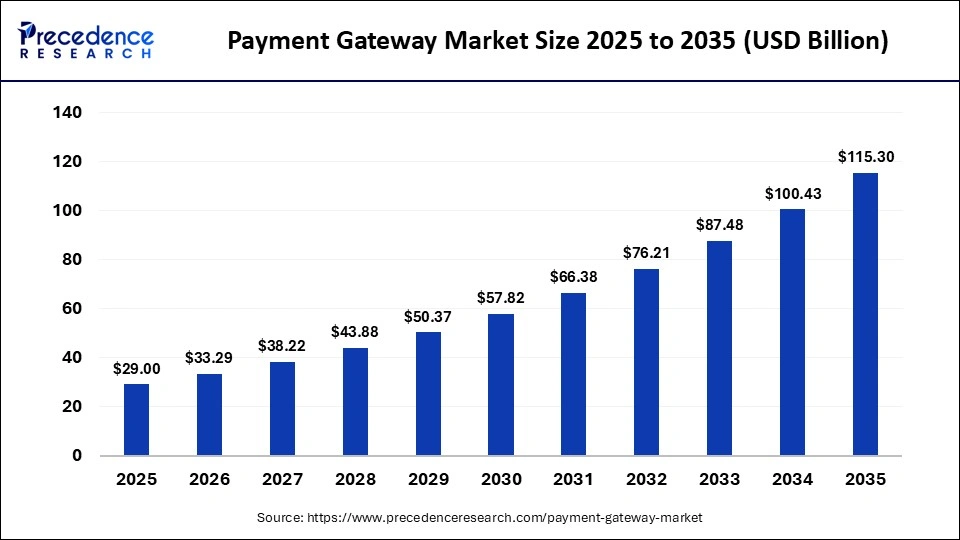
This rapid growth is driven by rising e-commerce penetration, mobile wallet adoption, fintech innovation, and increasing demand for secure online transactions.
Read Also: Small Nuclear Reactor Market
Market Overview
A payment gateway is a secure digital infrastructure that authorizes and processes online transactions by transferring payment information between customers, merchants, acquiring banks, and payment processors.
Modern payment gateways support:
- Encrypted transaction processing
- Tokenization of sensitive data
- PCI-DSS compliant security frameworks
- Multi-currency and cross-border payments
- UPI, cards, wallets, BNPL, and EMI options
- AI-driven fraud detection systems
As global commerce becomes increasingly digital, payment gateways have become a critical backbone of modern financial infrastructure.
Key Market Takeaways
- Market size: USD 29.00 billion in 2025
- Forecast: USD 33.29 billion in 2026
- Projected value: USD 115.30 billion by 2035
- CAGR (2026–2035): 14.80%
- North America led the market in 2025 with 30% share
- Asia Pacific expected to grow at the fastest CAGR of 17.5%
- Hosted gateways dominated with 54.50% share
- SMEs expected to be fastest-growing enterprise segment
- Retail & e-commerce led end-use with 34% share
Market Drivers
1. Rapid Expansion of E-Commerce
The global surge in online shopping platforms is significantly increasing transaction volumes, boosting demand for fast and secure payment processing systems.
2. Shift Toward Cashless Economies
Governments worldwide are promoting digital payments through initiatives such as UPI in India and contactless payment infrastructure in developed markets.
3. Rising Need for Fraud Prevention
Increasing cyber fraud and data breaches are accelerating adoption of AI-powered fraud detection and secure payment architectures.
4. Growth of Subscription and Digital Services
Streaming platforms, SaaS applications, and digital content providers are increasing demand for recurring billing and automated payment systems.
Market Restraints
Despite strong growth, the market faces several structural challenges:
High Transaction Costs
Cross-border payments often involve multiple intermediaries, increasing fees, currency conversion costs, and reducing merchant profitability.
Regulatory Complexity
Compliance with global standards such as PCI DSS, AML, KYC, and data privacy laws creates operational challenges for payment providers and merchants.
Cybersecurity and Fraud Risks
The increasing sophistication of cyberattacks requires continuous investment in advanced security systems, increasing operational costs.
Cross-Border Payment Challenges
International transactions face delays, currency volatility, and regulatory fragmentation across jurisdictions, slowing down global payment flows.
Infrastructure and Internet Limitations
In emerging regions, limited internet connectivity restricts the adoption of digital payment systems and slows market penetration.
Market Opportunities
The payment gateway market offers strong opportunities in:
- Expansion of cross-border e-commerce ecosystems
- Growth of embedded finance and API-based payments
- Adoption of AI-driven fraud detection systems
- Increasing SME digital transformation
- Rise of real-time and instant payment rails
- Integration with super apps and fintech ecosystems
Segment Analysis
By Product Type
The hosted payment gateway segment dominates due to ease of integration, security compliance, and reduced infrastructure burden. However, non-hosted gateways are growing faster due to higher customization and control.
By Enterprise Size
Large enterprises currently dominate due to high transaction volumes and global operations, while SMEs are emerging as the fastest-growing segment due to affordable API-based solutions.
By End Use
The retail & e-commerce segment leads the market, driven by increasing online purchases, digital marketplaces, and omnichannel retail expansion.
Travel & hospitality is emerging as a high-growth segment due to rising global tourism and cross-border bookings.
Regional Insights
North America
North America led the market in 2025 due to strong fintech infrastructure, advanced cybersecurity systems, and high digital payment adoption.
Asia Pacific
Asia Pacific is the fastest-growing region, driven by UPI expansion, mobile wallets, and rapid e-commerce growth in countries like India and China.
Europe
Europe shows steady growth supported by PSD2 regulations, open banking frameworks, and strong digital payment ecosystems.
Latin America & MEA
These regions are emerging markets with increasing fintech adoption and expanding digital financial inclusion.
Market Trends
1. AI-Powered Payment Intelligence
AI and machine learning are improving fraud detection, risk scoring, and transaction optimization.
2. Shift Toward Frictionless Payments
One-click checkout, tokenization, and embedded payment flows are improving user experience.
3. Cross-Border Payment Expansion
Global commerce growth is increasing demand for multi-currency and international payment capabilities.
4. Rise of Embedded Finance
Payment gateways are evolving into full-stack financial platforms embedded within apps and ecosystems.
Competitive Landscape
Key players in the market include:
- Stripe
- PayPal (Braintree)
- Adyen
- Square (Block, Inc.)
- Authorize.Net (Visa)
- Worldpay (FIS)
- Razorpay
- Checkout.com
- PayU
- 2Checkout (Verifone)
- BlueSnap
- Alipay Global
These companies are focusing on AI integration, global expansion, and API-driven innovation to strengthen their market positions.
Recent Developments
- Expansion of AI-based fraud detection systems across major payment platforms
- Partnerships between fintech firms to improve cross-border payment efficiency
- Integration of UPI and instant payment systems into global gateways
- Increasing regulatory tightening around PCI DSS compliance and data security standards
Conclusion
The global payment gateway market is expected to grow rapidly, reaching USD 115.30 billion by 2035, driven by rising digital transactions, global e-commerce expansion, and continuous fintech innovation.
However, challenges such as high transaction costs, regulatory complexity, and cybersecurity risks continue to shape market evolution.
As digital economies expand worldwide, payment gateways will remain a core infrastructure of global financial systems, enabling secure, fast, and seamless transactions across industries.
Get Sample Report: https://www.precedenceresearch.com/sample/8290
For inquiries regarding discounts, bulk purchases, or customization requests, please contact us at sales@precedenceresearch.com

- Digital Infrastructure Market to Reach USD 1.32 Trillion by 2035 - June 10, 2026
- Ethoxyquin Market Size to Reach USD 446 Million by 2035 - June 10, 2026
- Liquid Crystal Polymer Market Poised to Reach USD 3.82 Billion by 2035 - June 3, 2026
