
 by
by The global Minimal Residual Disease (MRD) Testing Market is poised for remarkable growth, expanding from USD 1.70 billion in 2025 to an anticipated USD 4.72 billion by 2034, growing at a robust CAGR of 12.00%. This upward trajectory is fueled by rising cancer prevalence worldwide, especially hematological malignancies, and the integration of highly sensitive technologies such as next-generation sequencing (NGS) and digital PCR (dPCR), which are revolutionizing personalized medicine and clinical trial applications.
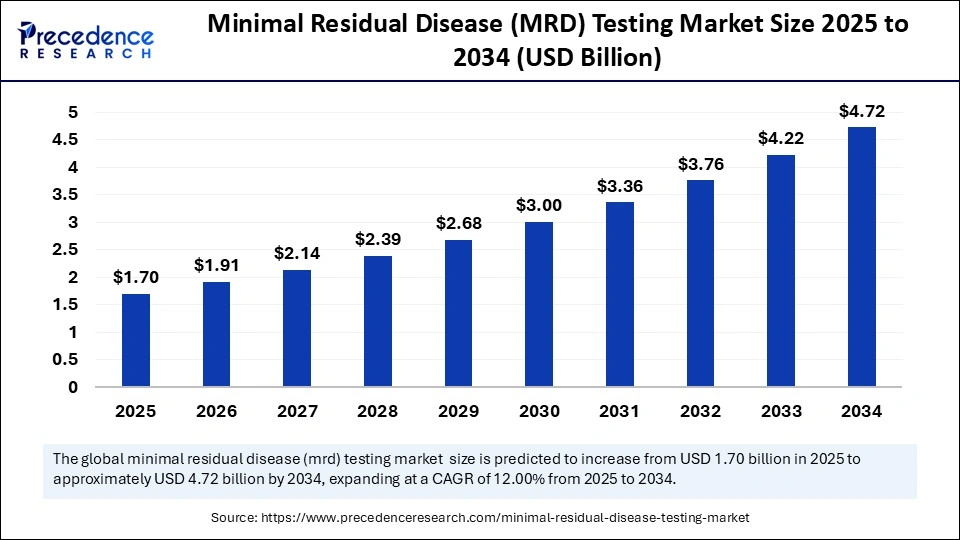
Minimal Residual Disease Testing Market Key Points
-
The market value is projected to reach approximately USD 4.72 billion by 2034.
-
North America led the market with a 45% share in 2024 due to advanced healthcare infrastructure and strong industry presence.
-
Asia Pacific is expected to be the fastest-growing regional market, driven by rising cancer incidence and healthcare improvements.
-
Flow cytometry (FC) accounted for 40% of the technology share in 2024, owing to its accessibility and cost efficiency.
-
NGS technology is forecasted to grow at the fastest CAGR, attributed to its superior sensitivity and multiplex capabilities.
-
Hematological malignancies hold around 65% of the application market share, with solid tumors gaining momentum.
-
Hospitals and specialty clinics represent 50% of end-user market share due to comprehensive cancer care programs.
-
Leading players include F. Hoffmann-La Roche Ltd, Guardant Health, Natera, Exact Sciences, and QIAGEN.
How Is Artificial Intelligence Shaping the MRD Testing Market?
AI is transforming MRD testing by enhancing the speed, accuracy, and standardization of data interpretation. In flow cytometry, AI algorithms reduce manual analysis from minutes to seconds, efficiently handling complex, multi-dimensional datasets to better identify minimal residual cancer cells. This automation improves accessibility of sophisticated MRD tests across laboratories globally.
Additionally, AI-driven bioinformatics accelerates biomarker discovery and refines diagnostic models, driving innovation in liquid biopsy technologies and enabling more precise patient stratification and treatment customization.
What Key Factors Are Driving Market Growth?
The MRD testing market thrives on several growth factors, including the escalating global cancer burden, especially blood cancers; advancements in ultra-sensitive diagnostic technologies like NGS and dPCR; and increasing adoption of MRD testing as a standard treatment monitoring tool. Furthermore, the trend towards non-invasive liquid biopsies reduces reliance on painful bone marrow biopsies, improving patient comfort and care efficiency.
Why Is Asia Pacific Emerging as the Fastest-Growing Region?
Asia Pacific’s rapid growth stems from rising cancer incidence, aging populations, and significant investments in healthcare infrastructure upgrades. Countries like China and India are embracing advanced MRD testing technologies and fostering domestic innovation through startups such as 4baseCare and Datar Genetics. The regional shift toward precision oncology and growing awareness further propel adoption rates.
Minimal Residual Disease Testing Market Scope
| Report Coverage | Details |
| Market Size in 2025 | USD 1.70 Billion |
| Market Size in 2026 | USD 1.91 Billion |
| Market Size by 2034 | USD 4.72 Billion |
| Market Growth Rate from 2025 to 2034 | CAGR of 12.00% |
| Dominating Region | North America |
| Fastest Growing Region | Asia Pacific |
| Base Year | 2024 |
| Forecast Period | 2025 to 2034 |
| Segments Covered | Application, Technology, End User, and Region |
| Regions Covered | North America, Europe, Asia-Pacific, Latin America, and Middle East & Africa |
Which Opportunities and Trends Are Shaping the MRD Testing Market?
How is the transition to non-invasive liquid biopsy impacting MRD testing?
The shift to liquid biopsy significantly enhances patient comfort and broadens clinical accessibility, enabling real-time disease monitoring while reducing sampling risks.
What role do startups and emerging companies play in innovation?
Startups focus on increasing detection sensitivity, shortening turnaround times, and integrating AI for data interpretation, fostering a vibrant ecosystem driving next-gen MRD solutions.
How are commercial and regulatory environments evolving?
Supportive reimbursement landscapes and regulatory approvals for assays like Adaptive Biotechnologies’ clonoSEQ® test are facilitating broader adoption and integration into clinical guidelines.
Market Segmentation Analysis
Technological segmentation highlights flow cytometry’s dominance for its cost-effectiveness and rapid results, while next-generation sequencing leads in growth prospects due to its multiplexing and heightened sensitivity. Application-wise, hematological malignancies dominate, anchored by established clinical utility, whereas solid tumors represent a burgeoning opportunity propelled by liquid biopsy advances.
Hospitals and specialty clinics, owing to their role in comprehensive cancer management and clinical trial participation, lead end-user segments. Diagnostic laboratories are gaining traction owing to outsourcing trends and advanced molecular diagnostics capabilities.
Minimal Residual Disease Testing Market Regional Analysis
North America commands the largest market share driven by advanced healthcare infrastructure and key market players. Europe follows with growing adoption backed by clinical guideline integration.
Asia Pacific emerges as the fastest-growing region, propelled by healthcare modernization and increasing cancer prevalence. Latin America and the Middle East & Africa demonstrate steady growth due to improving healthcare access.
Challenges and Cost Pressures
Despite promising growth, challenges persist such as high technical complexity, significant costs of advanced testing platforms, and the need for extensive clinical validation to ensure reliability. Additionally, regulatory approvals and reimbursement policies vary by region, potentially slowing market penetration.
Top Companies Operating in the Minimal Residual Disease Testing Market
Tier I: Market Leaders (40–50% cumulative share)
These companies are at the forefront of MRD testing, offering a range of diagnostic solutions and holding substantial market shares.
- F. Hoffmann-La Roche Ltd. – A leader in MRD testing, particularly in hematological malignancies, with a comprehensive portfolio of diagnostic solutions.
- Guardant Health – Known for its blood-based MRD tests, such as Guardant Reveal, which detect residual disease in solid tumors.
- Natera, Inc. – Offers the Signatera test, a personalized MRD test for solid tumors, and is expanding its presence in the MRD testing market.
- Exact Sciences – Developing MRD tests like Oncodetect, focusing on early detection and monitoring of minimal residual disease.
- Labcorp – Provides MRD testing services through its extensive laboratory network, contributing to the market’s growth.
- QIAGEN – Offers MRD testing solutions, including collaborations with companies like Tracer Biotechnologies and Foresight Diagnostics to enhance its MRD testing portfolio.
- Bio-Rad Laboratories, Inc. – Provides MRD testing solutions, including PCR-based assays, contributing to the market’s expansion.
- Sysmex Corporation – Offers diagnostic solutions, including MRD testing technologies, with a strong presence in Asia-Pacific.
Tier II: Emerging Players (20–30% cumulative share)
These companies are making significant strides in MRD testing, with innovative solutions and growing market presence.
- NeoGenomics Laboratories, Inc. – Provides MRD testing services, focusing on personalized oncology diagnostics.
- Adaptive Biotechnologies Corporation – Offers the clonoSEQ® MRD test, focusing on hematological malignancies.
- Foundation Medicine – Provides comprehensive genomic profiling, including MRD testing for various cancers.
- Veracyte, Inc. – Expanding into MRD testing, with plans to launch an MRD test for muscle-invasive bladder cancer in 2026.
- Illumina, Inc. – Offers next-generation sequencing platforms utilized in MRD testing applications.
- Bio-Techne Corp – Provides reagents and assays used in MRD testing, contributing to the market’s growth.
- Exact Sciences Corp – Expanding its portfolio to include MRD testing, with a focus on precision oncology.
Tier III: Niche & Regional Players (10–20% cumulative share)
These companies focus on specific aspects of MRD testing or serve particular regional markets.
- 3B BlackBio Biotech India – Provides MRD testing solutions in India, contributing to the regional market.
- Bioartis – Offers MRD testing services, focusing on personalized oncology diagnostics.
- EntroGen – Provides molecular diagnostic solutions, including MRD testing assays.
- ArcherDX, Inc. – Develops targeted sequencing technologies utilized in MRD testing applications.
- Asuragen Inc. – Offers molecular diagnostic solutions, including MRD testing assays.
- Arup Laboratories Inc. – Provides MRD testing services, focusing on personalized oncology diagnostics.
- PerkinElmer Inc. – Offers diagnostic solutions, including MRD testing technologies, with a strong presence in the Asia-Pacific region.
Case Study: Adaptive Biotechnologies and NeoGenomics Partnership
A landmark collaboration between Adaptive Biotechnologies and NeoGenomics in 2025 enhanced MRD monitoring for blood cancers by integrating Adaptive’s FDA-cleared clonoSEQ® test with NeoGenomics’ COMPASS® and CHART® platforms. This initiative offers real-time insights into disease progression, supporting personalized treatment and improving patient outcomes, exemplifying innovation through strategic alliances.
Read Also: Microbiology and Bacterial Culture Media Market
You can place an order or ask any questions. Please feel free to contact us at sales@precedenceresearch.com |+1 804 441 9344

- Managed DNS Services Market Size to Hit USD 2,288.60 Million by 2035 - March 5, 2026
- Power EPC Market Size to Hit USD 1,376.29 Billion by 2035 - March 5, 2026
- Ursolic Acid Market Size to Hit USD 68.77 Billion by 2035 - March 5, 2026
