
 by
by What is the Smartwatch Battery Market Size in 2026?
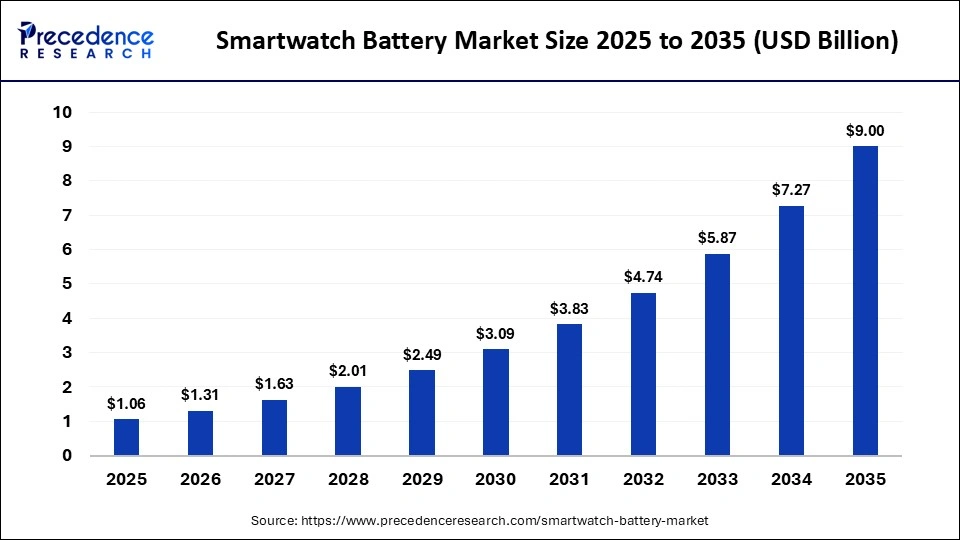
The global smartwatch battery market size was valued at USD 1.06 billion in 2025 and is projected to grow from USD 1.31 billion in 2026 to approximately USD 9.00 billion by 2035, expanding at a CAGR of 23.85% from 2026 to 2035.
The market is expanding rapidly due to the increasing adoption of feature-rich wearable devices that require compact and high-energy-density power solutions. Rising consumer demand for longer battery life, fast charging, and efficient power management is encouraging innovations in lithium-ion and lithium-polymer battery technologies. However, manufacturers still face challenges related to miniaturization, thermal management, battery lifecycle limitations, and sustainability concerns, which continue to influence product development strategies.
Read Also: Battery Swapping Market
Key Takeaways
-
Asia-Pacific accounted for the largest revenue share of 51% in 2025.
-
North America is expected to expand at the fastest CAGR between 2026 and 2035.
-
By rated voltage, the 3.7V segment held the dominant share of 68% in 2025.
-
The 4.2V segment is expected to grow at a notable CAGR during the forecast period.
-
By application, the iOS system smartwatch segment dominated the market in 2025.
-
The Android system smartwatch segment is projected to grow at the fastest rate from 2026 to 2035.
Market Overview
A smartwatch battery is a compact rechargeable power unit, typically based on lithium-ion or lithium-polymer chemistry, designed to provide stable and efficient energy in the limited space of a wearable device.
These batteries power multiple smartwatch functions, including:
-
Health and fitness tracking sensors
-
Bluetooth connectivity
-
GPS navigation
-
Display and touch interface
-
Mobile applications and notifications
The smartwatch battery market is becoming strategically important because battery life directly affects user experience, product competitiveness, and brand differentiation. With the integration of AI-based features, advanced health monitoring systems, and always-on displays, manufacturers are prioritizing batteries with high energy density, faster charging capabilities, and longer operational lifespan.
Battery innovation is enabling slimmer smartwatch designs, improved functionality, and sustainable wearable technology development, making it a critical component in the evolving wearable ecosystem.
Impact of AI on the Smartwatch Battery Market
Artificial intelligence is increasingly being integrated into smartwatch systems to optimize battery usage and extend device runtime.
AI-powered power management systems analyze real-time user behavior and adjust energy consumption accordingly. This includes:
-
Predicting app usage patterns
-
Reducing background processing
-
Optimizing sensor activation
Platforms such as Wear OS incorporate AI-based updates that balance device performance with energy efficiency. These smart algorithms help extend battery life without sacrificing key features or user experience.
AI also supports battery innovation by enabling advanced analytics for battery performance, predictive maintenance, and optimized power management strategies.
Key Trends Influencing the Smartwatch Battery Market
Enhanced Battery Life and Energy-Dense Cells
Manufacturers are focusing on improving battery energy density and efficiency to meet consumer expectations for longer usage between charges.
Innovations include:
-
Improved lithium-ion cell architecture
-
Development of solid-state batteries
-
Enhanced power management chips
Longer battery life is particularly important for wearables that continuously monitor health metrics or operate with always-on displays.
Fast and Convenient Charging Technologies
Fast charging and wireless charging technologies are becoming major differentiators in smartwatch products.
Companies such as Apple Inc. and Samsung Electronics are investing in rapid charging solutions that allow users to quickly recharge devices with minimal downtime.
Efficient charging technologies enable smartwatches to support power-intensive features while maintaining practical daily battery life.
Growing Focus on Sustainable Battery Development
Environmental sustainability is becoming a key priority for smartwatch battery manufacturers.
Companies are exploring:
-
Recyclable battery materials
-
Environmentally friendly manufacturing processes
-
Circular economy initiatives for battery recycling
Sustainable battery innovation not only reduces environmental impact but also strengthens brand reputation among environmentally conscious consumers.
Support for Advanced Smartwatch Features
Modern smartwatches integrate an increasing number of sensors and technologies, including:
-
ECG and heart-rate monitoring
-
GPS tracking
-
Sleep monitoring
-
Continuous connectivity
This trend requires higher-capacity batteries and intelligent power management systems capable of supporting advanced features without reducing device usability.
Emergence of Solid-State and Next-Generation Battery Technologies
Next-generation battery technologies, such as solid-state batteries, are expected to transform the smartwatch battery market.
Compared with traditional lithium-ion batteries, solid-state batteries offer:
-
Higher energy density
-
Improved safety
-
Reduced device size
These technologies may significantly extend smartwatch battery life and enable new wearable device designs.
Market Scope
| Report Coverage | Details |
|---|---|
| Market Size in 2025 | USD 1.06 Billion |
| Market Size in 2026 | USD 1.31 Billion |
| Market Size by 2035 | USD 9.00 Billion |
| Market Growth Rate | CAGR of 23.85% (2026–2035) |
| Dominating Region | Asia-Pacific |
| Fastest Growing Region | North America |
| Base Year | 2025 |
| Forecast Period | 2026–2035 |
| Segments Covered | Rated Voltage, Application, Region |
| Regions Covered | North America, Europe, Asia-Pacific, Latin America, Middle East & Africa |
Segment Insights
Rated Voltage Insights
3.7V Segment
The 3.7V battery segment dominated the smartwatch battery market in 2025 due to its ideal balance between energy density, compact size, and compatibility with lithium-ion and lithium-polymer technologies.
Key advantages include:
-
Stable performance for wearable electronics
-
Compatibility with standard power management systems
-
High safety profile
-
Cost-effective manufacturing
These benefits make 3.7V batteries the preferred choice for most smartwatch manufacturers.
4.2V Segment
The 4.2V battery segment is expected to experience significant growth during the forecast period.
Higher voltage capacity allows these batteries to:
-
Store more energy in compact designs
-
Support power-intensive features
-
Improve overall device performance
Advancements in battery management systems and cell chemistry are making 4.2V batteries increasingly suitable for premium and next-generation wearable devices.
Application Insights
iOS System Smartwatch Segment
The iOS system smartwatch segment held the largest market share in 2025.
Devices such as the Apple Watch are tightly integrated with the iPhone ecosystem, encouraging frequent usage and demand for reliable battery performance.
Advanced features include:
-
Always-on Retina displays
-
Continuous health monitoring
-
Large app ecosystems
require optimized and high-performance battery systems.
Android System Smartwatch Segment
The Android smartwatch segment is expected to grow at the fastest rate in the coming years.
This growth is driven by:
-
Wide availability of Android wearable devices
-
Multiple manufacturers offering diverse price ranges
-
Expanding functionality of wearable platforms
Brands such as Garmin, Samsung Electronics, and Huawei Technologies are increasingly focusing on improving battery efficiency in Android-based wearable devices.
Regional Insights
Asia-Pacific
Asia-Pacific dominated the smartwatch battery market in 2025 due to its strong electronics manufacturing ecosystem and large battery production capacity.
Countries such as China, Japan, and South Korea host major lithium-ion battery manufacturing facilities and wearable device production hubs.
Rising consumer adoption of smart wearables and expanding middle-class populations are also contributing to strong market growth.
China Market Trends
China leads the Asia-Pacific market due to its integrated lithium-ion battery supply chain and large-scale production capacity.
Domestic companies are expanding manufacturing capabilities and investing heavily in battery technology innovation and wearable electronics development, strengthening China’s position as a global smartwatch battery production hub.
North America
North America is expected to experience the fastest growth during the forecast period due to the rising demand for premium wearable devices and digital health technologies.
The region benefits from:
-
Advanced R&D infrastructure
-
Strong consumer demand for health monitoring devices
-
Rapid innovation in battery technologies
Major technology companies, including Apple Inc. and Garmin, are driving innovation in smartwatch battery performance and power management systems.
Europe
Europe is expected to witness notable growth due to increasing health awareness, wearable adoption, and environmental regulations promoting sustainable battery technologies.
Countries such as United Kingdom, Germany, and France are encouraging innovation in recyclable and environmentally friendly battery systems.
In 2024, the National Health Service in the UK announced plans to distribute millions of smart devices, including smartwatches, to help patients monitor their health independently, which is expected to further support market growth.
Smartwatch Battery Market Value Chain Analysis
Raw Material Sourcing
Battery manufacturing begins with sourcing raw materials such as lithium, cobalt, nickel, and graphite.
Key companies involved in this stage include:
-
Albemarle Corporation
-
Glencore
-
Sumitomo Metal Mining
Leading Companies in the Smartwatch Battery Market
Key companies operating in the market include:
-
LG Energy Solution
-
Contemporary Amperex Technology Co. Limited
-
EVE Energy
-
BYD Company
-
Sony Group Corporation
-
Panasonic Energy
-
Samsung SDI
-
Murata Manufacturing
-
TDK Corporation
-
Amperex Technology Limited
-
VARTA AG
-
Maxell
-
Toshiba Corporation
-
Sunwoda Electronic
-
Enovix Corporation
For inquiries regarding discounts, bulk purchases, or customization requests, please contact us at sales@precedenceresearch.com

- Managed DNS Services Market Size to Hit USD 2,288.60 Million by 2035 - March 5, 2026
- Power EPC Market Size to Hit USD 1,376.29 Billion by 2035 - March 5, 2026
- Ursolic Acid Market Size to Hit USD 68.77 Billion by 2035 - March 5, 2026
