
 by
by What is the Coal Bed Methane Market Size in 2026?
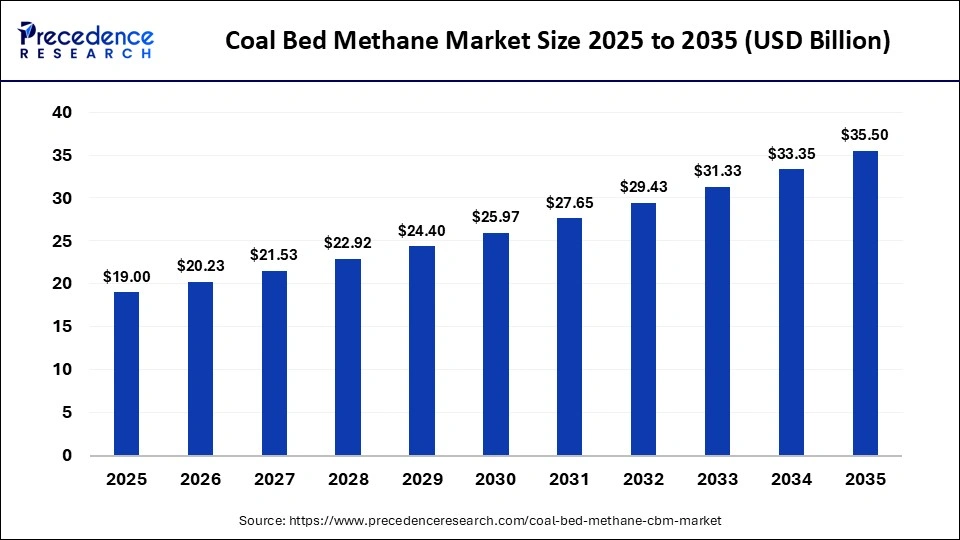
The global coal bed methane market size was valued at USD 19.00 billion in 2025 and is projected to grow from USD 20.23 billion in 2026 to approximately USD 35.50 billion by 2035, expanding at a CAGR of 6.45% from 2026 to 2035.
The market is witnessing strong growth due to the rising demand for cleaner energy sources, increasing natural gas prices, and continuous technological innovations in methane extraction techniques. Additionally, coal bed methane (CBM) is gaining traction as a lower-emission alternative to conventional fossil fuels, helping countries reduce greenhouse gas emissions while strengthening energy security.
Read Also: AI Control Tower Market
Coal Bed Methane Market Overview
The coal bed methane (CBM) market focuses on the extraction and commercialization of methane gas that is naturally stored within coal seams. Unlike conventional natural gas reservoirs, methane in coal beds is adsorbed onto coal surfaces and trapped within fractures and pores of coal formations. When pressure within the coal seam is reduced through drilling and dewatering, methane gas is released and captured for energy use.
Impact of Artificial Intelligence on the Coal Bed Methane Market
Artificial intelligence (AI) is increasingly playing a significant role in improving the efficiency, safety, and profitability of coal bed methane production. AI technologies analyze large datasets from seismic surveys, well logs, reservoir simulations, and pressure monitoring systems to accurately predict methane production potential.
With the help of AI-powered analytics, operators can:
-
Predict methane production rates with greater accuracy
-
Optimize drilling and dewatering operations
-
Reduce unnecessary drilling activities
-
Improve reservoir management strategies
Machine learning algorithms are also used to monitor surface infrastructure such as compression stations, pipelines, and water management systems, enabling predictive maintenance and reducing operational downtime.
Additionally, AI-based monitoring systems help detect methane leaks and fugitive emissions through satellite imagery and sensor networks. These technologies support companies in meeting environmental regulations and improving their environmental, social, and governance (ESG) performance.
Overall, AI is transforming CBM operations from traditional extraction methods into data-driven energy production systems, improving recovery rates while lowering operational costs.
Key Trends Influencing the Coal Bed Methane Market
LNG Integration and Market Diversification
Coal bed methane is increasingly being integrated into liquefied natural gas (LNG) value chains, allowing producers to access international export markets. By supplying CBM to LNG facilities, companies can benefit from long-term export contracts and flexible pricing structures.
In addition, CBM is being used as a transition fuel in hybrid power systems, supporting renewable energy sources by providing stable and reliable energy supply.
Expansion into Deeper Coal Seams
Advancements in drilling and stimulation technologies are enabling operators to explore deeper and lower-permeability coal seams. Technologies such as advanced hydraulic fracturing, horizontal drilling, and improved water management systems are improving gas recovery rates from previously untapped reservoirs.
Rising Focus on Energy Security
Governments worldwide are increasing investments in domestic energy resources to reduce reliance on energy imports. Countries with large coal reserves are prioritizing CBM development to enhance energy independence and diversify their energy portfolios.
This strategic shift is driving capital investment into unconventional gas exploration and production projects.
Application Insights
Power Generation
The power generation segment accounted for the largest share of the coal bed methane market in 2025. Growing electricity demand worldwide has increased the use of natural gas as a cleaner alternative to coal for power generation.
CBM is widely used in gas-fired power plants, where it helps reduce carbon emissions while maintaining reliable electricity supply. Long-term supply agreements between CBM producers and utility companies have further strengthened the dominance of this segment.
Transportation (CNG/LNG)
The transportation segment is expected to grow at the fastest rate during the forecast period. Increasing adoption of CNG and LNG vehicles in public transportation and freight fleets is driving this growth.
Coal bed methane can be converted into compressed natural gas (CNG) or liquefied natural gas (LNG), providing a cleaner and more cost-effective alternative to diesel fuel.
Many governments, particularly in the Asia-Pacific region, are promoting cleaner transportation solutions to reduce urban air pollution and carbon emissions.
End-User Insights
Electric Utilities
The electric utilities segment dominated the market in 2025. Utility companies consume large volumes of methane gas for electricity generation and often establish long-term procurement contracts with CBM producers.
By integrating CBM into their fuel mix, utilities can reduce reliance on coal while maintaining consistent power generation capacity.
Oil and Gas Companies
The oil and gas companies segment is projected to grow at the fastest rate during the forecast period. Many energy companies are expanding into unconventional gas resources as traditional oil and gas reserves decline.
With their expertise in advanced drilling technologies, reservoir analytics, and infrastructure development, oil and gas companies are well-positioned to scale CBM production efficiently.
Value Chain Analysis – Coal Bed Methane Market
- Resource Extraction
Methane is extracted from coal seams through geological surveys, drilling, and dewatering processes. - Power Generation
Extracted methane is used as fuel in turbines and gas engines to generate electricity. - Distribution Network Management
Pipeline infrastructure and compression stations transport methane gas to end users. - Energy Storage Systems
Gas storage facilities and LNG terminals balance supply and demand. - Grid Monitoring and Maintenance
Smart monitoring systems help manage pressure levels, gas flow, and infrastructure reliability. - Regulatory Compliance and Energy Trading
Energy companies comply with emission regulations while trading methane gas in energy markets.
Key Companies in the Coal Bed Methane Market
Several companies are actively involved in exploration, production, and commercialization of coal bed methane resources, including:
-
Global Energy Resources
-
Reliance Unconventional Gas
-
Nexus Hydrocarbons
-
Apex Gas Solutions
-
Liberty Energy Partners
-
Frontier Methane
-
Integrated Coalbed Ventures
-
PetroCarbon Innovations
-
Summit Energy Systems
-
Titan Gas Exploration
-
Arrow Energy
-
Pioneer CBM Solutions
-
Unity Unconventional
-
Valor Resources Group
-
Evergreen Fuels
-
Horizon Gas Development
-
Quantum Hydrocarbon
For inquiries regarding discounts, bulk purchases, or customization requests, please contact us at sales@precedenceresearch.com

- Digital Infrastructure Market to Reach USD 1.32 Trillion by 2035 - June 10, 2026
- Ethoxyquin Market Size to Reach USD 446 Million by 2035 - June 10, 2026
- Liquid Crystal Polymer Market Poised to Reach USD 3.82 Billion by 2035 - June 3, 2026
