
 by
by What is the Automotive Hypervisor Market Size in 2026?
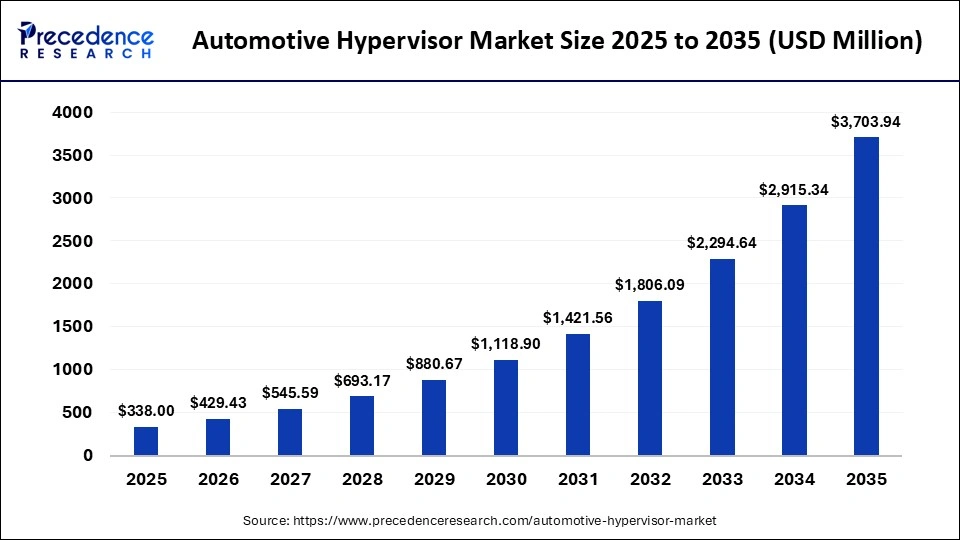
The global automotive hypervisor market is witnessing rapid expansion as the automotive industry shifts toward software-defined vehicles, connected mobility, and autonomous technologies. The market size was valued at USD 338.00 million in 2025 and is projected to grow from USD 429.43 million in 2026 to approximately USD 3,703.94 million by 2035, expanding at an impressive CAGR of 27.05% from 2026 to 2035.
The market is growing due to the increasing adoption of virtual cockpit platforms, in-vehicle virtualization technologies, advanced driver assistance systems (ADAS), and autonomous driving solutions. Automotive hypervisors enable automakers to run multiple operating systems and applications on a single hardware platform, reducing system complexity while improving safety, security, and efficiency.
Read Also: Chemical Hydrogen Market
Key Takeaways
-
Asia Pacific dominated the global automotive hypervisor market in 2025.
-
North America is expected to grow at the fastest rate during the forecast period.
-
By product type, the Type 1 automotive hypervisor segment held the largest market share in 2025.
-
The Type 2 automotive hypervisor segment is expected to grow at the fastest CAGR in the coming years.
-
By vehicle type, passenger vehicles dominated the market in 2025.
-
Heavy commercial vehicles are projected to witness the fastest growth during the forecast period.
-
By end user, the luxury vehicle segment accounted for the largest market share in 2025.
-
The economy segment is expected to grow at the fastest rate.
-
By mode of operation, semi-autonomous vehicles dominated the market in 2025.
-
The autonomous vehicle segment is expected to grow significantly during the forecast period.
Automotive Hypervisor Market Overview
An automotive hypervisor is a specialized software layer that runs directly on vehicle hardware and creates isolated environments for different vehicle applications. It acts as a virtualization platform, enabling multiple operating systems and applications to run simultaneously on a single hardware device.
By consolidating various electronic control units (ECUs) into a single platform, hypervisors help reduce:
-
Hardware requirements
-
Vehicle weight
-
Power consumption
-
Manufacturing costs
Automakers are increasingly introducing software-driven features such as advanced infotainment systems, ADAS, vehicle-to-everything (V2X) communication, and autonomous driving capabilities. These technologies significantly increase system complexity. Automotive hypervisors address this challenge by allowing multiple virtualized environments to operate securely on a single computing platform.
However, while this consolidation improves efficiency and scalability, it can also increase system complexity, making maintenance and troubleshooting more challenging.
Impact of Artificial Intelligence on the Automotive Hypervisor Market
Artificial intelligence (AI) and machine learning are significantly transforming automotive hypervisor technologies. AI-powered hypervisors enable predictive analytics, adaptive resource management, and advanced cybersecurity capabilities within modern vehicles.
AI integration allows hypervisors to securely manage multiple critical applications, including:
-
Infotainment systems
-
Driver assistance technologies
-
Autonomous driving software
Advanced hardware-assisted virtualization technologies such as Intel VT-x and ARM TrustZone enhance the performance and security of hypervisor platforms. When combined with AI algorithms, these technologies improve system isolation, real-time decision-making, predictive maintenance, and threat detection.
AI-driven virtualization is also accelerating the development of virtual cockpit platforms and autonomous vehicle architectures, enabling faster software development and deployment.
Automotive Hypervisor Market Trends
Rising Development of Autonomous Vehicles
The rapid development of autonomous vehicles is significantly increasing demand for automotive hypervisors. Autonomous driving systems rely on real-time sensor data processing, AI algorithms, and advanced computing platforms that require strong system isolation and security.
Hypervisors enable multiple vehicle functions to run securely on a single hardware platform, ensuring reliability and operational safety.
Increasing Focus on Vehicle Cybersecurity
As vehicles become more connected, cybersecurity has become a major concern for automotive manufacturers. Automotive hypervisors help isolate critical vehicle systems, preventing unauthorized access and reducing the risk of cyberattacks.
By separating safety-critical functions from infotainment and connectivity systems, hypervisors enhance the overall security architecture of modern vehicles.
Integration of ADAS and Advanced Infotainment Systems
The growing adoption of advanced driver assistance systems (ADAS) and high-performance infotainment platforms is boosting the demand for hypervisors. These systems require simultaneous operation of multiple software applications that must remain secure and isolated.
Hypervisors allow automakers to consolidate these systems on a single platform while ensuring real-time performance and functional safety.
Growth of Cloud-Based Development Platforms
Automotive manufacturers are increasingly leveraging cloud-based hypervisor platforms for simulation, testing, and over-the-air software updates. These platforms allow developers to test vehicle software virtually, significantly reducing development time and costs.
Expansion of Electric and Autonomous Vehicles
The rapid growth of electric vehicles (EVs) and autonomous vehicles (AVs) is creating new opportunities for automotive hypervisor solutions. These vehicles rely heavily on software-defined architectures that require robust virtualization technologies to manage multiple applications efficiently.
Segment Insights
Product Type Insights
Why Did the Type 1 Automotive Hypervisor Segment Dominate?
The Type 1 automotive hypervisor segment dominated the market in 2025 due to its ability to run directly on vehicle hardware without requiring a host operating system. This bare-metal architecture delivers superior performance, security, and system isolation.
Type 1 hypervisors are particularly suitable for safety-critical automotive applications because they support real-time processing and comply with strict functional safety standards such as ISO 26262.
They also enable:
-
Faster boot times
-
Reduced system latency
-
Enhanced reliability for mission-critical functions
The increasing adoption of ADAS, autonomous driving systems, and virtual cockpit technologies has further strengthened the demand for Type 1 hypervisors.
Why is the Type 2 Hypervisor Segment Growing Rapidly?
The Type 2 automotive hypervisor segment is expected to grow at the fastest rate during the forecast period. These hypervisors run on top of an existing operating system, which simplifies deployment and provides greater flexibility.
Type 2 hypervisors are particularly useful for integrating third-party applications such as:
-
Navigation systems
-
Voice assistants
-
Entertainment applications
Their compatibility with diverse hardware configurations and familiar management tools makes them attractive for automakers integrating new software environments.
Vehicle Type Insights
Why Did Passenger Vehicles Dominate the Market?
The passenger vehicle segment held the largest share of the automotive hypervisor market in 2025 due to rising demand for connected vehicles and enhanced in-car experiences.
According to the Ministry of Heavy Industries in India, approximately 53.8 lakh passenger vehicles were produced in 2025, with 44.9 lakh sold and 8.6 lakh exported, highlighting strong market demand.
Automotive hypervisors enable passenger vehicles to support multiple advanced features simultaneously while ensuring system safety and performance.
Why are Heavy Commercial Vehicles Growing Rapidly?
The heavy commercial vehicle segment is projected to grow at the fastest rate during the forecast period. These vehicles require advanced system monitoring, safety controls, and efficient resource management to handle demanding operating conditions.
Hypervisors help isolate critical vehicle functions, ensuring reliable system performance and enhanced safety.
End User Insights
Why Did the Luxury Segment Lead the Market?
The luxury vehicle segment dominated the market in 2025 due to the strong demand for premium features such as advanced infotainment, autonomous driving technologies, and connected vehicle services.
Luxury automakers rely heavily on hypervisors to manage sophisticated software systems and ensure seamless user experiences.
Why is the Economy Segment Growing Quickly?
The economy vehicle segment is expected to grow at the fastest rate during the forecast period. Automakers are increasingly adopting hypervisor technology to enhance safety and infotainment capabilities even in budget vehicles.
Hypervisors also improve cybersecurity by isolating critical and non-critical vehicle functions.
Mode of Operation Insights
Why Did Semi-Autonomous Vehicles Dominate the Market?
The semi-autonomous vehicle segment held the largest market share in 2025 due to the increasing integration of ADAS technologies. Hypervisors enable safe consolidation of multiple applications while maintaining system reliability and security.
Why Will Autonomous Vehicles Grow Rapidly?
The autonomous vehicle segment is expected to expand at the fastest rate as demand for self-driving vehicles increases globally. Autonomous vehicles require advanced computing platforms capable of managing numerous applications simultaneously.
Automotive hypervisors provide the required system isolation, reliability, and efficient resource allocation to support these complex systems.
Key Companies in the Automotive Hypervisor Market
Major companies operating in the global automotive hypervisor market include:
-
BlackBerry Limited (QNX)
-
Green Hills Software
-
Wind River Systems
-
Panasonic Holdings Corporation
-
Renesas Electronics Corporation
-
NXP Semiconductors
-
Continental AG
-
Siemens AG
-
Qualcomm Incorporated
-
Robert Bosch GmbH
-
Aptiv PLC
Get Sample: https://www.precedenceresearch.com/checkout/8040
For inquiries regarding discounts, bulk purchases, or customization requests, please contact us at sales@precedenceresearch.com

- Digital Infrastructure Market to Reach USD 1.32 Trillion by 2035 - June 10, 2026
- Ethoxyquin Market Size to Reach USD 446 Million by 2035 - June 10, 2026
- Liquid Crystal Polymer Market Poised to Reach USD 3.82 Billion by 2035 - June 3, 2026
