
 by
by Analog AI Chip Market Size in 2026
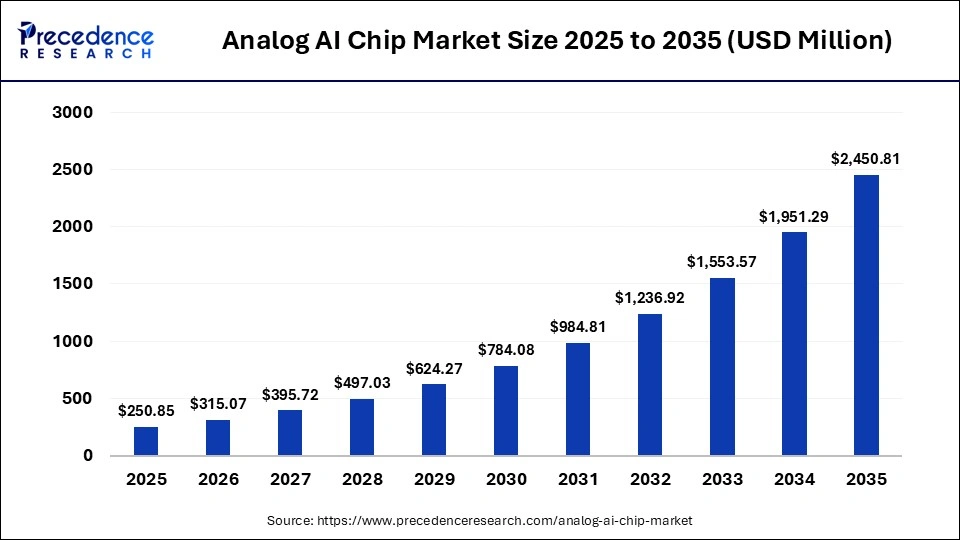
The global analog AI chip market size was valued at USD 250.85 million in 2025 and is projected to grow from USD 315.07 million in 2026 to approximately USD 2,450.81 million by 2035, expanding at a compound annual growth rate (CAGR) of 25.60% from 2026 to 2035. The market growth is primarily driven by the increasing adoption of deep learning technologies, the expansion of artificial intelligence across industries, and rising investments in next-generation semiconductor technologies.
Read Also: Automotive Hypervisor Market
Market Overview
The analog AI chip market focuses on semiconductor processors that run artificial intelligence workloads using analog computation instead of traditional digital architectures.
Unlike digital chips that process information using binary data, analog AI chips operate within continuous electrical domains, enabling:
-
Ultra-low power consumption
-
Faster matrix operations
-
High-efficiency AI inference at the edge
These chips are increasingly used in applications such as:
-
Edge computing devices
-
Autonomous systems
-
Robotics
-
IoT sensors
-
Scientific computing
Organizations across industries are rapidly adopting AI technologies to improve operational efficiency, automate processes, and reduce costs. This growing reliance on AI is increasing the demand for high-performance AI chips capable of handling complex workloads with improved energy efficiency.
Additionally, rising R&D investments in next-generation semiconductor designs and analog computing architectures are accelerating innovation in the market.
Analog AI chips are particularly suitable for edge computing environments, where devices must process information locally with minimal latency and limited power resources. Their ability to deliver real-time intelligence with lower energy requirements makes them critical for the future of AI-powered devices.
Major Trends in the Analog AI Chip Market
Growing Demand for Edge AI
The rise of edge computing is one of the most significant drivers for analog AI chips. These processors enable local machine learning capabilities, allowing devices to analyze data in real time without depending heavily on cloud infrastructure.
This technology is widely used in industries such as:
-
Healthcare
-
Industrial automation
-
Consumer electronics
-
Smart cities
Edge AI helps reduce latency, improve data privacy, and lower operational costs.
Government Support for Semiconductor Innovation
Governments around the world are increasingly supporting AI and semiconductor innovation through funding and policy initiatives.
Programs such as:
-
The U.S. CHIPS and Science Act
-
European AI development strategies
are encouraging domestic semiconductor production, research collaborations, and technological innovation.
These initiatives help strengthen global supply chains and accelerate the commercialization of advanced AI chips.
Rising Adoption in Edge Devices
Analog AI chips are being integrated into a wide range of edge devices including:
-
Wearables
-
Smart cameras
-
IoT sensors
-
Industrial monitoring devices
These chips process AI workloads locally, reducing reliance on cloud connectivity and improving responsiveness in environments where low latency is essential.
Increasing Focus on Energy-Efficient AI
As AI models become more complex, power consumption has emerged as a major challenge.
Analog AI chips address this challenge by performing computations with significantly lower energy consumption compared to digital processors. This allows devices to operate continuously while maintaining longer battery life.
Advances in Neuromorphic and In-Memory Computing
Technologies such as neuromorphic computing and in-memory computing architectures are transforming AI hardware design.
Neuromorphic chips mimic the behavior of the human brain by using spiking neural networks, enabling:
-
Real-time learning
-
Pattern recognition
-
Sensory data processing
These capabilities are particularly useful in robotics, speech recognition, and environmental monitoring.
Expansion of IoT Ecosystems
The rapid expansion of Internet of Things (IoT) devices is generating demand for on-device AI processing.
Analog AI chips are ideal for IoT systems because they support:
-
Real-time analytics
-
Energy-efficient operation
-
Reliable edge intelligence
Applications include smart homes, industrial IoT networks, and healthcare monitoring devices.
Innovation from Startups and Partnerships
Startups are introducing innovative hardware designs, while partnerships with established semiconductor companies enable large-scale manufacturing and global distribution.
These collaborations accelerate commercialization and strengthen the adoption of analog AI technologies worldwide.
Segment Insights
Chip Type Insights
Analog AI Accelerators
The analog AI accelerators segment dominated the market with 41% share in 2025.
These accelerators are designed to perform core AI operations such as matrix-vector multiplication and in-memory computing tasks. By performing calculations directly within memory arrays, they reduce data movement between memory and processors.
This results in:
-
Lower energy consumption
-
Faster processing speeds
-
Improved efficiency for edge AI systems
Neuromorphic Analog Chips
The neuromorphic analog chips segment is expected to grow at the fastest rate.
These chips replicate brain-like computing mechanisms and are capable of performing real-time learning and pattern recognition. They are particularly useful in applications such as:
-
Robotics
-
Autonomous systems
-
Smart IoT devices
Technology Insights
In-Memory Computing (IMC)
The in-memory computing segment dominated the market with 38% share in 2025.
IMC solves one of the biggest limitations of traditional computing systems: the constant transfer of data between memory and processors.
By integrating computation directly into memory arrays, IMC enables:
-
Faster AI calculations
-
Lower power consumption
-
Higher performance per watt
Photonic / Optical Analog AI
Photonic or optical analog AI technology is expected to grow rapidly.
This technology processes information using light instead of electrical signals, enabling extremely high-speed data processing and improved energy efficiency.
It is particularly beneficial for advanced AI models such as:
-
Large language models (LLMs)
-
Image generation systems
Application Insights
Edge AI & IoT Devices
The edge AI and IoT devices segment held the largest share of 34% in 2025.
These devices require fast, low-latency AI processing directly on the device. Analog AI chips allow them to perform complex computations locally while consuming minimal power.
This ensures:
-
Improved performance
-
Longer battery life
-
Reliable real-time decision making
Autonomous Systems and Robotics
The autonomous systems and robotics segment is projected to grow at the fastest CAGR.
Applications include:
-
Self-driving vehicles
-
Drones
-
Industrial robots
These systems must process large volumes of sensor data in real time, making analog AI chips highly valuable.
Deployment Type Insights
Edge Computing Devices
The edge computing devices segment dominated the market with 46% share in 2025.
These devices process data near its source, which reduces latency and lowers dependence on centralized cloud infrastructure.
They are widely used in:
-
Smart sensors
-
Industrial IoT systems
-
Real-time analytics platforms
Hybrid AI Processing Platforms
Hybrid platforms combine the capabilities of edge computing and cloud processing. They provide scalable AI processing solutions that support complex workloads.
Industry Vertical Insights
Electronics and Semiconductor Industry
The electronics and semiconductor sector held the largest share of 29% in 2025.
This industry relies heavily on advanced AI chips for applications such as:
-
Smartphones
-
Wearable devices
-
High-performance computing systems
Automotive and Mobility
The automotive sector is expected to grow at the fastest rate due to increasing adoption of:
-
Electric vehicles
-
Autonomous driving technologies
-
Connected mobility systems
AI Workload Insights
Inference Acceleration
The inference acceleration segment accounted for 52% of the market share in 2025.
Most AI applications rely on inference processes to deliver results from trained models. Analog AI chips provide faster inference speeds while using minimal energy.
Mixed Training and Inference Workloads
This segment will grow rapidly as organizations require systems capable of both training AI models and running inference operations efficiently.
Integration Level Insights
Standalone Analog AI Chips
The standalone analog AI chips segment held the largest share of 48% in 2025.
These chips are designed specifically for AI tasks and deliver high performance while consuming very little power.
Integrated SoC AI Modules
Integrated System-on-Chip (SoC) AI modules combine AI accelerators, processors, and memory on a single chip. They are widely used in smartphones, robotics, and autonomous vehicles.
Analog AI Chip Market Companies
Key companies operating in the global analog AI chip market include:
-
NVIDIA Corporation
-
Intel
-
Advanced Micro Devices Inc.
-
Amazon Web Services
-
Google Inc.
-
Microsoft Corporation
-
Mythic AI
-
IBM
-
Hailo
-
Syntiant
-
Aspinity
-
Rain Neuromorphics
-
Polyn Technology
-
General Vision Inc.
-
Merck KGaA
-
Air Liquide
Get Sample: https://www.precedenceresearch.com/checkout/7940
For inquiries regarding discounts, bulk purchases, or customization requests, please contact us at sales@precedenceresearch.com

- Digital Infrastructure Market to Reach USD 1.32 Trillion by 2035 - June 10, 2026
- Ethoxyquin Market Size to Reach USD 446 Million by 2035 - June 10, 2026
- Liquid Crystal Polymer Market Poised to Reach USD 3.82 Billion by 2035 - June 3, 2026
