
 by
by The global wearable AI market is entering a transformative phase as artificial intelligence becomes increasingly embedded into everyday wearable devices. From smartwatches and fitness bands to smart rings, AI-enabled glasses, and medical wearables, these technologies are helping consumers track health, improve fitness, manage chronic diseases, and enhance productivity in real time.
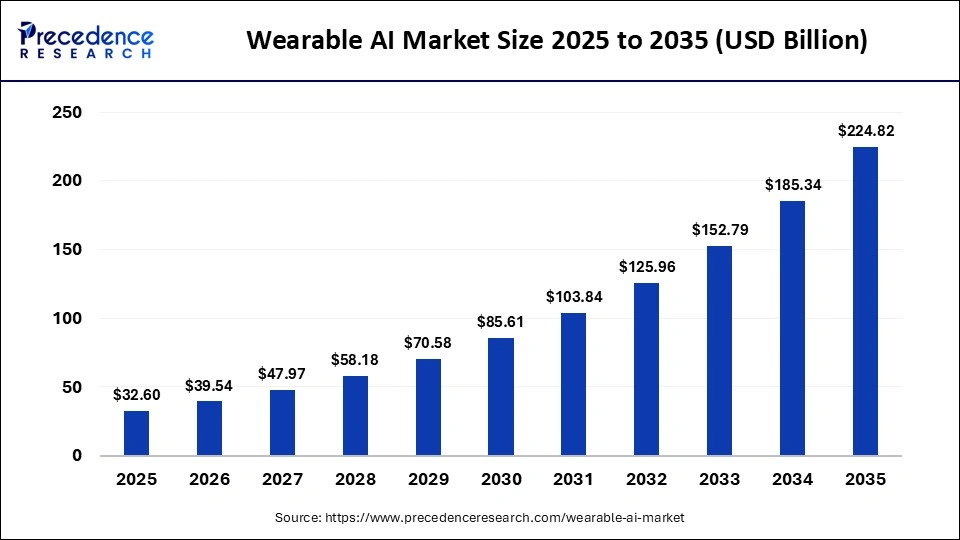
The global wearable AI market size was valued at USD 32.60 billion in 2025 and is projected to grow from USD 39.54 billion in 2026 to nearly USD 224.82 billion by 2035, expanding at a CAGR of 21.30% between 2026 and 2035. The growing demand for personalized health monitoring, predictive wellness insights, AI-powered coaching, and enterprise wearable solutions continues to fuel rapid market expansion.
Read Also: 5G Customer Premises Equipment Market
Quick Insights: What is Driving the Wearable AI Market?
- The wearable AI market is expected to reach USD 39.54 billion in 2026.
- The market is forecast to surpass USD 224.82 billion by 2035.
- North America accounted for the largest share of 40% in 2025.
- Asia Pacific is expected to witness the fastest growth during the forecast period.
- Hardware dominated the market with a 50% share in 2025.
- Software is expected to grow at the fastest pace through 2035.
- Smartwatches held the leading product share of 50% in 2025.
- Smart rings are projected to witness the fastest growth rate.
- Healthcare represented the largest application segment with a 35% market share in 2025.
- Healthcare providers emerged as the leading end-use segment in 2025.
Market Size Snapshot
| Market Metric | Value |
|---|---|
| Market Size in 2025 | USD 32.60 Billion |
| Market Size in 2026 | USD 39.54 Billion |
| Forecast Market Size by 2035 | USD 224.82 Billion |
| CAGR (2026-2035) | 21.30% |
| Leading Region | North America |
| Fastest Growing Region | Asia Pacific |
How is Artificial Intelligence Transforming Wearable Devices?
Artificial intelligence is no longer limited to smartphones and cloud platforms. It is now embedded directly into wearable devices, enabling users to receive predictive, real-time insights based on health, fitness, behavior, and environmental conditions.
AI-powered wearables can monitor heart rate, sleep cycles, oxygen levels, calorie expenditure, stress, body temperature, and even early symptoms of illness. These devices continuously learn from user behavior, making them more accurate over time and enabling personalized recommendations for fitness, diet, recovery, and wellness.
In healthcare, wearable AI is transforming chronic disease management and remote patient monitoring. Hospitals and clinics are increasingly relying on AI-enabled devices for continuous patient observation, improving outcomes while reducing hospital visits and costs. In enterprise settings, wearables are also being used for workforce monitoring, remote training, safety tracking, and operational efficiency.
What are the Major Growth Factors Behind the Wearable AI Market?
Rising Demand for Real-Time Health Monitoring
Consumers are becoming increasingly health-conscious and are seeking wearable devices that can deliver real-time insights into their physical condition. Smartwatches, smart rings, and medical-grade wearables are being used to monitor heart rate, sleep, stress, blood oxygen, and chronic conditions, boosting demand for AI-powered wearable technologies.
Expansion of Preventive Healthcare and Remote Monitoring
Healthcare providers are rapidly adopting wearable AI solutions for remote patient monitoring and chronic disease management. These technologies enable continuous care beyond hospitals and clinics, making healthcare more proactive and personalized.
Advances in Battery Life and Sensor Technology
Continuous improvements in sensors, chipsets, and battery efficiency are making wearable devices more powerful and convenient. Faster charging, longer battery life, and miniaturized sensors are encouraging greater adoption across consumer and enterprise applications.
Growing Adoption in Sports and Fitness
Athletes, fitness enthusiasts, and sports organizations are increasingly using AI wearables to monitor performance, prevent injuries, and track recovery. AI-driven analytics are helping users improve training outcomes and make data-driven fitness decisions.
What Opportunities are Emerging in the Wearable AI Market?
Could Smart Rings Become the Next Big Wearable Trend?
Smart rings are expected to emerge as one of the fastest-growing segments in the wearable AI market. These compact devices offer discreet health monitoring, sleep tracking, stress analysis, and fitness insights in a lightweight format. Growing consumer interest in minimalist, stylish wearables is creating strong demand for smart rings.
Will Smart Glasses Reshape Enterprise and Consumer Applications?
AI-powered smart glasses are gaining momentum across healthcare, manufacturing, logistics, retail, and consumer electronics. These devices provide hands-free information, augmented reality overlays, remote assistance, and voice-enabled AI interactions, making them valuable in both professional and personal settings.
How Will AI Wearables Support the Future of Wellness?
Experts predict that by 2035, wearable devices could evolve into invisible, self-powered systems embedded into clothing, contact lenses, patches, and accessories. AI will increasingly provide predictive health insights, enabling early disease detection and personalized wellness management.
Segment Analysis
Hardware Continues to Lead While Software Gains Momentum
Hardware accounted for 50% of the wearable AI market in 2025 due to the widespread adoption of smartwatches, fitness trackers, smart glasses, and AI-powered medical devices. However, software is expected to grow at the fastest rate, driven by demand for AI analytics, predictive health insights, sleep monitoring, and personalized coaching applications.
Smartwatches Remain the Leading Product Category
Smartwatches held the largest share of the wearable AI market in 2025, accounting for 50% of total revenue. Their ability to combine communication, health tracking, sleep analysis, and AI-powered assistance into a single device has made them the preferred choice among consumers. Meanwhile, smart rings and smart glasses are expected to experience the fastest growth in the coming years.
Healthcare is the Largest Application Area
Healthcare emerged as the leading application segment in 2025 with a 35% market share. AI-powered wearables are increasingly being used for chronic disease management, early diagnosis, patient monitoring, and preventive healthcare. Fitness and wellness followed as the second-largest segment, while sports is projected to grow at the fastest rate over the forecast period.
Why is North America Leading the Wearable AI Market?
North America accounted for 40% of the global wearable AI market in 2025 due to high consumer awareness, strong healthcare infrastructure, widespread adoption of digital health technologies, and major investments in AI research and development.
The United States remains the largest contributor to regional growth, supported by the increasing use of telemedicine, remote patient monitoring, and AI-powered wellness programs. Strong demand for smartwatches, fitness trackers, AI rings, and medical wearables continues to drive growth across the region.
Why is Asia Pacific the Fastest-Growing Market?
Asia Pacific is expected to witness the fastest growth during the forecast period due to rising disposable incomes, growing health awareness, and rapid adoption of 5G, AI, and digital health technologies.
Countries such as China, India, Japan, and South Korea are experiencing strong demand for wearable devices as consumers increasingly adopt smartwatches, fitness trackers, and AI-enabled health monitoring solutions. Government investments in digital health infrastructure and the rapid expansion of telemedicine services are also supporting regional growth.
Latest Innovations and Competitive Developments
The wearable AI market is witnessing significant innovation from major technology companies and startups. Recent developments include:
- Qualcomm introduced its Snapdragon Wear Elite platform in 2026 to support advanced on-device AI processing for smartwatches, smart glasses, AI pendants, and next-generation wearables.
- Amazon re-entered the wearable market with its AI-enabled Bee device, designed to automatically document conversations and generate summaries and reminders.
- Major brands such as Meta, Google, Apple, Samsung, and Fitbit are increasingly integrating generative AI and predictive analytics into wearable products.
Leading Companies in the Wearable AI Market
Key companies operating in the wearable AI market include:
- Apple
- Samsung Electronics
- Meta Platforms
- Qualcomm
- Fitbit
- Garmin
- Oura
- Amazon
- Motorola
What Challenges Could Limit Market Growth?
Despite strong growth prospects, the wearable AI market still faces challenges related to data privacy, cybersecurity, high device costs, interoperability issues, and concerns around the accuracy of consumer-grade devices.
Many consumers remain cautious about sharing sensitive health information through connected devices. In addition, limited integration between wearable ecosystems and healthcare systems can reduce the overall value of these technologies. Ensuring data security, regulatory compliance, and clinical-grade accuracy will be essential for sustained market growth.
Case Study: Wearable AI in Chronic Disease Management
Healthcare providers are increasingly using wearable AI devices to monitor chronic conditions such as diabetes, cardiovascular diseases, and sleep disorders. Smartwatches and AI-enabled medical wearables allow patients to track vital signs continuously, while clinicians can access real-time data remotely to adjust treatments and intervene early if needed.
This shift from episodic care to continuous monitoring is improving patient outcomes, reducing hospital admissions, and helping healthcare systems manage rising patient volumes more efficiently.
Get Sample Report: https://www.precedenceresearch.com/sample/8298
For inquiries regarding discounts, bulk purchases, or customization requests, please contact us at sales@precedenceresearch.com

- Digital Infrastructure Market to Reach USD 1.32 Trillion by 2035 - June 10, 2026
- Ethoxyquin Market Size to Reach USD 446 Million by 2035 - June 10, 2026
- Liquid Crystal Polymer Market Poised to Reach USD 3.82 Billion by 2035 - June 3, 2026
