 by
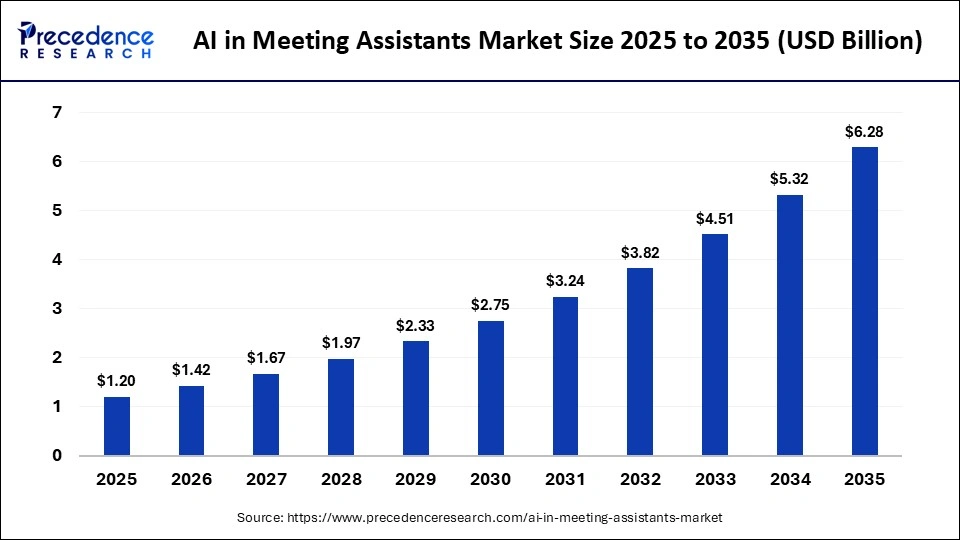
by The global AI in meeting assistants market is witnessing strong momentum as businesses continue to adopt hybrid work models and prioritize productivity automation. The market size stood at USD 1.20 billion in 2025 and is projected to reach approximately USD 6.28 billion by 2035, expanding at a CAGR of 18.00% from 2026 to 2035. Growing reliance on AI-powered transcription, real-time summarization, task tracking, and collaboration analytics is transforming how enterprises manage meetings and internal communication.
Organizations across corporate, healthcare, legal, and education sectors are increasingly integrating AI meeting assistants into their workflows to reduce manual note-taking, improve decision-making, and streamline post-meeting action items. Tools such as Otter.ai, Fireflies.ai, and Avoma are becoming essential for enterprises seeking to improve employee productivity and operational efficiency.
Read Also: Wearable AI Market
Quick Insights
- The global AI in meeting assistants market was valued at USD 1.20 billion in 2025 and is forecast to hit USD 6.28 billion by 2035.
- The market is expected to expand at a CAGR of 18.00% from 2026 to 2035.
- North America dominated the market with a 35% share in 2025 due to rapid adoption of AI-enabled collaboration tools.
- Asia Pacific is projected to witness the fastest growth because of rising enterprise digitization and increased AI adoption across healthcare, education, and manufacturing sectors.
- The cloud-based deployment segment led the market with a 75% share in 2025.
- The corporate sector emerged as the largest application segment with a 40% share in 2025.
- Large enterprises accounted for the highest share of 35% in 2025 as they continue to invest heavily in workflow automation and AI-enabled collaboration.
How is Artificial Intelligence Transforming the Meeting Assistant Industry?
Artificial intelligence is fundamentally reshaping workplace collaboration by enabling real-time transcription, contextual summarization, sentiment analysis, and automated follow-up actions. Instead of relying on employees to manually record meeting notes, AI assistants can automatically capture key decisions, action items, and discussion highlights in seconds.
The growing use of generative AI and natural language processing has further improved the accuracy and relevance of meeting summaries. AI assistants are now capable of identifying speakers, understanding conversational context, integrating with CRM systems, and creating workflow tasks directly from meeting discussions. This is helping organizations reduce administrative workloads while improving team productivity and accountability.
What are the Major Growth Factors Driving the AI in Meeting Assistants Market?
Why are Hybrid Work Models Accelerating Market Growth?
The rapid shift toward remote and hybrid work environments is one of the biggest growth drivers for AI meeting assistants. As organizations manage distributed teams across different locations and time zones, there is a greater need for automated tools that ensure everyone stays aligned and informed after meetings. AI assistants eliminate the need for employees to manually document conversations, improving collaboration across teams.
How is Enterprise Integration Creating New Opportunities?
The integration of AI meeting assistants with enterprise software ecosystems such as CRM platforms, project management tools, and video conferencing applications is creating significant opportunities for vendors. Enterprises are increasingly looking for AI tools that connect directly with platforms such as Microsoft Teams, Zoom, and Google Meet to enable seamless workflows and actionable meeting insights.
Why is Demand Rising in Healthcare and Legal Industries?
Industries such as healthcare and legal services are increasingly adopting AI meeting assistants to manage large volumes of sensitive documentation and compliance-related records. Healthcare providers are using AI tools to reduce administrative workloads and improve clinical note-taking, while legal professionals are leveraging AI to automate documentation and client meeting summaries.
Which Segment Dominated the AI in Meeting Assistants Market?
The cloud-based deployment segment dominated the market in 2025 with a 75% share due to its scalability, flexibility, and ability to support remote work environments. Businesses are increasingly favoring cloud-based AI meeting assistants because they can be deployed quickly and integrated across multiple collaboration platforms without extensive infrastructure investments.
On the application side, the corporate sector held the largest market share of 40% in 2025. Companies are using AI meeting assistants to automate repetitive administrative tasks, reduce meeting fatigue, and improve employee productivity. Meanwhile, healthcare is projected to be the fastest-growing application segment because of its need to streamline documentation and reduce clinician workloads.
Large enterprises led the market in 2025 as they continue to invest heavily in AI-driven automation and digital transformation initiatives. However, medium-sized businesses are expected to grow at the fastest pace due to their increasing demand for affordable and scalable AI solutions.
Why Did North America Dominate the Market?
North America accounted for 35% of the global AI in meeting assistants market in 2025. The region benefits from strong cloud infrastructure, high AI adoption rates, and the presence of major technology companies that continue to innovate in the meeting productivity space. The United States remains the key contributor, supported by strong enterprise demand and high investment in generative AI technologies.
Europe emerged as the second-largest market due to strong compliance requirements, rising demand for remote collaboration tools, and favorable government support for AI adoption. Meanwhile, Asia Pacific is projected to register the fastest growth through 2035 as businesses across China, India, and Japan accelerate enterprise digitization and AI integration.
What Challenges Could Limit Market Expansion?
Despite the strong growth outlook, the market faces several challenges. Data privacy concerns, especially around storing and processing confidential meeting information, remain a key restraint. Organizations in highly regulated industries such as healthcare and finance often require on-premises solutions to maintain control over sensitive data.
There is also growing concern around shadow AI, where employees use unauthorized AI tools without organizational approval. This can create security vulnerabilities, compliance risks, and inconsistencies in data governance. Compliance with regulations such as GDPR and HIPAA may also slow adoption in some sectors.
Case Study: How AI Meeting Assistants are Improving Workplace Productivity
Many medium-sized enterprises report significant time savings after implementing AI meeting assistants. According to market estimates, businesses using AI note-taking and meeting summarization tools can save nearly five to seven hours per employee every week by reducing manual note-taking and repetitive follow-up tasks. These gains are particularly valuable for sales, customer support, and project management teams that handle multiple meetings every day.
Reddit discussions also suggest that businesses are increasingly comparing platforms based on workflow integration and collaboration features rather than transcription alone. Some users highlight that while tools like Otter.ai are preferred for individual transcription, Fireflies.ai offers stronger CRM integrations and automation features for teams.
Leading Companies in the AI in Meeting Assistants Market
Key companies operating in the market include:
- Otter.ai
- Fireflies.ai
- Rev.com, Inc.
- Fathom
- x.ai
- Chorus.ai
- Grain.co
- Deepgram
- Sonix.ai
- Symbl.ai
- Verbit
- MeetGeek
- Miro
- Avoma
- Trello
Get Sample Copy: https://www.precedenceresearch.com/sample/8302
For inquiries regarding discounts, bulk purchases, or customization requests, please contact us at sales@precedenceresearch.com

