
 by
by Inorganic Scintillators Market: Advancing Radiation Detection and Medical Imaging Technologies
Introduction: The Science Behind Radiation Detection
Inorganic scintillators are at the heart of modern radiation detection systems, playing a critical role in industries ranging from healthcare and nuclear energy to homeland security and scientific research. These advanced materials convert high-energy radiation into visible light, enabling accurate measurement and imaging.
With the growing need for early disease diagnosis, nuclear safety, and advanced research capabilities, the demand for inorganic scintillators is steadily rising across the globe.
Market Overview: Steady Growth Driven by Healthcare and Security Needs
The global inorganic scintillators market was valued at USD 780 million in 2025 and is projected to grow from USD 833.82 million in 2026 to USD 1,520.10 million by 2035, expanding at a CAGR of 6.90%.
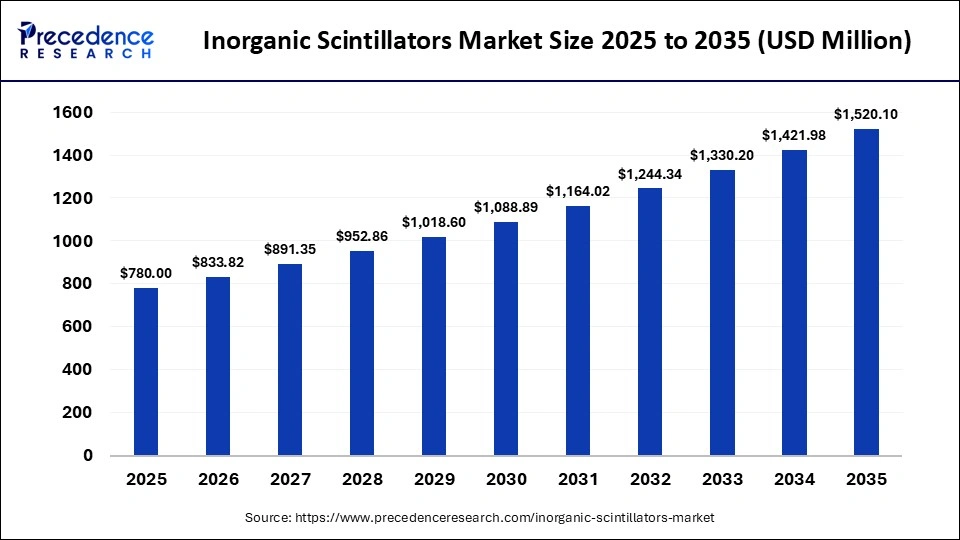
This growth is primarily fueled by:
- Increasing use of medical imaging technologies
- Rising demand for radiation detection systems
- Expanding applications in defense and homeland security
- Advancements in high-performance scintillation materials
Read Also: Sovereign AI Infrastructure Market
What Are Inorganic Scintillators?
Inorganic scintillators are crystalline materials that emit light when exposed to ionizing radiation. They are widely used in:
- PET (Positron Emission Tomography)
- SPECT imaging systems
- CT scanners
- Radiation detectors in nuclear facilities
Their ability to deliver high sensitivity, fast response time, and accurate detection makes them indispensable in modern technology.
Key Market Trends
1. Rising Demand in Medical Imaging
Medical imaging remains the largest application segment, accounting for around 40% of the market share in 2025.
The growing prevalence of chronic diseases and the need for early diagnosis are driving the adoption of:
- PET scans
- CT imaging
- Nuclear medicine
Scintillators enable precise detection of radiation, improving diagnostic accuracy.
2. Growing Importance in Radiation Detection and Security
Governments and defense agencies are increasingly investing in radiation detection systems for:
- Border security
- Airport surveillance
- Nuclear threat detection
This trend is significantly boosting demand for high-performance scintillator materials.
3. Technological Advancements in Materials
New materials such as:
- Lutetium-based scintillators (LSO/LYSO)
- Advanced oxide and halide crystals
are improving:
- Detection efficiency
- Light output
- Response time
These innovations are enabling next-generation imaging and detection systems.
4. Shift Toward Silicon Photomultiplier (SiPM) Technology
While traditional photomultiplier tubes dominate, SiPM-based systems are growing rapidly due to:
- Compact size
- Higher efficiency
- Ability to detect low-light signals
This shift is transforming detector design and performance.
Market Dynamics
Key Drivers
1. Expansion of Healthcare Infrastructure
The increasing number of hospitals and diagnostic centers worldwide is boosting demand for imaging technologies.
2. Rising Nuclear Energy Projects
As countries invest in nuclear power, the need for radiation monitoring systems is growing.
3. Increased Research in High-Energy Physics
Scientific research institutions are using scintillators for particle detection and experimental analysis.
Challenges
1. High Production Costs
Manufacturing high-quality scintillator crystals is expensive and technically complex.
2. Material Limitations
Some materials are hygroscopic (sensitive to moisture), requiring special handling.
3. Supply Chain Constraints
Dependence on rare elements can impact availability and pricing.
Opportunities
1. Growth in Emerging Markets
Asia Pacific is witnessing rapid expansion due to healthcare development and industrial growth.
2. Development of Advanced Materials
Innovations in crystal growth and nanotechnology are opening new possibilities.
3. Integration with AI-Based Imaging Systems
Combining scintillators with AI-driven diagnostics can enhance performance and efficiency.
Segment Analysis
By Material Type
- Sodium Iodide (NaI) – 35% Market Share
Widely used due to cost-effectiveness and high light yield. - Cesium Iodide (CsI)
Known for durability and efficiency in gamma-ray detection - Bismuth Germanate (BGO)
Used in high-energy physics and medical imaging - Lutetium-based Scintillators (LSO/LYSO)
Fastest-growing segment due to superior performance
By Application
- Medical Imaging (40%) – Largest Segment
- Nuclear Power & Radiation Detection (25%)
- Homeland Security & Defense (15%)
- High-Energy Physics Research (10%)
- Oil & Gas Exploration (10%)
By End-Use Industry
- Healthcare & Diagnostics (45%) – Leading Segment
- Energy & Nuclear Industry (20%)
- Defense & Security Agencies (15%)
- Research Institutes (10%)
- Industrial Applications (10%)
By Detection Technology
- Photomultiplier Tube (PMT) Systems (55%) – Dominant
- Silicon Photomultiplier (SiPM) Systems – Fastest Growing
- Hybrid Detection Systems
Regional Insights
North America (38% Market Share)
- Strong healthcare infrastructure
- Advanced research facilities
- High adoption of imaging technologies
Asia Pacific (Fastest Growing Region)
- Expanding healthcare systems
- Growth in nuclear energy projects
- Rising industrial applications
Europe
- Strong focus on research and development
- Increasing adoption of advanced diagnostic technologies
Future Outlook: Innovation Meets Demand
The inorganic scintillators market is poised for steady growth as technological advancements continue to enhance performance and efficiency.
Key Future Trends:
- Development of high-speed, high-resolution scintillators
- Increased adoption of SiPM-based detection systems
- Integration with AI and digital imaging technologies
- Expansion of portable and wearable radiation detectors
Conclusion
The inorganic scintillators market plays a vital role in enabling critical technologies across healthcare, security, and scientific research. While growth is moderate compared to emerging tech sectors, the market remains highly stable and essential.
With a projected value of USD 1,520.10 million by 2035, the industry will continue to evolve through material innovation, expanding applications, and increasing global demand for safety and diagnostics.
Get a Sample Copy: https://www.precedenceresearch.com/sample/8322
For inquiries regarding discounts, bulk purchases, or customization requests, please contact us at sales@precedenceresearch.com

- Digital Infrastructure Market to Reach USD 1.32 Trillion by 2035 - June 10, 2026
- Ethoxyquin Market Size to Reach USD 446 Million by 2035 - June 10, 2026
- Liquid Crystal Polymer Market Poised to Reach USD 3.82 Billion by 2035 - June 3, 2026
