
 by
by The global federated learning market is emerging as a transformative force in artificial intelligence, enabling organizations to harness the power of data without compromising privacy. The market was valued at USD 1,219.00 million in 2025 and is projected to grow from USD 1,590.80 million in 2026 to approximately USD 17,462.60 million by 2035, expanding at an impressive CAGR of 30.50% during the forecast period.
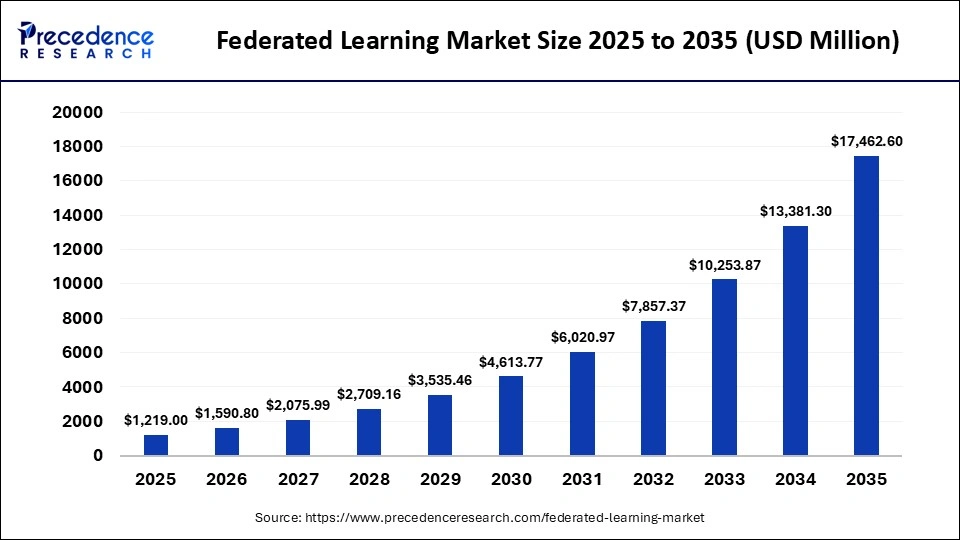
This rapid growth is driven by increasing demand for privacy-preserving AI models, rising adoption of edge computing and IoT, and the need for secure, collaborative model training across industries such as healthcare, finance, and telecommunications.
Read Also: Sequencers and Synthesizers Market
What is Federated Learning?
Federated learning is a decentralized machine learning approach where models are trained across multiple devices or servers without sharing raw data. Instead, only model updates are exchanged and aggregated into a global model.
This approach enhances:
- Data privacy and security
- Regulatory compliance (GDPR, HIPAA)
- Efficiency by reducing data transfer
It is particularly valuable for industries dealing with sensitive data.
Key Market Highlights (Quick Insights)
- The market is expected to grow at a 30.50% CAGR (2026–2035)
- North America led with ~40% market share in 2025
- Asia Pacific is the fastest-growing region
- Deep learning models dominated with ~55% share
- Cloud-based deployment led with ~55% share
- Healthcare & life sciences held the largest application share at ~25%
Role of AI in Federated Learning
Artificial intelligence is the backbone of federated learning, enabling decentralized training and intelligent data processing. AI algorithms allow systems to learn from distributed datasets while maintaining privacy and accuracy.
Advanced techniques such as differential privacy, homomorphic encryption, and secure multi-party computation are enhancing the robustness of federated learning systems. These technologies ensure that sensitive data remains protected while improving model performance.
Additionally, the integration of federated learning with edge AI enables real-time decision-making in applications such as autonomous vehicles, healthcare diagnostics, and smart devices.
Market Growth Drivers
Rising Demand for Privacy-Centric AI
Organizations are prioritizing privacy-preserving technologies due to strict regulatory frameworks and increasing data breach concerns.
Expansion of Edge Computing & IoT
The growing number of connected devices is driving demand for decentralized AI solutions that can process data locally.
Adoption in Data-Sensitive Industries
Healthcare, BFSI, and government sectors are leveraging federated learning to ensure secure data collaboration.
Data Localization and Compliance
Global regulations are encouraging organizations to adopt federated learning to maintain data sovereignty.
Segment Analysis
By Model Type
- Deep learning models dominate with 55% share, due to their ability to process complex datasets and support applications like image and speech recognition
- Reinforcement learning models hold ~15% share and are expected to grow fastest, driven by real-time decision-making use cases
- Transfer learning models improve efficiency by leveraging knowledge across domains
- Ensemble learning models enhance accuracy by combining multiple models
By Application
- Healthcare & life sciences lead with ~25% share, driven by secure data sharing in diagnostics and research
- BFSI accounts for ~20% share, using federated learning for fraud detection and risk analysis
- Retail & e-commerce (15%) focuses on personalization
- Telecom & IT (15%) use it for network optimization
- Automotive (10%) supports autonomous systems
- Government & defense (10%) ensures secure AI deployment
By Deployment Mode
- Cloud-based solutions dominate with ~55% share, offering scalability and flexibility
- On-premise deployment holds ~25% share, preferred for high-security environments
- Hybrid models (20%) are gaining traction for combining security and scalability
By End-User
- Healthcare providers & pharmaceutical companies lead with ~25% share
- Banks & financial institutions follow with ~20% share
- Retail, telecom, automotive, and government sectors are rapidly expanding adoption
Regional Analysis
North America
North America dominates the market due to early AI adoption, strong regulatory frameworks, and the presence of major technology companies.
Europe
Europe is the second-largest market, driven by strict data protection laws and increasing focus on ethical AI.
Asia Pacific
Asia Pacific is the fastest-growing region, fueled by rapid digital transformation, increasing AI investments, and expanding cloud infrastructure.
Competitive Landscape
Key players shaping the federated learning market include:
- Google LLC
- Apple Inc.
- IBM Corporation
- Microsoft Corporation
- Intel Corporation
- NVIDIA Corporation
- Huawei Technologies Co., Ltd.
- Cisco Systems, Inc.
- Samsung Electronics
- Qualcomm Technologies, Inc.
- Accenture Plc
- Alibaba Cloud
These companies are investing heavily in privacy-preserving AI technologies, decentralized architectures, and collaborative AI platforms.
Challenges in the Market
- Data heterogeneity across distributed systems
- High implementation and infrastructure costs
- Lack of standardization
- Complexity of decentralized model training
Opportunities and Emerging Trends
Privacy-Enhancing Technologies
Increasing adoption of encryption methods and secure computation techniques is boosting market growth.
Edge AI Integration
Federated learning combined with edge computing enables faster, real-time decision-making.
Blockchain Integration
Blockchain is being used to improve transparency and trust in federated learning systems.
Vertical-Specific Platforms
Industry-specific solutions are emerging for healthcare, finance, and automotive applications.
Case Insight: Healthcare Collaboration Without Data Sharing
Federated learning is transforming healthcare by enabling hospitals and research institutions to collaborate on AI models without sharing sensitive patient data. This approach improves diagnostic accuracy while maintaining strict compliance with data protection regulations.
Conclusion
The federated learning market is redefining how organizations leverage data by enabling secure, decentralized, and collaborative AI. As privacy concerns and regulatory requirements continue to grow, federated learning is becoming a cornerstone of modern AI strategies.
With strong growth projected through 2035, the market is poised to play a critical role in shaping the future of ethical, secure, and scalable AI systems.
Get Sample Link: https://www.precedenceresearch.com/sample/8339
For inquiries regarding discounts, bulk purchases, or customization requests, please contact us at sales@precedenceresearch.com

- Digital Infrastructure Market to Reach USD 1.32 Trillion by 2035 - June 10, 2026
- Ethoxyquin Market Size to Reach USD 446 Million by 2035 - June 10, 2026
- Liquid Crystal Polymer Market Poised to Reach USD 3.82 Billion by 2035 - June 3, 2026
