
 by
by The pharmaceutical industry is undergoing a profound technological transformation. Traditional drug discovery methods are expensive, time-consuming, and often associated with high failure rates. As healthcare systems worldwide demand faster, more efficient, and highly targeted therapies, pharmaceutical companies are increasingly turning to computational medicine and advanced drug discovery software.
Computational medicine combines artificial intelligence, machine learning, molecular modeling, bioinformatics, cloud computing, and high-performance computing to accelerate every stage of the drug development process. These software platforms are helping researchers simulate biological systems, identify potential drug targets, optimize compounds, and predict clinical outcomes with unprecedented speed and precision.
As AI-driven healthcare innovation accelerates globally, the computational medicine and drug discovery software market is emerging as one of the most strategically important sectors in the pharmaceutical technology ecosystem.
Market Overview: Rapid Growth Driven by AI-Powered Drug Discovery
The global computational medicine and drug discovery software market was valued at USD 10.90 billion in 2025 and is projected to grow from USD 12.94 billion in 2026 to approximately USD 60.52 billion by 2035, expanding at a remarkable CAGR of 18.70% during the forecast period.
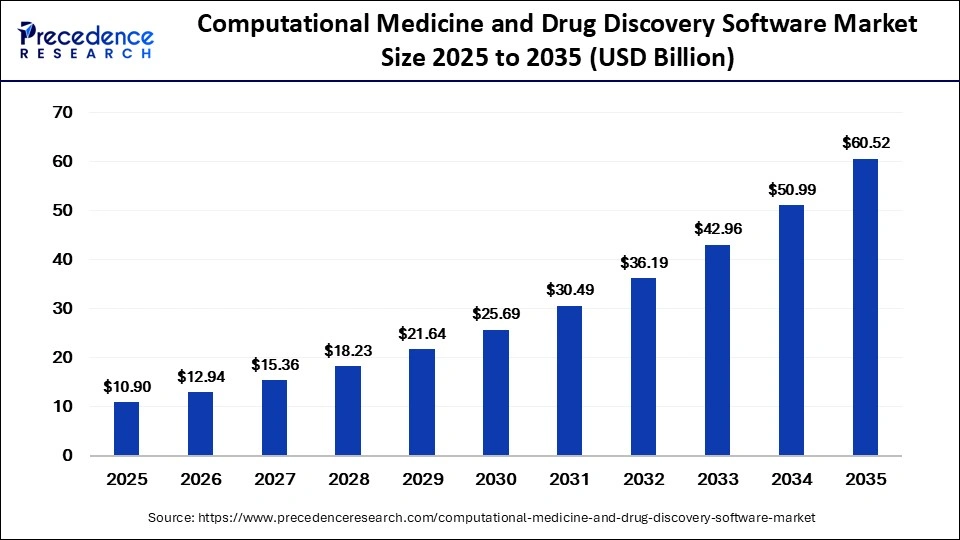
The market’s rapid growth is being fueled by:
- Increasing adoption of artificial intelligence in drug discovery
- Rising demand for personalized and precision medicine
- Growing R&D investments by pharmaceutical and biotech companies
- Expansion of cloud-based computational platforms
- Increasing complexity of biological data and molecular research
Computational software is becoming essential for reducing development timelines, lowering research costs, and improving the success rate of new therapeutics.
Read Also: Data Center Robotics Market
What is Computational Medicine and Drug Discovery Software?
Computational medicine and drug discovery software refers to advanced digital platforms designed to support pharmaceutical research, molecular analysis, and therapeutic development using computational techniques.
These solutions are widely used for:
- Molecular modeling and simulation
- AI-driven drug design
- Genomic and bioinformatics analysis
- Clinical trial simulation
- Biomarker discovery
- Predictive disease modeling
- Virtual screening of compounds
The integration of AI and advanced analytics is enabling pharmaceutical researchers to make faster and more data-driven decisions throughout the drug development lifecycle.
Key Market Trends
1. Artificial Intelligence Becoming Central to Drug Discovery
Artificial intelligence and machine learning accounted for approximately 35% of market share in 2025, making them the dominant technology segment.
AI-driven software platforms are increasingly used to:
- Predict molecular interactions
- Identify drug targets
- Accelerate compound screening
- Optimize therapeutic candidates
Generative AI is also revolutionizing molecular design by enabling the rapid creation and evaluation of new chemical structures.
Recent industry developments highlight the growing importance of AI in pharmaceutical research. In 2026, Amazon Web Services launched “Amazon Bio Discovery,” an AI-powered platform designed to accelerate early-stage drug discovery workflows without requiring coding expertise.
2. Growth of AI-Driven Drug Discovery Platforms
AI-driven drug discovery platforms represented approximately 22% of market share in 2025 and are projected to grow at the fastest CAGR of 23.5% through 2035.
These platforms are gaining traction because they:
- Reduce drug development timelines
- Improve predictive accuracy
- Lower research costs
- Enable faster therapeutic innovation
Pharmaceutical companies are increasingly partnering with AI software providers to strengthen their drug discovery capabilities.
In 2026, Eli Lilly expanded its collaboration with Insilico Medicine in a deal valued at up to $2.75 billion to accelerate AI-powered drug discovery initiatives.
3. Expansion of Cloud-Based Drug Discovery Platforms
Cloud-based deployment dominated the market with approximately 60% revenue share in 2025.
Cloud computing is transforming pharmaceutical research by enabling:
- Global collaboration
- Real-time data access
- Scalable computational resources
- Faster deployment of AI models
Cloud infrastructure significantly reduces the need for expensive on-premise systems while improving flexibility and research efficiency.
4. Rising Use of Molecular Modeling and Simulation Software
The molecular modeling and simulation segment held approximately 25% market share in 2025, making it the largest software category.
These tools help researchers:
- Understand molecular interactions
- Predict drug behavior
- Analyze protein structures
- Reduce early-stage development failures
Their critical role in structure-based drug design continues to support strong market demand.
5. Emergence of Digital Twins and In Silico Modeling
Digital twins and in silico modeling technologies are gaining momentum due to their ability to simulate biological systems virtually.
These technologies help:
- Reduce laboratory experimentation
- Improve clinical prediction accuracy
- Accelerate therapeutic validation
- Lower R&D costs
The segment is expected to witness strong long-term growth as virtual simulation technologies advance further.
Market Dynamics
Market Drivers
Growing Pressure to Reduce Drug Development Costs
Traditional pharmaceutical development can take over a decade and require billions of dollars in investment. Computational platforms help pharmaceutical companies:
- Reduce experimental failures
- Accelerate screening processes
- Improve candidate selection efficiency
This cost-saving advantage is a major growth driver for the market.
Increasing Demand for Precision Medicine
Personalized medicine requires sophisticated computational analysis to understand genetic variability and patient-specific responses.
Computational medicine software plays a critical role in:
- Biomarker discovery
- Genomic analysis
- Personalized therapeutic development
Expansion of Biotech and Pharmaceutical R&D
Biotechnology firms and pharmaceutical companies are significantly increasing investments in AI-driven research tools to improve innovation and competitiveness.
Pharma and biotech companies accounted for approximately 55% of market share in 2025, making them the largest end-user segment.
Growing Availability of Biomedical Data
The rapid expansion of:
- Genomics datasets
- Clinical trial databases
- Real-world evidence platforms
- Multi-omics data
is increasing demand for advanced computational analysis tools.
Research platforms such as Therapeutics Data Commons are helping standardize AI-ready biomedical datasets for drug discovery applications.
Market Challenges
Data Privacy and Regulatory Concerns
Handling sensitive patient and genomic data creates major regulatory and cybersecurity challenges.
Organizations must comply with:
- HIPAA
- GDPR
- Global healthcare data regulations
High Complexity of Biological Systems
Despite advances in AI, accurately modeling human biology remains highly complex.
Drug discovery platforms still face challenges related to:
- Biological variability
- Dataset quality
- Predictive reliability
Shortage of Skilled Computational Experts
The industry faces growing demand for:
- Computational biologists
- AI specialists
- Bioinformatics professionals
- Cloud infrastructure experts
The shortage of skilled talent remains a key operational challenge.
Regional Insights
North America – Dominant Region
North America accounted for approximately 45% of global market share in 2025.
The region benefits from:
- Strong pharmaceutical industry presence
- Advanced AI ecosystem
- Major biotechnology investments
- High cloud technology adoption
The United States remains the global leader in computational drug discovery innovation.
Asia Pacific – Fastest Growing Region
Asia Pacific is projected to grow at the fastest CAGR of 22.5% during the forecast period.
Growth Drivers Include:
- Expanding pharmaceutical manufacturing
- Increasing biotechnology investments
- Government healthcare digitization initiatives
- Growing AI research ecosystems
Countries such as China, India, Japan, and South Korea are driving regional expansion.
Europe
Europe continues to witness strong growth due to:
- Advanced biomedical research infrastructure
- Increasing AI adoption in healthcare
- Supportive regulatory frameworks for digital health innovation
Competitive Landscape
The computational medicine and drug discovery software market is becoming increasingly competitive as pharmaceutical companies, AI startups, cloud providers, and biotech firms expand their digital research capabilities.
Companies are focusing on:
- AI-powered molecular discovery
- Cloud-native drug development platforms
- Digital twin technologies
- Predictive analytics systems
- Generative AI for molecule design
Strategic collaborations between pharmaceutical companies and AI software providers are accelerating industry innovation.
Recent partnerships between Eli Lilly, Insilico Medicine, Schrödinger, and AWS highlight the growing convergence of AI and pharmaceutical R&D.
Future Outlook: Toward AI-Native Pharmaceutical Research
The future of computational medicine will be shaped by increasingly autonomous and AI-native research ecosystems.
Key Future Trends
- Generative AI-driven drug design
- Digital twin simulations of human biology
- AI-powered clinical trial optimization
- Quantum computing applications in molecular modeling
- Multi-omics integration platforms
- Personalized AI-driven therapeutics
The pharmaceutical industry is rapidly moving toward fully integrated computational research pipelines capable of dramatically accelerating therapeutic innovation.
Conclusion
The computational medicine and drug discovery software market is emerging as a foundational pillar of the future pharmaceutical ecosystem. As AI, cloud computing, and advanced analytics continue to transform biomedical research, computational platforms are becoming essential tools for accelerating innovation and improving drug development efficiency.
Get a Sample Copy: https://www.precedenceresearch.com/sample/8386
For inquiries regarding discounts, bulk purchases, or customization requests, please contact us at sales@precedenceresearch.com

