
 by
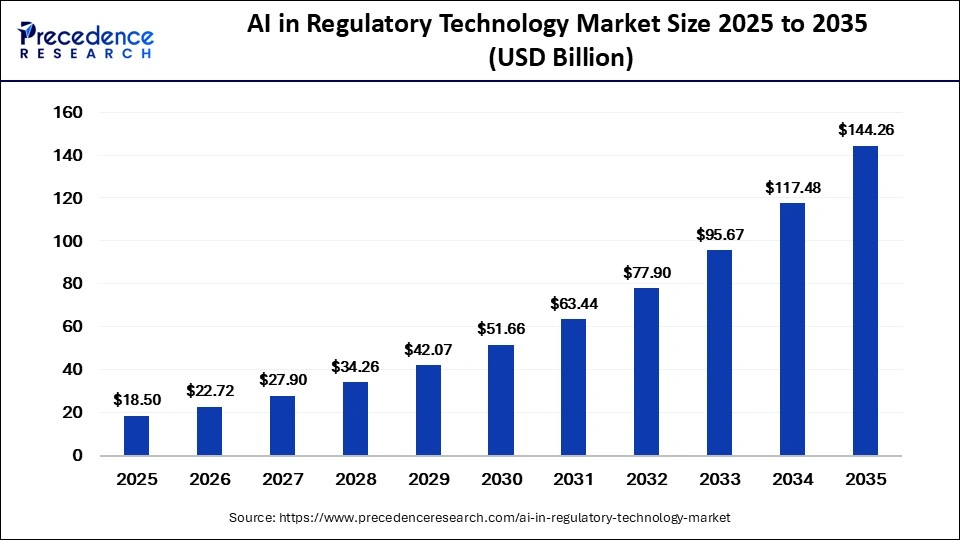
by The global AI in Regulatory Technology market is projected to reach USD 42.86 billion by 2035 at a CAGR of 23.9%. Explore key trends, drivers, segmentation, regional insights, and future opportunities.
Read Also: Computational Medicine and Drug Discovery Software Market
AI in Regulatory Technology Market: Transforming Compliance Through Intelligent Automation
Introduction: The Evolution of Regulatory Compliance
Regulatory compliance has become one of the most complex operational challenges for organizations worldwide. Financial institutions, healthcare providers, insurance companies, telecommunications firms, and multinational enterprises are facing increasing pressure to comply with evolving regulations, manage risk, prevent fraud, and maintain transparency across global operations.
Traditional compliance systems often rely heavily on manual processes, fragmented workflows, and labor-intensive monitoring, making them costly and inefficient in today’s rapidly changing regulatory landscape.
This challenge has accelerated the adoption of artificial intelligence in regulatory technology, commonly known as RegTech. AI-powered regulatory technology solutions are transforming how organizations manage compliance by automating monitoring, improving risk analysis, enhancing fraud detection, and enabling real-time regulatory reporting.
As digital transformation accelerates globally, the AI in Regulatory Technology market is emerging as one of the fastest-growing sectors within enterprise software and financial technology ecosystems.
Market Overview: Rapid Expansion Driven by Compliance Automation
The global AI in Regulatory Technology market was valued at USD 6.18 billion in 2025 and is projected to grow from USD 7.66 billion in 2026 to approximately USD 42.86 billion by 2035, expanding at a remarkable CAGR of 23.90% during the forecast period.
The market’s strong growth is being fueled by:
- Increasing regulatory complexity worldwide
- Rising adoption of AI-driven compliance automation
- Growing demand for fraud detection and AML solutions
- Expansion of digital banking and fintech ecosystems
- Increasing financial cybercrime and data privacy regulations
Organizations are increasingly adopting AI-powered RegTech platforms to improve operational efficiency, reduce compliance costs, and strengthen risk management capabilities.
Understanding AI in Regulatory Technology
AI in Regulatory Technology refers to the use of artificial intelligence, machine learning, natural language processing, predictive analytics, and automation technologies to streamline regulatory compliance and risk management processes.
These platforms help organizations automate tasks such as:
- Regulatory reporting
- Anti-money laundering (AML) monitoring
- Fraud detection
- Know Your Customer (KYC) verification
- Transaction monitoring
- Risk assessment
- Compliance analytics
- Data governance
AI-powered RegTech solutions enable businesses to process vast volumes of regulatory data quickly and accurately while reducing manual intervention.
Key Market Trends
1. Growing Adoption of AI-Powered Fraud Detection
Fraud detection and anti-money laundering solutions accounted for approximately 30% of market share in 2025, making them the dominant application segment.
Financial institutions are increasingly deploying AI systems to:
- Detect suspicious transactions
- Identify fraud patterns in real time
- Reduce false positives
- Strengthen financial crime prevention
Machine learning algorithms can analyze massive datasets and identify anomalies significantly faster than traditional rule-based systems.
2. Expansion of Automated Regulatory Reporting
Regulatory reporting remains one of the most resource-intensive compliance functions for enterprises.
AI-driven reporting platforms are helping organizations:
- Automate data collection
- Improve reporting accuracy
- Reduce compliance delays
- Adapt quickly to changing regulations
The increasing complexity of global compliance frameworks is accelerating adoption of automated reporting solutions.
3. Rise of Natural Language Processing (NLP) in Compliance
Natural language processing technologies are becoming increasingly important for analyzing:
- Legal documents
- Regulatory updates
- Compliance reports
- Policy changes
NLP systems help organizations monitor regulatory developments and interpret complex legal language more efficiently.
This trend is particularly valuable for multinational enterprises operating across multiple jurisdictions.
4. Cloud-Based RegTech Platforms Gaining Momentum
Cloud deployment accounted for approximately 65% of market share in 2025, making it the dominant deployment mode.
Cloud-based AI RegTech solutions offer:
- Scalability
- Lower infrastructure costs
- Real-time updates
- Faster deployment
- Improved accessibility
Financial institutions are increasingly adopting cloud-native compliance systems to improve operational flexibility and scalability.
5. Increasing Focus on Real-Time Compliance Monitoring
Organizations are shifting from periodic compliance reviews to continuous real-time monitoring systems.
AI-powered monitoring tools enable:
- Instant anomaly detection
- Continuous transaction analysis
- Automated risk alerts
- Proactive compliance management
Real-time compliance systems are becoming essential as regulatory scrutiny intensifies globally.
Market Dynamics
Market Drivers
Increasing Global Regulatory Complexity
Governments and regulatory authorities worldwide are introducing increasingly stringent regulations related to:
- Financial transparency
- Data privacy
- Cybersecurity
- Consumer protection
- Anti-money laundering
This growing complexity is driving demand for intelligent compliance automation platforms.
Rising Financial Crime and Cybersecurity Risks
The increase in:
- Digital fraud
- Cybercrime
- Identity theft
- Money laundering activities
is encouraging organizations to adopt AI-powered monitoring and fraud detection systems.
Expansion of Digital Banking and Fintech
The rapid growth of fintech platforms, digital payments, and online banking ecosystems is creating greater compliance challenges for financial institutions.
AI-driven RegTech solutions help financial organizations manage:
- KYC verification
- Transaction monitoring
- Regulatory reporting
- Customer risk assessment
Demand for Cost Reduction and Operational Efficiency
Traditional compliance operations often involve high labor costs and manual processes.
AI automation helps organizations:
- Reduce operational expenses
- Improve compliance accuracy
- Accelerate reporting workflows
- Enhance productivity
Market Challenges
Data Privacy and Security Concerns
RegTech platforms often process highly sensitive financial and customer data.
Organizations must comply with:
- GDPR
- HIPAA
- Financial data regulations
- Cross-border data governance requirements
Protecting compliance systems from cyber threats remains a major challenge.
Regulatory Uncertainty Around AI
While AI adoption is growing rapidly, regulatory frameworks governing AI systems are still evolving.
Organizations face uncertainty regarding:
- AI transparency requirements
- Algorithmic accountability
- Ethical AI standards
- Regulatory acceptance of automated decision-making
Integration Complexity
Integrating AI-powered RegTech solutions with legacy enterprise systems can be technically challenging and resource-intensive.
Regional Insights
North America – Dominant Region
North America accounted for approximately 42% of global market share in 2025.
The region benefits from:
- Advanced financial infrastructure
- Strong fintech ecosystem
- High AI adoption rates
- Strict regulatory frameworks
The United States remains the global leader in AI-driven RegTech innovation.
Asia Pacific – Fastest Growing Region
Asia Pacific is projected to witness the fastest CAGR during the forecast period.
Growth Drivers Include:
- Expansion of digital banking
- Increasing fintech investments
- Rapid digital transformation
- Growing cybersecurity concerns
Countries such as China, India, Singapore, Japan, and South Korea are driving regional growth.
Europe
Europe continues to experience strong growth due to:
- GDPR enforcement
- Financial compliance reforms
- Increasing AI adoption across financial services
The region’s strong regulatory environment is accelerating demand for intelligent compliance solutions.
Competitive Landscape
The AI in Regulatory Technology market is becoming increasingly competitive as fintech firms, AI software providers, enterprise technology companies, and cloud vendors expand compliance automation capabilities.
Companies are focusing on:
- AI-powered AML platforms
- Automated compliance reporting systems
- Real-time transaction monitoring
- Predictive risk analytics
- Cloud-native RegTech infrastructure
Strategic partnerships between financial institutions and AI software providers are accelerating innovation across the industry.
Future Outlook: Toward Autonomous Compliance Systems
The future of regulatory compliance will become increasingly automated and AI-driven.
Key Future Trends
- Autonomous compliance monitoring systems
- AI-driven regulatory interpretation
- Real-time global compliance orchestration
- Explainable AI for regulatory transparency
- Blockchain-integrated compliance frameworks
- Predictive regulatory risk management
As regulations continue to evolve globally, organizations will increasingly rely on intelligent automation to manage compliance complexity efficiently.
Conclusion
The AI in Regulatory Technology market is rapidly becoming a foundational component of modern enterprise risk management and compliance infrastructure. As organizations face increasing regulatory complexity and rising financial crime risks, AI-powered RegTech solutions are enabling faster, smarter, and more efficient compliance operations.
Get a Sample Copy: https://www.precedenceresearch.com/sample/8387
For inquiries regarding discounts, bulk purchases, or customization requests, please contact us at sales@precedenceresearch.com

