
 by
by The global digital infrastructure market is witnessing unprecedented expansion as enterprises, governments, and technology providers invest aggressively in next-generation digital ecosystems. The market size was valued at USD 425 billion in 2025 and is projected to grow from USD 475.10 billion in 2026 to approximately USD 1,321.26 billion by 2035, expanding at a CAGR of 11.8% during the forecast period. The rapid proliferation of artificial intelligence (AI), cloud computing, 5G networks, edge computing, and data-intensive applications is creating a new era of infrastructure modernization worldwide.
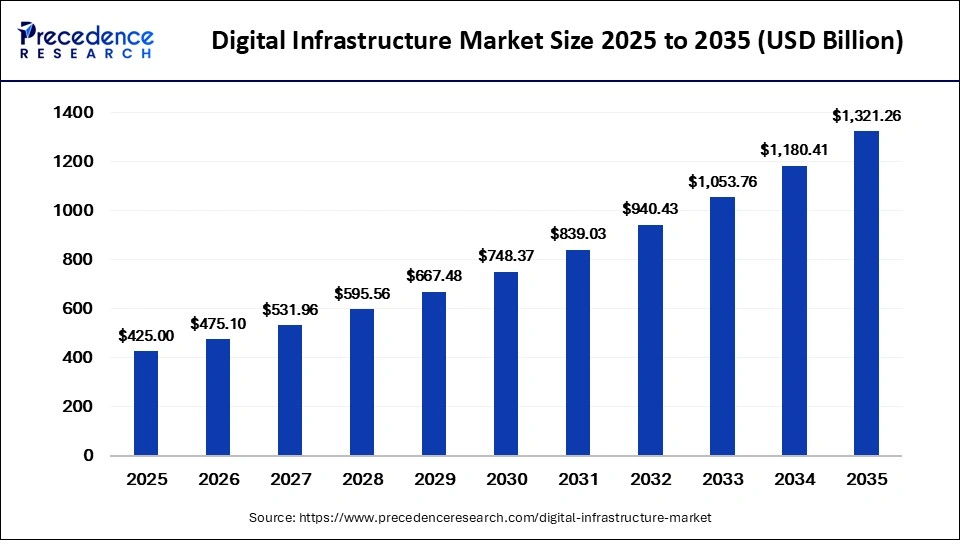
Digital infrastructure has become the backbone of the modern economy, enabling organizations to process, store, secure, and transmit enormous volumes of data in real time. As businesses increasingly rely on digital services, AI-powered applications, and cloud-native environments, demand for scalable, resilient, and high-performance infrastructure continues to surge across every industry.
Read Also: Ethoxyquin Market
Quick Insights: Why Is the Digital Infrastructure Market Expanding So Rapidly?
- The digital infrastructure market generated USD 425 billion in revenue in 2025 and is expected to surpass USD 1.32 trillion by 2035.
- North America dominated the market with a 36% share in 2025 due to significant investments in AI-ready data centers and cloud infrastructure.
- Asia Pacific emerged as the fastest-growing region and is projected to expand at a CAGR of 14.5% through 2035.
- Data center infrastructure accounted for 31% of total revenue in 2025, making it the largest infrastructure segment.
- Hardware remained the leading component category with a 58% market share due to increasing deployments of AI accelerators and server systems.
- Cloud-based deployment dominated the market with a 44% revenue share, reflecting growing enterprise adoption of scalable digital environments.
- Artificial intelligence infrastructure is expected to be the fastest-growing technology segment, expanding at a CAGR of 18.7% through 2035.
How Is Artificial Intelligence Transforming the Digital Infrastructure Market?
Artificial intelligence has become one of the most powerful catalysts driving digital infrastructure investments. AI applications require immense computing power, high-density server environments, specialized GPUs, advanced networking systems, and sophisticated cooling technologies. As organizations deploy large language models (LLMs), generative AI platforms, and machine learning applications, traditional IT environments are being transformed into AI-optimized infrastructure ecosystems.
AI is also improving infrastructure management itself. Data center operators increasingly use AI-driven predictive maintenance, workload balancing, intelligent cooling optimization, and energy management systems to improve operational efficiency. These technologies help reduce downtime, optimize power consumption, and enhance overall infrastructure performance.
What Are the Major Growth Drivers Behind the Digital Infrastructure Market?
Why Is Cloud Adoption Creating Massive Infrastructure Demand?
The widespread adoption of public, private, and hybrid cloud environments continues to fuel demand for modern digital infrastructure. Organizations increasingly rely on cloud-native applications and scalable computing resources to support business agility, remote operations, and digital transformation initiatives.
How Are AI Workloads Reshaping Infrastructure Requirements?
Generative AI and machine learning applications require significantly greater computational resources than conventional enterprise software. This is driving investments in GPU clusters, AI accelerators, high-performance storage systems, and advanced cooling technologies.
Why Is 5G Infrastructure Becoming Essential?
The global rollout of 5G networks is enabling low-latency applications such as autonomous vehicles, smart cities, industrial automation, and real-time analytics. Telecom providers are investing heavily in network modernization and high-capacity connectivity infrastructure.
How Is Edge Computing Supporting Market Growth?
As enterprises require real-time data processing, edge computing infrastructure is becoming increasingly important. Processing data closer to its source improves response times, reduces latency, and lowers bandwidth requirements.
What Trends Are Defining the Future of Digital Infrastructure?
AI-Optimized Data Centers Are Becoming Mainstream
Traditional facilities are being redesigned to accommodate AI-intensive workloads and GPU-based computing environments.
Liquid Cooling Technologies Are Rapidly Expanding
Growing AI workloads are driving adoption of advanced liquid cooling systems that provide superior thermal management and energy efficiency.
Data Sovereignty Is Encouraging Local Infrastructure Investments
Countries are increasingly implementing regulations that require data to be stored and processed locally, driving demand for regional data centers.
Edge Infrastructure Deployment Continues to Accelerate
Industries requiring low-latency operations are investing heavily in distributed computing architectures and edge facilities.
Why Does North America Lead the Global Digital Infrastructure Market?
North America accounted for 36% of global revenue in 2025, supported by strong cloud adoption, hyperscale data center development, and substantial investments in AI computing infrastructure. The United States remains the dominant contributor, benefiting from the presence of major technology companies, cloud service providers, and advanced telecommunications networks.
The region’s robust innovation ecosystem, extensive capital investments, and leadership in artificial intelligence continue to strengthen its market position.
Why Is Asia Pacific the Fastest-Growing Region?
Asia Pacific held 30% of the global market in 2025 and is forecast to grow at the fastest CAGR of 14.5% through 2035. Growth is driven by rapid digitalization, increasing cloud adoption, expanding internet penetration, and large-scale investments in telecommunications and smart city projects. Countries including China, India, Japan, South Korea, and Southeast Asian nations are at the forefront of regional infrastructure development.
Which Companies Are Leading Innovation in Digital Infrastructure?
Major market participants are investing aggressively in AI-ready infrastructure, next-generation networking systems, cloud platforms, and edge computing solutions.
Key Companies Mentioned in the Market
- Cisco Systems
- Huawei Technologies
- Nokia
- Ericsson
- Dell Technologies
- Hewlett Packard Enterprise
- Lenovo
- Super Micro Computer
- Arista Networks
- Juniper Networks
- Schneider Electric
- Vertiv
- Fujitsu
- NEC Corporation
- ZTE Corporation
Latest Industry Developments
The industry is witnessing rapid adoption of AI-focused infrastructure architectures, advanced liquid cooling systems, software-defined networking platforms, and distributed edge computing models. Technology vendors are expanding investments in high-performance computing facilities to meet rising demand from generative AI and machine learning applications.
Companies are also strengthening sustainability initiatives through renewable energy integration, intelligent power management, and carbon reduction strategies.
What Challenges Could Restrict Market Growth?
Rising Energy Consumption
AI workloads and hyperscale data centers require enormous amounts of electricity, creating challenges related to energy availability and operational costs.
Data Sovereignty Regulations
Strict regional regulations governing data storage and processing increase infrastructure complexity and compliance costs.
Capital-Intensive Infrastructure Projects
Building advanced data centers, edge facilities, and telecommunications networks requires substantial upfront investments.
Skilled Workforce Shortages
The growing complexity of AI infrastructure and cloud environments is increasing demand for specialized talent in infrastructure management and cybersecurity.
Case Study: AI-Powered Infrastructure Modernization in the Financial Services Sector
A multinational financial institution implemented a hybrid cloud infrastructure strategy supported by AI-driven analytics and high-performance computing systems. By modernizing its digital infrastructure, the company reduced latency, improved transaction processing speeds, enhanced cybersecurity capabilities, and accelerated deployment of AI-powered customer services.
The initiative resulted in greater operational efficiency, improved customer experiences, and increased scalability for future digital banking innovations.
Conclusion
The global digital infrastructure market is poised for exceptional growth through 2035 as AI, cloud computing, edge processing, and 5G technologies transform the way organizations operate. With market revenues projected to exceed USD 1.32 trillion, digital infrastructure will remain a foundational pillar of global economic development and technological innovation.
Companies that invest in scalable, sustainable, and AI-ready infrastructure solutions will be best positioned to capitalize on emerging opportunities and maintain competitive leadership in the digital economy.
Get Sample Copy: https://www.precedenceresearch.com/sample/8466
For inquiries regarding discounts, bulk purchases, or customization requests, please contact us at sales@precedenceresearch.com

- Digital Infrastructure Market to Reach USD 1.32 Trillion by 2035 - June 10, 2026
- Ethoxyquin Market Size to Reach USD 446 Million by 2035 - June 10, 2026
- Liquid Crystal Polymer Market Poised to Reach USD 3.82 Billion by 2035 - June 3, 2026
