
 by
by The global small caliber ammunition market is expected to reach approximately USD 15.08 billion by 2035, growing from USD 10.81 billion in 2026 at a CAGR of 3.77% during the forecast period. The steady expansion reflects increasing defense procurement, rising demand for self-defense ammunition, and growing participation in shooting sports across various regions.
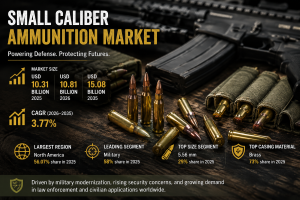
The global defense landscape is changing rapidly. Nations are investing heavily in military modernization programs, border security initiatives, and advanced weapon systems to address evolving security challenges. Amid these developments, the small caliber ammunition market continues to play a critical role in supporting military, law enforcement, and civilian firearm applications worldwide.
Small Caliber Ammunition Market Snapshot
| Market Indicator | Value |
|---|---|
| Market Size (2025) | USD 10.31 Billion |
| Market Size (2026) | USD 10.81 Billion |
| Expected Market Size (2035) | USD 15.08 Billion |
| CAGR (2026–2035) | 3.77% |
| Largest Regional Market | North America |
| Leading End User | Military |
| Leading Casing Material | Brass |
| Fastest Growing Material Segment | Polymer/Hybrid |
Understanding Small Caliber Ammunition
Small caliber ammunition refers to cartridges designed for firearms with bore diameters typically below .50 caliber. These rounds are widely used in assault rifles, handguns, carbines, machine guns, and sporting firearms. Small caliber ammunition is essential for training exercises, combat operations, homeland security activities, competitive shooting events, hunting, and personal protection applications. As geopolitical tensions continue to influence defense spending decisions globally, ammunition remains one of the most strategically important components of military preparedness.
The market serves three major end-user groups:
- Military forces
- Law enforcement agencies
- Civilian and commercial firearm users
Why the Market Continues to Grow
The demand for small caliber ammunition is closely linked to defense budgets, military readiness programs, civilian firearm ownership, and law enforcement requirements.
Several factors are contributing to market growth:
Rising Military Modernization Programs
- Countries across North America, Europe, Asia-Pacific, and the Middle East are upgrading infantry weapons and combat systems. Modern military forces require ammunition that delivers improved accuracy, penetration capabilities, and operational reliability.
- Governments are also increasing investments in advanced ammunition technologies that support next-generation soldier systems and modern battlefield requirements.
Growing Civilian Demand
- Civilian firearm ownership continues to support ammunition sales in many countries. Personal security concerns, recreational shooting, hunting activities, and competitive shooting sports have contributed to a stable consumer market.
- In regions where firearm ownership remains strong, ammunition demand often increases alongside firearm purchases.
Expansion of Shooting Sports
- Competitive shooting events have become increasingly popular worldwide. Participants require high-quality ammunition that offers consistency, precision, and dependable performance.
- This trend has encouraged manufacturers to develop specialized ammunition products tailored to sport shooting disciplines.
The Impact of Artificial Intelligence on the Ammunition Industry
Artificial intelligence is beginning to transform several aspects of ammunition manufacturing and supply chain management. Manufacturers are using AI-powered systems to improve production efficiency, automate quality inspections, and predict maintenance requirements within manufacturing facilities.
Key AI applications include:
- Predictive maintenance of production equipment
- Automated quality control inspections
- Smart inventory management
- Supply chain optimization
- Ballistic simulation and trajectory analysis
- Training simulations for military personnel
These technologies help manufacturers improve product consistency while reducing operational costs and production downtime.
Sustainability Is Becoming a Priority
Environmental concerns are creating new opportunities within the ammunition industry.
Traditionally, many ammunition products have relied on lead-based projectiles. However, stricter environmental regulations and sustainability goals are encouraging the development of alternative materials.
Manufacturers are increasingly investing in:
- Lead-free ammunition
- Eco-friendly projectiles
- Lightweight polymer casings
- Recyclable materials
- Reduced-emission manufacturing processes
These innovations are expected to become more important as governments introduce stricter environmental standards for military and civilian ammunition.
Market Driver: Military Readiness and National Security
- One of the strongest growth drivers for the industry is the ongoing need for military readiness.
- Modern armed forces maintain extensive ammunition stockpiles to support training exercises and potential combat operations. Rising geopolitical uncertainty and regional conflicts continue to reinforce the importance of maintaining adequate ammunition reserves.
- Military organizations are also investing in ammunition capable of supporting advanced infantry weapons, enhancing soldier effectiveness while improving operational flexibility.
- As defense budgets increase globally, procurement of small caliber ammunition remains a strategic priority.
Download the Sample: https://www.precedenceresearch.com/sample/3321
Market Challenge: Regulatory Restrictions
Despite growth opportunities, the market faces several challenges.
Firearms regulations vary significantly across countries and regions. Manufacturers often face complex compliance requirements related to production, transportation, storage, and sales.
Additional challenges include:
- Export control restrictions
- Licensing requirements
- Environmental regulations
- Public safety concerns
- Supply chain disruptions
These factors can affect market accessibility and increase operational costs for ammunition manufacturers.
Size Segment Analysis: Why 5.56 mm Leads the Market
Among all ammunition sizes, the 5.56 mm segment accounted for the largest share of the market in 2025. Because 5.56 mm ammunition is lightweight, soldiers can carry larger quantities during operations without significantly increasing their equipment load. The widespread standardization of 5.56 mm ammunition among NATO and allied defense forces further strengthens global demand.
The caliber’s dominance stems from its widespread adoption by military organizations around the world. It offers an effective balance between:
- Accuracy
- Recoil management
- Weight efficiency
- Combat effectiveness
End-Use Analysis: Military Remains the Largest Consumer
The military segment represented 58% of total market revenue in 2025, making it the largest end-use category. Growing defense spending worldwide continues to support procurement activities, ensuring long-term demand for small caliber ammunition products.
Defense organizations require enormous quantities of ammunition for:
- Combat preparedness
- Training exercises
- Strategic reserves
- Joint military operations
- Border security missions
Casing Material Trends
Brass Continues to Dominate. Brass remains the preferred casing material, accounting for approximately 73% of market revenue in 2025.
Its popularity is driven by several advantages:
- Excellent corrosion resistance
- Reliable performance under pressure
- Superior durability
- Smooth extraction during firing
- High reloadability
These characteristics make brass suitable for both military and civilian applications.
Polymer and Hybrid Casings Gain Momentum
While brass dominates today, polymer and hybrid casings are emerging as one of the fastest-growing segments.
Their key benefits include:
- Significant weight reduction
- Improved corrosion resistance
- Lower transportation costs
- Enhanced thermal insulation
- Reduced manufacturing expenses
Military organizations are particularly interested in lightweight ammunition solutions that reduce the burden on soldiers operating in demanding environments.
Recent Developments in the Small Caliber Ammunition Market
The market has witnessed several notable developments in recent years.
- In 2025, Polish ammunition manufacturer MESKO significantly expanded its annual production capacity from 20 million rounds to 250 million rounds through the launch of four new production lines.
- Belgium-based FN Herstal also introduced the SAAT project, a European initiative aimed at developing common standards for small arms ammunition to improve interoperability among defense forces.
- Meanwhile, global defense modernization programs continue to create opportunities for ammunition manufacturers through new procurement contracts and technological innovation initiatives.
Read More Blog: Liquid Packaging Market
Regional Market Insights
North America Leads the Industry
- North America held more than 56% of global revenue in 2025, making it the largest regional market.
- The United States remains the primary contributor to regional growth, supported by military procurement activities and commercial demand.
Asia-Pacific Shows the Fastest Growth Potential
- Asia-Pacific is expected to witness the most rapid expansion during the forecast period.
- Countries such as India and China continue to strengthen military capabilities through modernization initiatives and increased defense investments.
- Growing border security concerns and rising participation in recreational shooting activities are also supporting regional demand.
Europe Focuses on Precision and Sustainability
- European countries are increasingly investing in advanced ammunition technologies while emphasizing environmental compliance.
- Manufacturers in the region are actively developing lead-free ammunition and precision-focused products that align with evolving regulatory standards and defense requirements.
Small Caliber Ammunition Market Companies
The small caliber ammunition industry is highly competitive, with leading companies investing heavily in innovation, manufacturing capacity expansion, and strategic partnerships.
Major industry participants include:
- Northrop Grumman Corporation
- General Dynamics Corporation
- BAE Systems PLC
- Nammo AS
- Olin Corporation
- Elbit Systems Ltd.
- CBC Global Ammunition
- RUAG Group
- Remington Arms Company LLC
- Denel SOC Ltd.
- PT Pindad
- MESKO
These companies continue to expand production capabilities and develop advanced ammunition solutions to address changing military and commercial requirements.
Segments Covered in the Report
By Casing Material
- Brass
- Steel
- Polymer/Hybrid
By Size
- 5.56 mm
- 7.62 mm
- 9 mm
- 0.50 Caliber [12.7 mm]
- Shotshells
By End-Use Application
- Military
- Law Enforcement & Homeland Security
- Commercial / Civilian
The Road Ahead
- The small caliber ammunition market is expected to maintain steady growth over the next decade as military modernization, geopolitical tensions, and civilian demand continue to drive procurement activities.
- Manufacturers that invest in advanced materials, sustainable ammunition technologies, AI-powered production systems, and next-generation ballistic performance are likely to gain a competitive advantage in the years ahead.
- While regulatory challenges and environmental concerns will remain important considerations, the fundamental role of small caliber ammunition in defense, security, and civilian applications ensures a stable long-term outlook for the industry.
- As global security priorities evolve, small caliber ammunition will continue to serve as a critical component of military readiness and public safety worldwide.
You can place an order or ask any questions. Please feel free to contact us at sales@precedenceresearch.com |+1 804 441 9344

- Small Caliber Ammunition Market Size and Outlook 2035 - June 17, 2026
- Liquid Packaging Market Size, Share and Forecast 2026 to 2035 - June 16, 2026
