
 by
by The global AI search engine market is entering a high-growth phase as enterprises and consumers increasingly rely on conversational search, predictive recommendations, and context-aware digital experiences. The market size stood at USD 16.30 billion in 2025 and is expected to rise from USD 20.75 billion in 2026 to nearly USD 182.17 billion by 2035, expanding at a robust CAGR of 27.30% between 2026 and 2035. Growing demand for personalized search experiences, rapid advancements in natural language processing, and the increasing use of AI-powered enterprise tools are expected to remain the primary growth drivers.
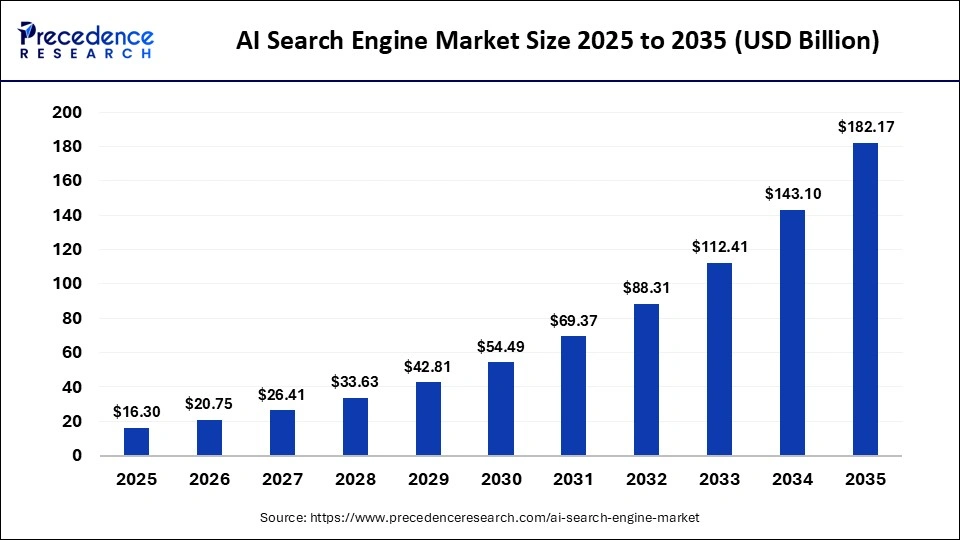
The rise of conversational interfaces, voice assistants, and generative AI platforms is fundamentally changing how users access information online. AI-powered search engines are increasingly capable of understanding user intent, context, and sentiment, allowing businesses to deliver faster and more relevant responses across web search, enterprise search, e-commerce, and customer service applications.
Read Also: Applied AI in Autonomous Vehicles Market
Quick Insights
- North America led the global AI search engine market with a 40% revenue share in 2025 due to strong cloud adoption, advanced digital infrastructure, and early adoption of generative AI search technologies.
- Asia Pacific is expected to witness the fastest growth between 2026 and 2035 because of rapid digital transformation, government support for AI, and rising mobile internet usage.
- The natural language processing segment accounted for approximately 32% of the market in 2025 due to its strong ability to understand conversational queries and deliver contextual search results.
- Enterprise search dominated the market with a 40% share in 2025 as organizations increasingly use AI to manage and retrieve information from large datasets.
- Enterprises represented 60% of total market demand in 2025 as businesses seek AI-powered search tools to improve workflow efficiency and knowledge management.
Market Revenue Snapshot
| Metric | Value |
|---|---|
| Market Size in 2025 | USD 16.30 Billion |
| Market Size in 2026 | USD 20.75 Billion |
| Forecast Market Size in 2035 | USD 182.17 Billion |
| CAGR (2026-2035) | 27.30% |
| Leading Region | North America |
| Fastest Growing Region | Asia Pacific |
How is AI Transforming the AI Search Engine Market?
Artificial intelligence is not only the foundation of the AI search engine market but also its biggest growth catalyst. Modern search engines increasingly use natural language processing, machine learning, and deep learning models to deliver conversational and context-aware responses rather than simply matching keywords. AI search engines can analyze previous user behavior, preferences, and browsing intent to create highly personalized search journeys.
AI is also transforming enterprise search by helping organizations retrieve information from internal databases, cloud platforms, emails, documents, and communication tools. Businesses are increasingly using AI-powered search solutions to reduce time spent looking for information, improve productivity, and make data-driven decisions more quickly. Predictive AI models are also enabling adaptive search experiences where systems continuously refine search quality based on user feedback and engagement.
What are the Major Growth Factors Driving the AI Search Engine Market?
Rising Demand for Personalized and Context-Aware Search
Consumers increasingly expect search engines to deliver highly relevant, personalized, and intent-driven results. AI-powered search platforms are capable of understanding not just what users type but also why they are searching, making the experience faster and more intuitive. This shift is especially important in industries such as e-commerce, media, healthcare, and enterprise software.
Rapid Expansion of Enterprise Search Applications
Organizations are generating massive amounts of structured and unstructured data, making efficient information retrieval a major challenge. AI-powered enterprise search tools help employees quickly access critical documents, customer records, project files, and business insights, significantly improving productivity and operational efficiency.
Growth of Voice Search and Conversational Interfaces
The increasing use of smart devices, virtual assistants, and AI chatbots is creating strong demand for voice-enabled search technologies. Consumers are becoming more comfortable with conversational queries, leading businesses to invest heavily in NLP-powered search capabilities.
Why is Zero-Click Search Becoming a Defining Industry Trend?
One of the biggest trends in the AI search engine market is the shift toward zero-click search experiences, where users receive answers directly inside AI search interfaces without needing to visit external websites. This trend is changing the economics of digital publishing, SEO, and online advertising.
Recent research indicates that AI search summaries and chatbots are already reducing referral traffic to websites. Media companies expect search-driven traffic to decline significantly over the next few years as AI-generated summaries provide users with direct answers. This is pushing publishers and marketers to rethink their content strategies and focus more on direct audience engagement, subscriptions, and multimedia content.
What Does AI Search Mean for SEO and Digital Marketing?
AI is not replacing SEO, but it is fundamentally changing how content is discovered and ranked. Search engines increasingly prioritize content that is trustworthy, structured, deeply researched, and highly relevant. Long-tail and conversational queries are becoming more important, while AI-generated answers are reducing clicks on traditional search listings.
According to recent industry discussions, AI search engines now process billions of queries every month, with one in five question-based searches increasingly shifting away from traditional search engines and toward conversational AI platforms. This is creating new opportunities for brands that optimize content for AI-driven discovery rather than only focusing on conventional search rankings.
Segment Analysis
Why Did Natural Language Processing Dominate the Market?
The natural language processing segment accounted for the largest share of 32% in 2025 because NLP technologies allow AI search engines to understand human language, context, and intent with greater accuracy. NLP enables conversational search, voice interaction, and context retention, making search engines more user-friendly and intuitive. Companies are increasingly adopting NLP to automate customer interactions, improve chatbots, and enhance digital experiences across multiple platforms.
The machine learning segment represented 28% of the market in 2025 and is expected to grow steadily because ML algorithms continuously improve search accuracy based on user behavior and historical search patterns. Reinforcement learning is also gaining traction because of its ability to refine search performance through continuous feedback loops.
Why is Enterprise Search Leading the Application Segment?
Enterprise search held the largest market share of 40% in 2025 because organizations increasingly rely on AI to manage large volumes of internal information. AI-powered enterprise search helps employees find relevant documents, improve knowledge sharing, and streamline workflows across departments. Integration with cloud services, internal databases, and collaboration platforms further strengthens demand for enterprise search tools.
E-commerce search is expected to emerge as one of the fastest-growing applications due to rising demand for visual search, recommendation engines, and personalized shopping experiences. AI-powered search capabilities help retailers improve conversion rates, customer engagement, and product discovery.
Regional Analysis
Why Did North America Lead the Global AI Search Engine Market?
North America accounted for 40% of the AI search engine market in 2025 due to the region’s advanced digital infrastructure, high cloud adoption, and strong presence of major technology companies such as Google, Microsoft, and OpenAI. The region benefits from early adoption of generative AI search tools, strong R&D capabilities, and continuous innovation in enterprise AI platforms.
The U.S. remains the largest contributor to the North American market due to its mature cloud ecosystem, widespread adoption of AI-powered productivity tools, and continuous investment in enterprise intelligence solutions.
Why is Asia Pacific Emerging as the Fastest-Growing Region?
Asia Pacific is expected to grow at the fastest pace through 2035 because of rising digital adoption, rapid internet penetration, and government support for AI development. Countries such as China, India, and Japan are making major investments in AI infrastructure, multilingual search tools, and mobile-first platforms. The region’s large consumer base and expanding e-commerce ecosystem are also creating significant opportunities for AI search adoption.
Competitive Landscape: Which Companies are Shaping the Future of AI Search?
The AI search engine market is highly competitive, with both established technology giants and emerging AI-native companies competing to redefine search experiences.
Major companies operating in the market include:
- Microsoft
- OpenAI
- Amazon
- Meta
- Perplexity AI
- Anthropic
- Baidu
- DuckDuckGo
Get Sample Copy: https://www.precedenceresearch.com/sample/8312
For inquiries regarding discounts, bulk purchases, or customization requests, please contact us at sales@precedenceresearch.com

- Digital Infrastructure Market to Reach USD 1.32 Trillion by 2035 - June 10, 2026
- Ethoxyquin Market Size to Reach USD 446 Million by 2035 - June 10, 2026
- Liquid Crystal Polymer Market Poised to Reach USD 3.82 Billion by 2035 - June 3, 2026
