
 by
by AI Data Center Power Consumption Market: Powering the Future of Artificial Intelligence
Introduction: The Hidden Cost of Intelligence
Artificial intelligence is often discussed in terms of algorithms, data, and innovation—but rarely in terms of energy consumption, which is rapidly becoming one of the most critical challenges in the AI ecosystem.
As enterprises deploy increasingly complex AI models—particularly generative AI and large language models—the demand for computational power has skyrocketed. This surge directly translates into massive electricity consumption, making power management a central concern for data center operators worldwide.
The AI data center power consumption market has therefore emerged as a crucial segment within the digital infrastructure landscape, balancing performance, scalability, and sustainability.
Market Overview: A Rapidly Expanding Energy Ecosystem
The global AI data center power consumption market is witnessing exponential growth. It was valued at USD 12.50 billion in 2025 and is expected to grow from USD 14.86 billion in 2026 to approximately USD 70.59 billion by 2035, registering a CAGR of 18.90%.
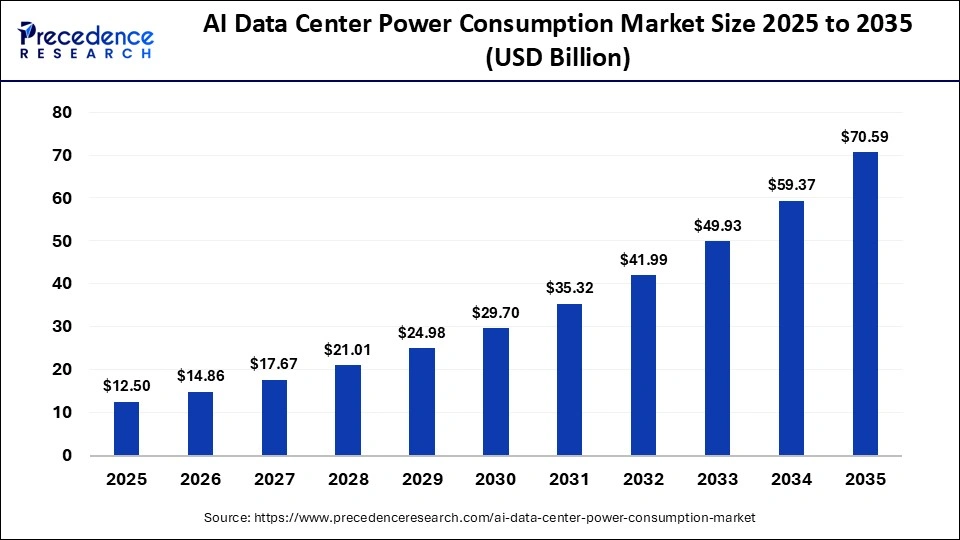
This remarkable expansion is driven by:
- The proliferation of AI-powered applications
- Rising demand for high-performance computing (HPC)
- Growth of cloud-based AI services
- Expansion of hyperscale and edge data centers
Unlike traditional data centers, AI-focused facilities require significantly higher power density, often exceeding conventional infrastructure limits.
Read Also: Fiber Optic Cable Market
Understanding Power Consumption in AI Data Centers
AI workloads differ fundamentally from traditional computing tasks. Training advanced AI models involves:
- Processing massive datasets
- Running computations across thousands of GPUs or accelerators
- Operating continuously for extended periods
Key Contributors to Power Consumption
- Compute Infrastructure
GPUs, TPUs, and AI accelerators consume far more power than traditional CPUs. - Cooling Systems
High-density hardware generates intense heat, requiring advanced cooling technologies. - Power Distribution Systems
Efficient delivery of electricity through UPS, PDUs, and transformers is essential. - Networking Equipment
High-speed data transfer adds to overall energy consumption. - Storage Systems
AI workloads rely heavily on data storage and retrieval operations.
Key Market Trends Shaping the Industry
1. Explosion of Generative AI Workloads
The rise of generative AI models has dramatically increased the demand for computational power. Training a single large-scale model can consume megawatt-hours of electricity, pushing data centers to expand their power capacity.
This trend is expected to intensify as organizations integrate AI into everyday business processes.
2. Transition to Advanced Cooling Technologies
Cooling is no longer a secondary concern—it is now a primary driver of innovation in data center design.
Emerging Cooling Solutions:
- Liquid cooling systems
- Immersion cooling
- Direct-to-chip cooling
- Hybrid air-liquid systems
These technologies improve energy efficiency and reduce operational costs, making them essential for future AI infrastructure.
3. Integration of Renewable Energy Sources
Sustainability is becoming a strategic priority. Data centers are increasingly adopting:
- Solar power installations
- Wind energy procurement
- Hydroelectric energy sources
Companies are also entering power purchase agreements (PPAs) to ensure long-term access to clean energy.
4. Rise of Hyperscale and Edge Data Centers
- Hyperscale data centers dominate due to their ability to support large-scale AI workloads
- Edge data centers are gaining traction for real-time AI processing and low-latency applications
Together, these models are reshaping global power consumption patterns.
Market Dynamics
Drivers
1. Accelerating AI Adoption Across Industries
Industries such as healthcare, finance, retail, and manufacturing are increasingly leveraging AI for automation, analytics, and decision-making.
2. Demand for Real-Time Processing
Applications like autonomous vehicles, fraud detection, and smart cities require instant data processing, increasing power requirements.
3. Growth of Cloud Computing
Cloud providers are expanding AI capabilities, leading to higher energy consumption in data centers.
Challenges
1. Rising Energy Costs
Electricity costs represent a significant portion of data center operational expenses.
2. Environmental Impact
AI data centers contribute to carbon emissions, prompting regulatory scrutiny and sustainability initiatives.
3. Infrastructure Limitations
Existing power grids may struggle to support the growing energy demands of AI infrastructure.
Opportunities
1. Energy-Efficient Hardware
Development of low-power AI chips and processors offers significant potential for reducing energy consumption.
2. Smart Energy Management Systems
AI-driven power optimization tools can enhance efficiency and reduce waste.
3. Green Data Centers
Sustainable infrastructure solutions present long-term growth opportunities.
Segment Analysis
By Component
- Cooling Systems (30%)
The largest segment due to the critical need for thermal management. - UPS Systems (25%)
Ensures uninterrupted power supply and system reliability. - Power Distribution Units (20%)
Facilitates efficient power delivery within data centers. - Power Monitoring Software (15%)
Enables real-time tracking and optimization of energy usage. - Backup Generators & Storage (10%)
Provides redundancy and operational continuity.
By Data Center Type
- Hyperscale Data Centers (45%)
Dominant segment due to large-scale AI workloads. - Colocation Data Centers (25%)
Shared infrastructure supporting multiple organizations. - Enterprise Data Centers (20%)
Used by large corporations for internal operations. - Edge Data Centers (10%)
Fastest-growing segment driven by IoT and real-time AI.
By Application
- AI Training Workloads (35%)
Largest contributor due to intensive computational requirements. - Generative AI & Large Language Models
Fastest-growing segment. - AI Inference Workloads
Increasing demand for real-time decision-making. - High-Density GPU Clusters
Core infrastructure for AI processing. - Edge AI Processing
Supports decentralized AI applications.
By End-Use Industry
- IT & Telecommunications (35%)
Leading segment due to cloud and AI services. - BFSI (15%)
Growing use in fraud detection and analytics. - Healthcare
Fastest-growing due to AI-driven diagnostics. - Retail & E-commerce
Personalized customer experiences. - Government & Defense
Increasing AI adoption for security and analytics. - Manufacturing
Smart factories and predictive maintenance.
Regional Insights
North America (42% Market Share)
- Strong presence of hyperscale data centers
- Advanced AI ecosystem
- High investment in cloud infrastructure
Asia Pacific (Fastest Growing Region)
- Rapid digital transformation
- Expanding cloud adoption
- Government initiatives supporting AI
Europe
- Focus on sustainability and green energy
- Strict environmental regulations
Future Outlook: The Road Ahead
The AI data center power consumption market is entering a transformative phase. Key developments to watch include:
- AI-optimized processors with lower energy consumption
- Next-generation cooling technologies
- Integration of smart grids and energy storage systems
- Increased use of carbon-neutral and renewable energy sources
As AI continues to evolve, energy efficiency will become a key differentiator for data center operators.
Conclusion
The rapid expansion of artificial intelligence is redefining global energy consumption patterns. AI data centers, while enabling innovation, are also creating significant challenges in terms of power demand and sustainability.
With the market projected to reach USD 70.59 billion by 2035, stakeholders must prioritize efficient energy management, sustainable practices, and technological innovation to ensure long-term growth.
The future of AI will not only depend on smarter algorithms—but also on smarter energy usage.
Get a Sample Link: https://www.precedenceresearch.com/sample/8318

