
 by
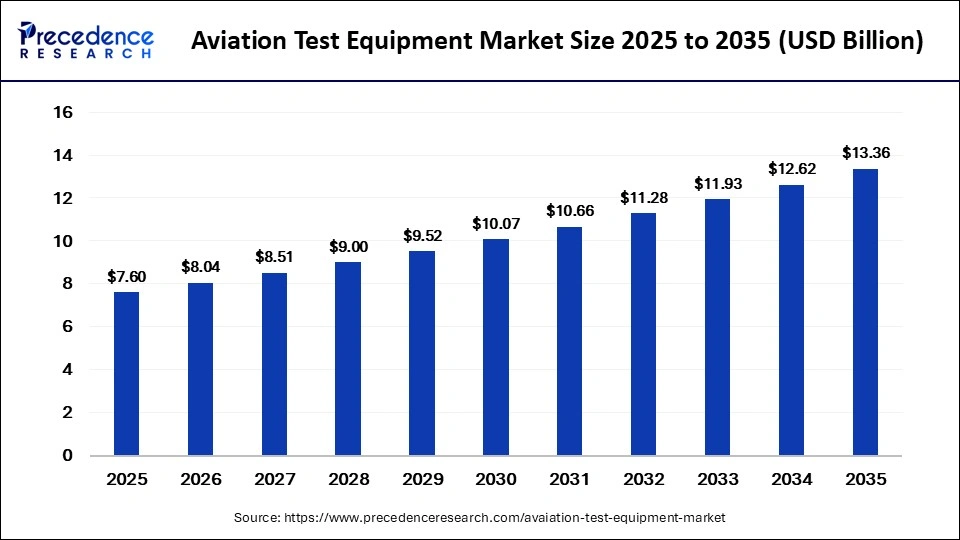
by The global aviation test equipment market is projected to reach USD 14.77 billion by 2035, driven by aircraft modernization, advanced avionics integration, MRO expansion, and AI-powered diagnostic systems.
Read Also: Green Commodities Market
Why is the Aviation Test Equipment Market Witnessing Rapid Growth?
The global aviation test equipment market is experiencing substantial momentum as the aviation sector undergoes rapid technological evolution. From advanced commercial aircraft to next-generation military aviation systems, the demand for highly accurate and reliable testing solutions is becoming increasingly critical.
The market is projected to grow from USD 8.63 billion in 2026 to USD 14.77 billion by 2035, expanding at a CAGR of 6.15% during the forecast period.
This growth is being driven by increasing aircraft production, stringent safety regulations, rising maintenance requirements, and growing investments in advanced avionics testing systems.
As aircraft become smarter and more digitally integrated, aviation test equipment is becoming indispensable across manufacturing, maintenance, and operational environments.
What is Aviation Test Equipment?
Aviation test equipment refers to specialized systems used to inspect, diagnose, calibrate, and verify the performance of aircraft systems and components.
These systems are essential for ensuring compliance with global aviation safety standards and operational efficiency.
They are used for testing:
- Avionics systems
- Communication systems
- Navigation equipment
- Electrical systems
- Hydraulic systems
- Engine performance
- Radar and sensor systems
These testing platforms are deployed by aircraft manufacturers, airlines, maintenance providers, and defense organizations.
Quick Market Insights
The aviation test equipment market was valued at USD 8.10 billion in 2025 and is forecast to reach USD 14.77 billion by 2035.
North America accounted for the largest market share due to strong aerospace infrastructure and defense investments.
Asia Pacific is expected to witness the fastest growth due to expanding airline fleets and regional aircraft manufacturing.
Avionics testing remains the dominant segment due to increasing aircraft digitalization.
Maintenance, repair, and overhaul (MRO) applications account for a major share of market revenue.
How is AI Transforming Aviation Testing?
Artificial intelligence is significantly enhancing aviation diagnostics and testing capabilities.
AI-powered analytics can process enormous volumes of aircraft performance data in real time, helping engineers identify anomalies before failures occur.
This enables:
- Predictive maintenance
- Faster diagnostics
- Reduced aircraft downtime
- Lower maintenance costs
- Improved operational reliability
AI is also being integrated with digital twin technology, allowing virtual testing of aircraft systems before physical deployment.
This dramatically improves efficiency and testing precision.
Key Market Growth Drivers
Why is Aircraft Modernization Fueling Demand?
Airlines and defense agencies are modernizing aging fleets with digitally advanced aircraft.
These new aircraft require highly sophisticated test systems capable of validating integrated avionics and sensor platforms.
How is the Expansion of MRO Services Impacting Growth?
The global rise in air travel has increased aircraft utilization rates.
This has led to higher demand for maintenance and inspection services, directly boosting aviation test equipment adoption.
Are Advanced Avionics Increasing Testing Complexity?
Modern aircraft rely heavily on complex electronics, communication systems, and software-driven controls.
This requires next-generation test equipment capable of real-time diagnostics and multi-system verification.
How Are Regulatory Standards Supporting Market Expansion?
Global aviation regulators continue to enforce rigorous safety and performance standards.
Mandatory inspection protocols are pushing airlines and OEMs to invest in advanced test solutions.
Emerging Opportunities and Industry Trends
Are Portable Test Equipment Systems Gaining Popularity?
Yes.
Portable aviation testing devices are becoming increasingly popular due to their flexibility, field usability, and cost efficiency.
These systems enable on-site diagnostics, reducing turnaround times.
How is Digitalization Reshaping Aviation Testing?
Cloud-enabled diagnostics, IoT integration, and automated calibration systems are redefining aircraft testing.
Digital transformation is enabling faster, more accurate, and scalable test operations.
What Role Do UAVs Play in Market Growth?
The growing deployment of unmanned aerial vehicles is creating new testing requirements.
Specialized equipment is being developed for UAV avionics, propulsion systems, and communication modules.
Market Segmentation Analysis
By Equipment Type
Avionics test equipment dominates the market due to increasing cockpit digitalization.
Engine testing systems are also witnessing strong demand due to performance optimization requirements.
By Application
MRO applications hold the largest market share owing to regular aircraft maintenance cycles.
Manufacturing testing is also expanding as aircraft production rises globally.
By End User
Commercial aviation leads the market due to fleet expansion.
Defense aviation is expected to grow steadily with military aircraft modernization programs.
Regional Market Insights
Why Does North America Lead?
North America dominates due to:
- Presence of major aerospace manufacturers
- Strong defense expenditure
- Advanced aviation testing infrastructure
- High MRO activity
The presence of major players such as The Boeing Company and Lockheed Martin Corporation strengthens regional leadership.
How is Europe Contributing?
Europe maintains a strong market position through:
- Advanced aerospace R&D
- Strict regulatory compliance
- Aircraft innovation initiatives
Companies like Airbus SE continue driving regional growth.
Why is Asia Pacific Growing Fastest?
Asia Pacific is experiencing rapid expansion due to:
- Growing passenger traffic
- Fleet expansion
- Rising defense budgets
- Local aircraft manufacturing investments
Countries such as India, China, and Japan are becoming major growth engines.
Competitive Landscape
Major market participants include:
- Honeywell International Inc.
- General Electric Company
- Airbus SE
- The Boeing Company
- Lockheed Martin Corporation
- Safran S.A.
- Collins Aerospace
- Teradyne Inc.
These companies are heavily investing in automation, AI-driven diagnostics, and next-generation avionics testing systems.
What Challenges Could Limit Growth?
Despite strong momentum, the market faces challenges such as:
- High initial equipment costs
- Complex integration requirements
- Skilled workforce shortages
- Rapid technology obsolescence
Manufacturers must continuously innovate to remain competitive.
Case Study: AI-Driven Predictive Maintenance in Commercial Aviation
Several leading airlines have deployed AI-integrated testing systems to monitor aircraft health.
These systems analyze operational data continuously and identify maintenance needs before failures occur.
Results include:
- Reduced unscheduled maintenance
- Lower operational costs
- Improved fleet availability
- Enhanced passenger safety
This demonstrates the strategic value of smart aviation test equipment.
Future Outlook
The aviation test equipment market is entering a new era of digital transformation.
As aircraft systems become more advanced, demand for intelligent, automated, and highly accurate testing solutions will continue rising.
Organizations investing in next-generation testing technologies today will shape the future of global aviation reliability and safety.
Get Sample Link: https://www.precedenceresearch.com/sample/8365
For inquiries regarding discounts, bulk purchases, or customization requests, please contact us at sales@precedenceresearch.com

- Digital Infrastructure Market to Reach USD 1.32 Trillion by 2035 - June 10, 2026
- Ethoxyquin Market Size to Reach USD 446 Million by 2035 - June 10, 2026
- Liquid Crystal Polymer Market Poised to Reach USD 3.82 Billion by 2035 - June 3, 2026
