
 by
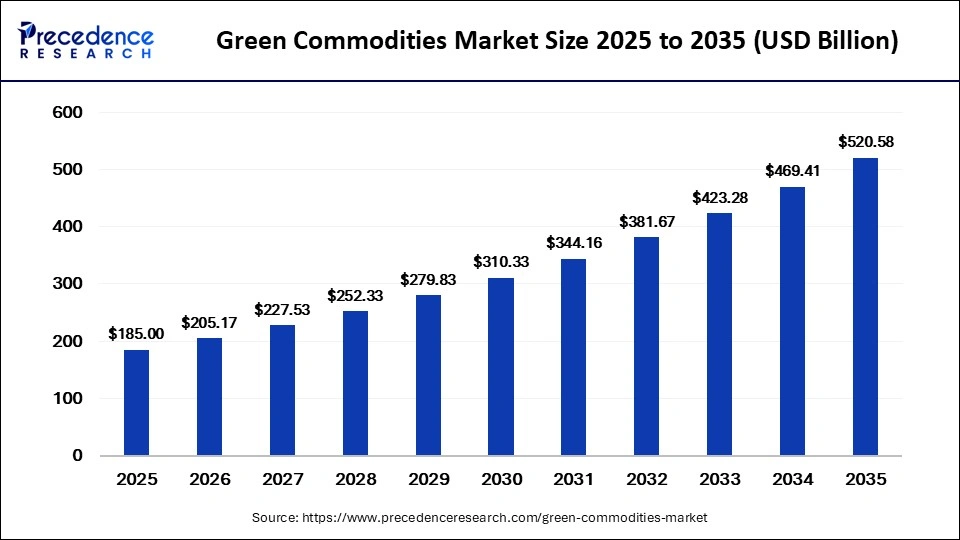
by The global green commodities market is projected to hit USD 520.58 billion by 2035, driven by ESG adoption, renewable energy demand, and sustainable sourcing trends.
Read Also: Recarbonization in Chemicals Market
Introduction: Why Are Green Commodities Becoming Central to Global Trade?
The global green commodities market is undergoing a transformative shift as sustainability becomes a core pillar of economic growth and industrial strategy. Green commodities—ranging from sustainable agricultural goods to renewable energy resources and carbon credits—are redefining how industries source, produce, and trade raw materials.
The market is projected to grow from USD 205.17 billion in 2026 to approximately USD 520.58 billion by 2035, registering a CAGR of 10.90%.
This growth is primarily driven by increasing climate awareness, rising ESG commitments, and strong government initiatives promoting sustainable production and consumption practices.
Quick Insights: What Are the Most Important Market Highlights?
The green commodities market was valued at USD 185 billion in 2025 and is forecast to exceed USD 520.58 billion by 2035, reflecting strong long-term growth momentum.
Europe led the market with a 35% share in 2025, while Asia Pacific is expected to grow at the fastest CAGR of 13.5% during the forecast period.
Sustainable agriculture commodities dominated with a 35% share, and the food & beverage industry accounted for around 40% of total applications.
Energy & biofuel production is emerging as the fastest-growing application segment, driven by global decarbonization efforts.
What Exactly Are Green Commodities and Why Do They Matter?
Green commodities refer to raw materials produced through environmentally sustainable practices that reduce carbon emissions and environmental impact. These include agricultural products, renewable energy inputs, bio-based materials, and carbon credits.
They play a crucial role in supporting global climate goals, enabling industries to transition toward a low-carbon and circular economy while maintaining economic growth.
How is AI Transforming the Green Commodities Market?
Artificial intelligence is emerging as a powerful enabler in the green commodities ecosystem. AI-driven systems are optimizing energy production, forecasting demand, and improving grid efficiency, making renewable energy systems more reliable and scalable.
In agriculture, AI is enabling precision farming by enhancing irrigation, crop monitoring, and pesticide application. These advancements are increasing productivity while minimizing environmental impact, strengthening the sustainability value chain.
Market Growth Drivers: What is Fueling This Rapid Expansion?
Why Is Climate Change Awareness Driving Demand?
Rising global concerns about climate change are accelerating the adoption of renewable energy technologies and sustainable commodities.
How Are Government Policies Supporting Growth?
Government initiatives and sustainability programs are encouraging responsible sourcing and production, creating favorable conditions for market expansion.
Are Consumers Influencing Market Trends?
Yes, consumers are increasingly willing to pay a premium for eco-friendly products, pushing companies to adopt sustainable sourcing practices.
How is Renewable Energy Boosting the Market?
The global shift toward clean energy is significantly increasing demand for renewable energy commodities and biofuels.
Opportunities & Trends: What’s Shaping the Future of the Market?
Can Supply Chain Traceability Become a Competitive Advantage?
Companies are investing in digital traceability tools to ensure transparency and ethical sourcing across supply chains, strengthening consumer trust.
Is Regenerative Agriculture the Next Big Shift?
Regenerative farming practices that restore soil health and capture carbon are gaining traction as sustainable alternatives to traditional agriculture.
Are Consumers Driving Premium Sustainable Products?
Growing demand for eco-labeled and certified products is encouraging companies to adopt sustainability certifications and differentiate their offerings.
Market Segmentation: Where Are the Key Revenue Opportunities?
By Commodity Type
- Sustainable agriculture commodities lead with 35% share
- Renewable energy commodities are the fastest-growing segment (12.5% CAGR)
By Certification Type
- Organic-certified products dominate with a 30% share
- Rainforest Alliance certification is growing rapidly
By Application
- Food & beverage industry leads with 40% share
- Energy & biofuel production is the fastest-growing segment
By End-Use Industry
- Food & beverage companies dominate with 35% share
- Energy & utilities is the fastest-growing sector
Regional Insights: Which Markets Are Leading the Transition?
Why is Europe Dominating the Market?
Europe leads with a 35% share due to strict ESG regulations, strong sustainability policies, and high consumer awareness.
How Strong is North America’s Position?
North America holds the second-largest share, driven by corporate sustainability initiatives and advanced infrastructure.
Why is Asia Pacific Growing the Fastest?
Asia Pacific is expanding rapidly due to industrial growth, renewable energy investments, and supportive government policies.
Competitive Landscape: Who Are the Key Players?
Major companies operating in the green commodities market include:
- Cargill, Incorporated
- Archer Daniels Midland Company
- Bunge Limited
- Louis Dreyfus Company
- Olam Group Limited
- Nestlé S.A.
- Unilever PLC
- Danone S.A.
- Wilmar International Limited
- Starbucks Corporation
These companies are actively investing in sustainable sourcing, renewable energy adoption, and ESG-driven supply chain transformation.
Challenges: What Could Slow Down Market Growth?
Despite strong momentum, the market faces challenges such as inconsistent regulatory frameworks, trade barriers, and supply chain disruptions.
Additionally, uneven carbon pricing and geopolitical uncertainties can create hurdles for global market expansion.
Case Study: How Sustainable Sourcing is Transforming Agriculture
Global sustainability programs are helping improve farmer livelihoods, protect ecosystems, and promote responsible land use. These initiatives demonstrate how green commodities can balance economic growth with environmental sustainability while ensuring long-term resource availability.
Conclusion: What Lies Ahead for Green Commodities?
The green commodities market is set to play a pivotal role in shaping a sustainable global economy. With strong regulatory support, technological advancements, and rising consumer demand, the market is poised for significant expansion over the next decade.
Organizations that embrace sustainability-driven strategies will not only gain competitive advantage but also contribute to a more resilient and environmentally responsible future.
Get Sample Link: https://www.precedenceresearch.com/sample/8364
For inquiries regarding discounts, bulk purchases, or customization requests, please contact us at sales@precedenceresearch.com

- Digital Infrastructure Market to Reach USD 1.32 Trillion by 2035 - June 10, 2026
- Ethoxyquin Market Size to Reach USD 446 Million by 2035 - June 10, 2026
- Liquid Crystal Polymer Market Poised to Reach USD 3.82 Billion by 2035 - June 3, 2026
